
Blue Monday falls on the third Monday of January. This concept is conventional, as Huawei reminds us, but it does not change the fact that many of us feel overwhelmed. The term Blue Monday was invented by British psychologist Cliff Arnall as a concept based on simplified assumptions about the weather (low sunlight), finances (budget burdened with holiday expenses) and social mood (including problems with maintaining New Year's resolutions).
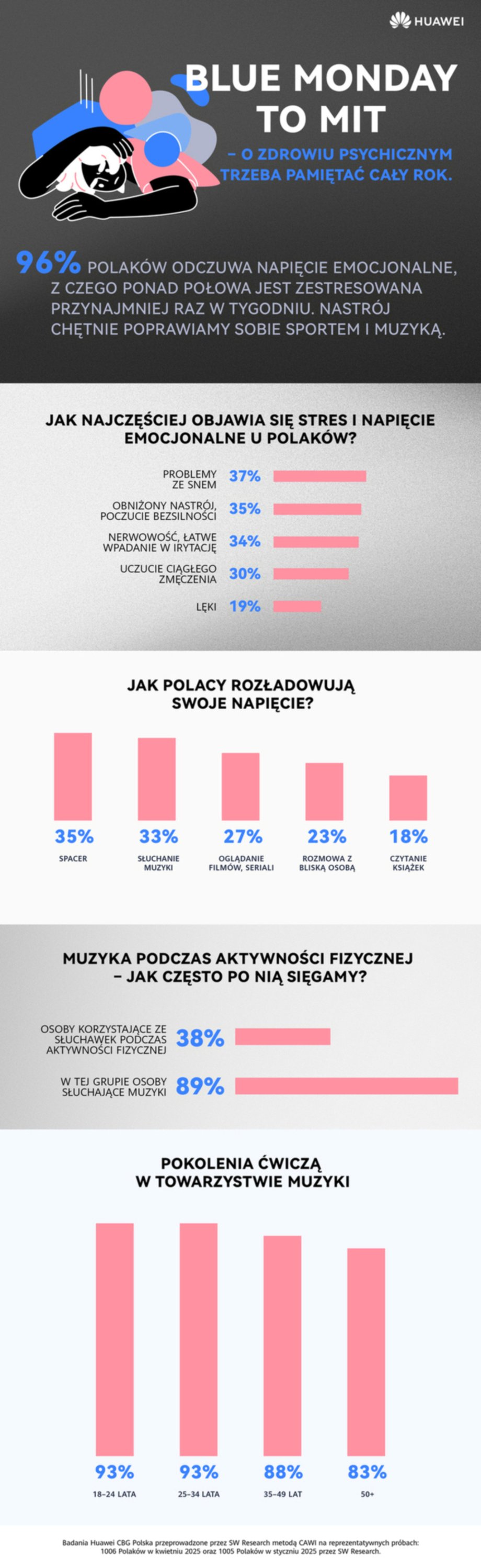
However, emotional tension is nothing new to us. Huawei CBG Polska research shows that as many as 96 percent of us feel emotional tension, and more than half of us are stressed at least once a week. How do we “unload”?
When asked about their proven methods, respondents most often choose walking (35%), but every third Pole (33%) reaches for their favorite music.
The rest of the article is below the video
“Listening to music regulates stress and emotional tension in many ways, at the same time influencing the physiological functioning of the body (breathing rate, heart rate, muscle tension and hormone secretion) and the psychological area, including cognitive and emotional processes. Research shows that listening to properly selected music both before and after a stressful event can reduce the symptoms of stress,” emphasizes Bartłomiej Tarkowski, M.D., psychologist, music therapist and neuromusicotherapist at Academy of Music in Łódź, founder of the Center for Psychology and Music Therapy.
See also: Beware of AI. Failure to comply with these rules may result in data loss
Poles also often indicate that stress can be relieved by watching films and series (27 percent of responses) or simply talking to loved ones (23 percent).
Huawei CBG Polska research shows that the felt tension manifests itself, among others, in: problems with sleep (37%), low mood and a feeling of helplessness (35%), nervousness and easily irritated (34%) or feeling constantly tired (30%).
Music as a solution to stress?
Music accompanies Poles during physical activity – nearly 4 out of 10 people (38%) use headphones while exercising, and in this group as many as 89%. listens to music. It is the first choice in each age group – 93 percent each. people aged 18-24 and 25-34, 88 percent respondents 35-49 and 83 percent People aged 50+ listen to music during exercise and recreation. It is also the most popular choice for runners, walkers, cyclists and gym enthusiasts – for each of these groups the percentage of people listening to music is close to 90%.
What headphones do we choose? Small, wireless earphones dominate among physically active people – as many as 43% use them. respondents. In second place are small, wired in-ear headphones (26%), and in third place – large, wireless over-ear headphones (22%). However, such designs are not without drawbacks – every third sports person (34%) complains primarily about the headphones falling out or falling off, which indicates the need for a better fit of the device to the shape of the ear or head – we read in the analysis.
Blue Monday – myth or fact?
|
Huawei
Huawei is one of the largest consumer electronics manufacturers in the world. Huawei services and devices are available in over 170 countries and are used by over 3 billion people around the world.