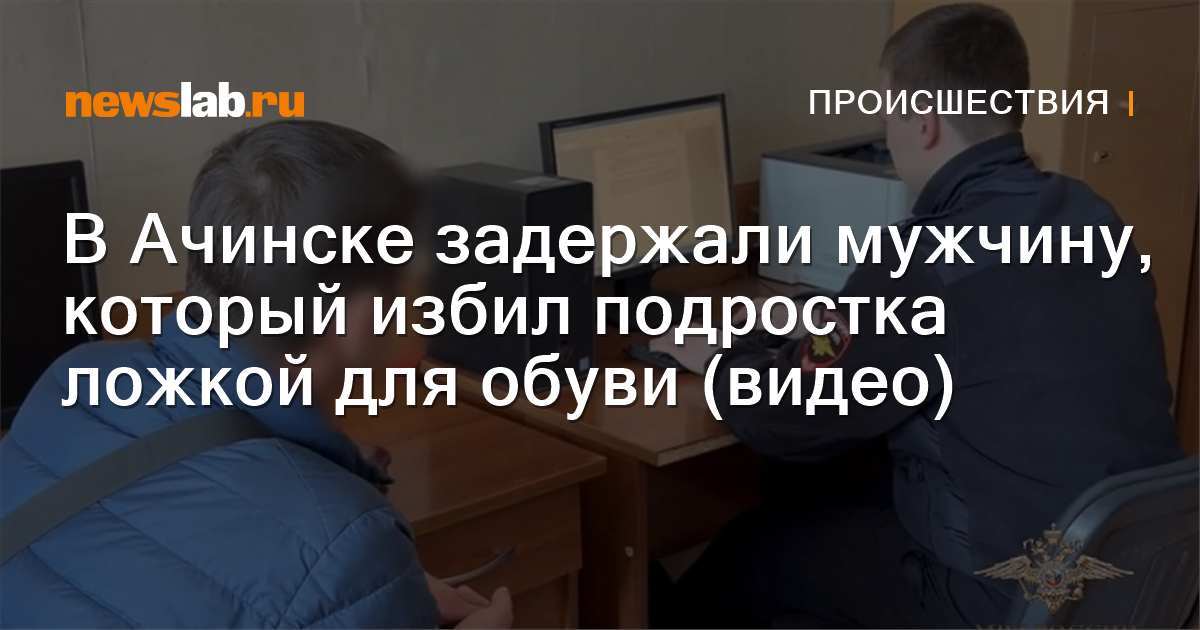
The answer option “I can easily agree with this condition” was chosen by only 8% of respondents; another 31% called this condition “difficult, but generally acceptable.”
The remaining respondents were undecided about their opinion (5%) or refused to answer (2%).
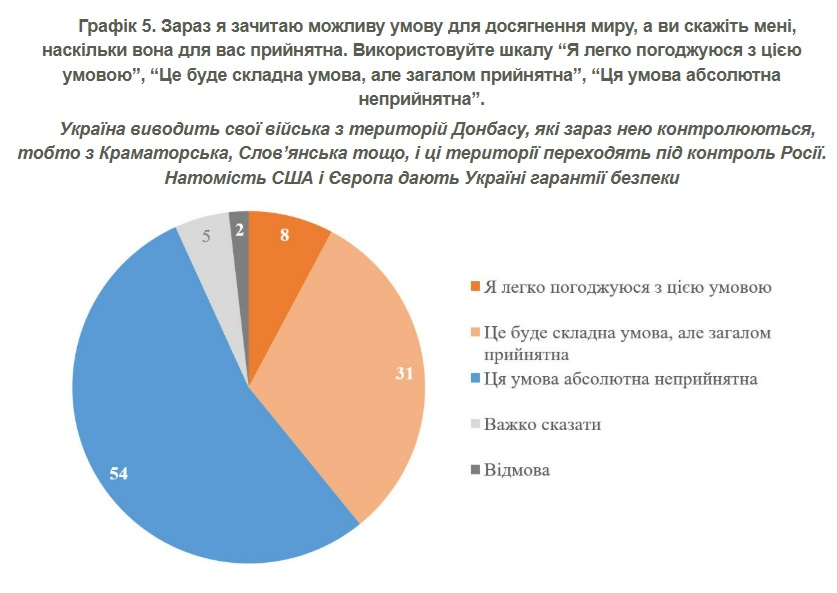
Sociologists openly asked those who were against territorial concessions why they thought so.
KIIS noted that there are three approximately equally common explanations:
- Russia will still not stop and will continue to try to fight against Ukraine (35%);
- Ukraine cannot simply give up its territories and the people living there; Ukraine has a Constitution and territorial integrity (33%);
- do not believe in the feasibility of security guarantees from the West (25%).
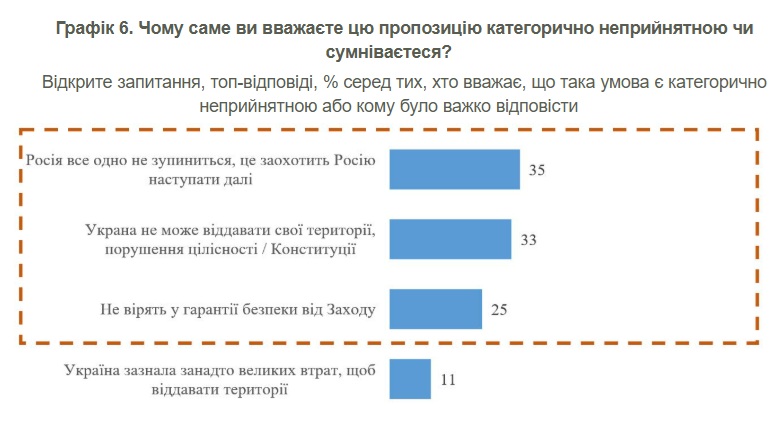
A clarifying question was also asked to those respondents who were ready to accept the transfer of Donbass to Russian control in exchange for security guarantees. They were asked what security guarantees they would trust.
“Most often, respondents spoke about legal obligations and real protection mechanisms in the event of a second attack (24%), about the deployment of Western troops in Ukraine (21%, with some talking about deployment precisely at the front line, that is, about a serious contingent), about providing Ukraine with all the necessary weapons (18%, some spoke, for example, about long-range missiles, etc.),” wrote KIIS.
The institute noted that many respondents do not believe in the effectiveness of security guarantees (11%), “that is, these respondents are ready for the withdrawal of troops from Donbass, but do not expect real security guarantees.”
“It is important to note that those who are ready to withdraw from Donbass mostly still expect practical and convincing security guarantees. That is, if it turns out that the proposed security guarantees are weak and do not imply a serious response to Russian aggression, then support for the withdrawal of troops from Donbass will be even lower,” sociologists say.
The sociological study was conducted from January 9 to January 14 using telephone interviews based on a random sample of mobile numbers in all regions controlled by the Ukrainian authorities. 601 respondents aged 18 years and older were surveyed. The statistical sampling error does not exceed 5.3%.
Context
Since 2025, the United States has been negotiating with the Russian Federation and Ukraine to end the war, in particular, the administration of US President Donald Trump has proposed a draft “peace plan.”
According to Trump, representatives of the United States and Ukraine discussed all issues of a potential agreement Andaccording to him, the parties have reached “great detail,” but there are still “one or two questions.”
President of Ukraine Vladimir Zelensky clarified that in the 20-point “peace plan,” only the issue of control over territories and the work of the Zaporizhia NPP, which is controlled by the occupiers, is not resolved.
In December 2025, Zelensky said that the United States offered Ukraine an agreement under which it would provide security guarantees for 15 years. It is possible to extend its validity period. In January, US representatives at the “coalition of the willing” negotiations in Paris did not join the joint statement on security guarantees, Politico noted.