The bloody trail of mullahs leads straight to Putin. Here's what's behind the scenes of the deal that gags Iran. We reveal


The mullahs are shaky, but they still hold power. Their brutal policies towards their own people seem to be paying off once again. The protests of the past two weeks have largely died down – after regime militias murdered more than 2,500 people and thousands of detainees fear they could be sentenced to death and executed.
Vladimir Putin is co-responsible for this state of affairs.
BILD explains how Russia keeps the Iranian regime alive.
After Syria and Venezuela, overthrowing power in Iran would be a real disaster for the Kremlin. If another key partner in the Middle East falls off the map of Russia's alliances, Moscow will lose even more influence in the region. Therefore, Putin has a clear interest in ensuring that the protests die down and that the mullahs remain in power.
It is true that the head of the Kremlin did not provide direct military assistance to Iran (e.g. he did not send his own troops) – but in practice he did not have to. For more than two decades, he consistently helped mullahs arm themselves against their own society.
“Steel Beasts” From Russia
As reported by Foreign Policy, the mullahs deliberately modified Soviet BTR-50 and BTR-60 armored personnel carriers to make them suitable for suppressing protests. They were equipped with heavier weapons, and Russian PKM machine guns were mounted on the vehicles. Weapons of this type were already used during the bloodiest riots in 2019 so far (estimates range from approx. 350 to 1,500 victims).
Moreover, last November, Iran received 40 Spartak armored vehicles, also called “steel beasts”. They were officially handed over to the Iranian border guards, but according to Foreign Policy, it was assumed from the very beginning that they would be used primarily for activities inside the country – against citizens.
This delivery was to be the result of a “shopping trip” by Iranian delegates to Russian arms companies in March 2023 – six months after the outbreak of protests triggered by the death of Jina Mahsa Amini. [22-letnia Kurdyjka została zatrzymana przez tzw. policję moralności za rzekomo “nieprawidłowe” noszenie hidżabu, a wkrótce potem zmarła w areszcie — według rodziny i świadków na skutek pobicia]. At that time, buyers' targets included, among others: stun guns, flashbang grenades and other “non-lethal” systems designed to incapacitate protesters.
A digital muzzle for protests
Russian telecommunications providers (e.g. Protei) were to help Iranian mobile operators build systems that can do much more than just eavesdrop on conversations.
With their support, the regime even developed traffic management systems that constantly analyze the situation in the city and allow early detection of emerging protest structures.
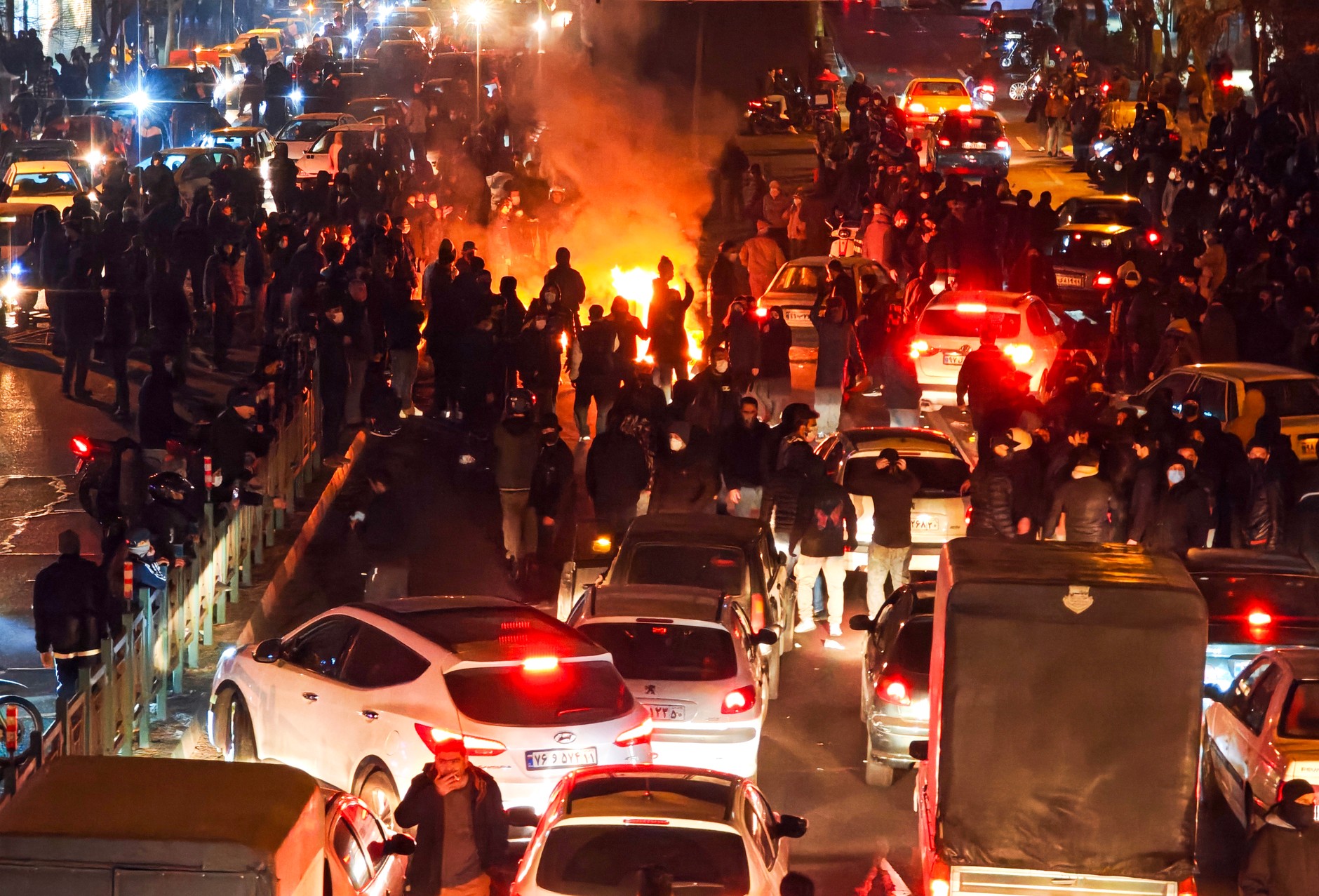
Protest in the capital of Iran, Tehran (stock photo)Anonymous/Getty Images
Tehran has a dense network of surveillance cameras – and it's not just about “security.” The cameras are also used to later recognize protesters, identify their faces and arrest them after the protests have ended.
What turned out to be particularly painful was that from January 8, 2026, the mullahs led to a nationwide blockade of the Internet – while government institutions continued to remain online (even Khamenei's profile on the X platform was active).
With Russian help, Iran has been building digital control infrastructure (so-called internet governance) for years, which allows it to selectively block instant messengers, websites and VPN connections.
In other words: the regime can precisely cut off citizens from the tools used to organize protests and transmit information to the world.
Russia has extensive experience in internet censorship. Many Western messaging apps — such as Snapchat and FaceTime — are already blocked there, and WhatsApp may also join them this year, according to reports. The result is simple: coordinating protests becomes increasingly difficult, and content that could mobilize more people stops spreading on social media.
Terror diplomacy
Russia is also pulling the strings diplomatically — and in practice stands behind the mullahs, shielding them from the pressure of the world. The Kremlin does not need to send soldiers or equipment to have a real impact on the situation in Iran: it is enough that it consistently uses its influence and powers in international institutions.
As a permanent member of the UN Security Council, Moscow has at its disposal a weapon of enormous destructive power – the power of veto. Thanks to it, it can stop initiatives imposing new sanctions on Iran, block international condemnations or at least dilute their content so that they lose their teeth and become only a symbolic gesture.
At the same time, the Kremlin is playing a classic narrative game: it presents the protests in Iran as an “internal matter of a sovereign state” in which no one from outside has the right to interfere.
Moscow dismisses Western calls for the protection of human rights and criticism of brutal pacifications with accusations of “external interference”, suggesting that the demonstrations are inspired or even directed by foreign countries. In this way, Russia not only protects Iran politically, but also provides it with a ready justification for further repression: since the protesters are “tools of the West”, the regime can present the violent crackdown on them as a defense of the state against alleged conspiracy and destabilization.
What does this mean?
In practice, Putin's support is like oxygen for Tehran – so far it has proven to be essential for the regime's survival.
However, even the Kremlin cannot single-handedly save the Iranian economy or rebuild public support for the mullahs. The pressure on the regime does not disappear. The Iranian government is still against the wall.