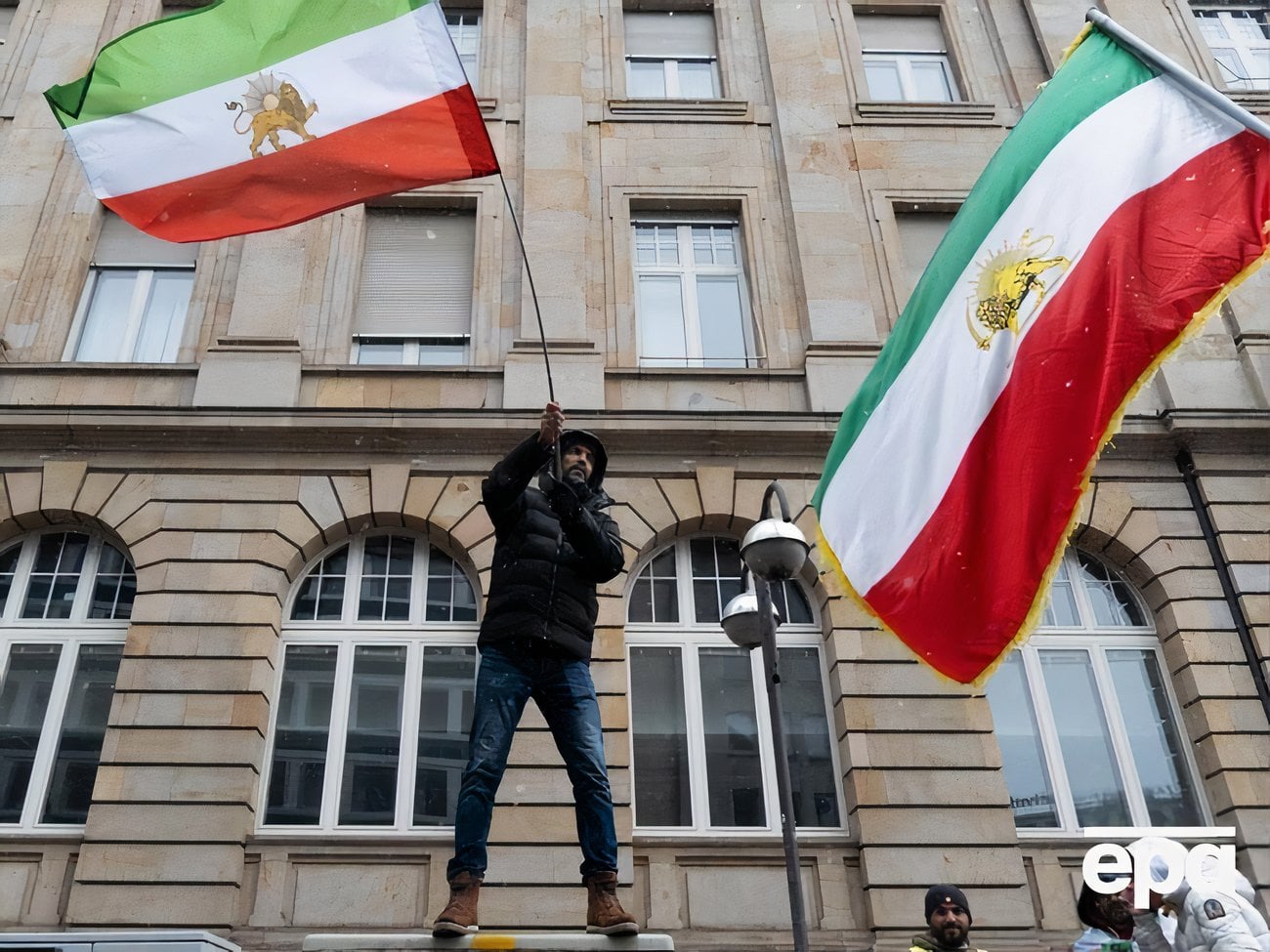
If the regime of Ayatollah Khamenei is overthrown in Iran, it will “upend global geopolitics,” energy markets and could lead to “large-scale chaos,” its authors believe.
They point out that the Khamenei regime has experienced protests more than once, but the current ones, which began in December 2025, appear to be spreading more and more widely, despite government threats and repression, and involve “hundreds of thousands of people” in dozens of cities.
Bloomberg notes that the Iranian protesters are supported by US President Donald Trump, on whose orders Venezuelan leader Nicolas Maduro was captured and who has repeatedly threatened to strike Iran. The media believes that the head of the White House is hinting that “America is again engaged in regime change.”
Amid Trump's threats against Iran, Brent oil prices rose by more than 5%, exceeding $63 per barrel, the publication writes. It explained that investors had factored in the possibility of supply disruptions from the country, which is OPEC's fourth-largest oil producer.
If the regime in Iran is overthrown, this will be the second “blow” for illegitimate Russian President Vladimir Putin after the overthrow of Maduro in Venezuela and Bashar al-Assad in Syria, two more allies of the Kremlin, Bloomberg emphasizes.
According to his observations, the Trump administration, after a successful special operation in Venezuela, is “in high spirits,” and the head of the White House “may well succumb to temptation” and, despite the risks, try to overthrow the government of Iran, which has been at odds with the United States and Israel for 45 years.
The media recalled that the overthrow of longtime US enemy Saddam Hussein in Iraq provoked “chaos and terrorism” that claimed hundreds of thousands of lives and caused “trillions of dollars in damage.” It is precisely this development of events in the event of the fall of the Ayatollah's regime in Iran that worries the leaders of the Gulf countries: Saudi Arabia, the United Arab Emirates and Qatar.
The specter of the Arab Spring, when “dictators fell across the region and chaos followed,” is still “in the air,” the material says.
Its authors note that over the past two years, the Islamic Republic of Iran has been “severely weakened” due to economic stagnation, “rampant inflation” and Israeli attacks on both Iran itself and its proxies in the region; however, Iran has a “large and sophisticated arsenal” of ballistic missiles capable of hitting targets throughout the Middle East.
Experts interviewed by journalists express the opinion that chaos in Iran could be the “worst outcome” for Turkey and Pakistan, because for some states “it is better to deal with a familiar evil than with complete chaos or an unknown, alien power structure.”
Experts also predict that likely attacks on Iran by the United States and Israel could strengthen power in Iran and reduce the attractiveness of the protest movement, as was observed in June 2025 after Israeli and American attacks.
Middle East analyst Dina Esfandiari expressed the opinion that the Islamic Republic of Iran may not survive in its current form until the end of 2026.
The most likely scenario, she said, is either a change in the country's leadership (which would largely preserve the existing system) or a coup by the Islamic Revolutionary Guard Corps (IRGC), which would lead to greater social freedoms (the IRGC is run by generals, not clerics) but less political freedom and a more militant foreign policy.
According to Esfandiari, the chances of a revolution in Iran are “pretty low” as Iranians are afraid of the chaos they have seen in Iraq and Syria.