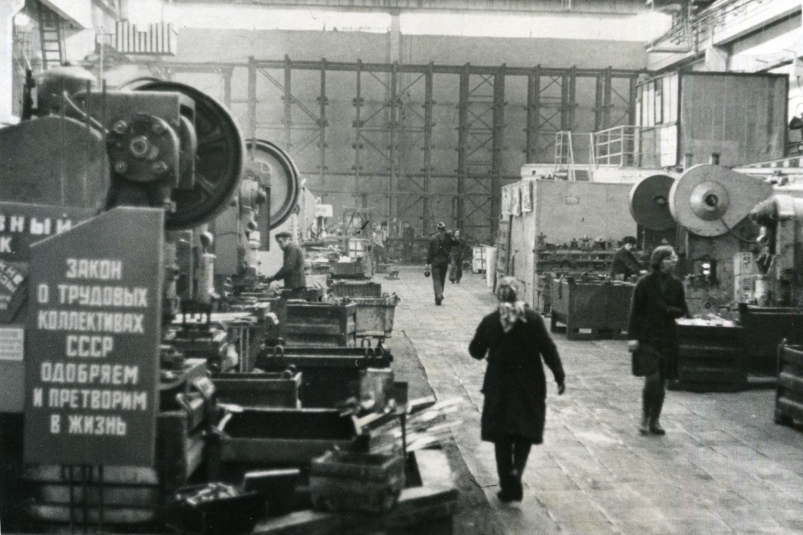
Workshop No. 17 of the Dalselmash plant. 1980s
Photo: State Archive of the Jewish Autonomous Region
January 13, 1962
In the reference and information publication “Administrative-territorial structure of the Jewish Autonomous Region 1853-2003.” (0+) information is posted that the village of Stalindorf of the Pashkovsky Village Council was renamed into the village of Zarechnoye by the Decree of the Presidium of the Supreme Soviet of the RSFSR dated January 13, 1962 “On the renaming of the village of Stalindorf of the Obluchensky district of the Jewish Autonomous Okrug into the village of Zarechnoye.”
The village of Zarechnoye is located on the right bank of the Khingan River. The road to the village of Zarechnoye goes from the Obluchye – Pashkovo highway along the bridge over the Khingan River.
The village began to be populated by settlers in 1937. The first 15 families arrived from the Volgograd region. Before that, there were prisoners here, they built houses, prepared forests, and operated a subsidiary farm – the Iskra artel. Since 1937, the collective farm began to be called Stalindorf. In subsequent years, immigrants came from the Volgograd, Kursk, Zhitomir regions, and from Ukraine.
In 1953, the Stalindorf collective farm was renamed the collective farm named after the 20th Party Congress. In 1968 p. Zarechnoye, Radde, Bashurovo, Pashkovo were united into the Pashkovsky state farm. In 1982, Zarechnoye and Pashkovo were separated from Radde and Bashurovo.
January 13, 1962
In the reference and information publication “Administrative-territorial structure of the Jewish Autonomous Region 1853-2003.” it is written that by the Decree of the Presidium of the Supreme Soviet of the RSFSR dated January 13, 1962, the village of Stalinsk, Amur District, was renamed into the village. Oktyabrskoe.

Koshever (immigrant from Lithuania, confectioner) with his family. Stalinsk on Amur. 1934. Photo: Photo: State Archive of the Jewish Autonomous Region
The village of Stalinsk was located in a picturesque location on the banks of the Amur, between the ancient Cossack villages of Dobroye and Nagibovo. In Stalinsk there was a base and central repair shops, a garage with a large fleet of vehicles, and an oil depot that supplied all farms in the region with fuel and lubricants. There was a hospital equipped with everything necessary. There was a Birobidzhan Agricultural College in Stalinsk, which trained agronomists and mechanics for regional farms. In 1962, the village of Stalinsk was renamed into the village. Oktyabrskoe. In the best years, in the village of Oktyabrsky, Leninsky district of the Jewish Autonomous Okrug, there was both a school and a kindergarten, and the local branch of the Babstovsky state farm was famous for its high harvests and milk yield.
The livestock farm in Oktyabrsky thundered throughout the region. In addition to raising cattle, they engaged in horse breeding and raised sheep. In addition to grain crops and soybeans, potatoes and vegetables were grown in the fields. Many farmers and livestock breeders were awarded orders and medals; the village was among the leaders in the number of awards per capita of the adult population.
January 13, 1938
The bureau of the regional committee of the All-Union Communist Party of Bolsheviks approved measures in connection with the plan for the resettlement of demobilized Red Army soldiers and residents of the European part of the USSR to the Jewish Autonomous Region in the amount of 530 families.
January 13, 1942
The Bureau of the Regional Party Committee considered the issue of the progress of universal education in the region.
The work on military training of workers was approved in accordance with the 110-hour program of the State Defense Committee.
January 13, 1957

Day in the history of the Jewish Autonomous Region. Photo: Photo: Regional Library
In the newspaper “Birobidzhan Star” (12+) on January 13, 1957, he talks about the month of mass book distribution that took place in our region. During the Book Month, Far Eastern writers V. Aleksandrovsky, N. Maksimov and poet Stepan Smolyakov visited the region. The writers held meetings with workers of auto-tractor trailers, students of the pedagogical school, and read their works in the regional library named after. Sholom Aleichem.
“In the Birobidzhan City House of Pioneers, V. Aleksandrovsky told how he worked on his book about tenth graders, shared his creative plans and ideas.” N. Maksimov introduced the children to excerpts from the new novel “Noise, Cupid” (0+). Lyrical poems were read by Stepan Smolyakov. Young readers were interested in what works Far Eastern writers are currently working on.
After the meeting in the foyer of the House of Pioneers, a sale of a collection of poems by Stepan Smolyakov “My Amur Region” (0+) was organized.
January 13, 1965
The Bureau of the Regional Committee of the CPSU approved the initiative of the team of the Dalselkhozmash plant, which, following the example of Moscow and Leningrad production associations and enterprises, took socialist obligations aimed at further improving the technical level, quality and reliability of its products.

Self-propelled rice harvester on caterpillar tracks SKG-4, supplied to Cuba. 1969… Photo: Photo: State Archive of the Jewish Autonomous Region
In 1965-1966, the enterprise team decided, in creative collaboration with the Taganrog State Design Bureau and the leading design organization for agricultural machinery for the Far East, to master serial production of the more productive SKG-4 rice grain harvester, which would increase labor productivity in grain harvesting by 30 percent. Combine manufacturers have pledged to double the warranty service life of combine harvesters.
January 13, 1994
By Presidential Decree of January 13, 1994, the teacher of mathematics and physics of secondary school No. 170 Art. Limestone Far Eastern Railway Vladimir Pitirimovich Tyrin was awarded the title of Honored Teacher of the Russian Federation.
In 1993, Vladimir Pitirimovich was awarded the title “Excellence in Public Education”, and in 2009 he received the badge “For Services to the Jewish Autonomous Region”, and in 2016 he received a letter of gratitude from the Legislative Assembly of the Jewish Autonomous Region.