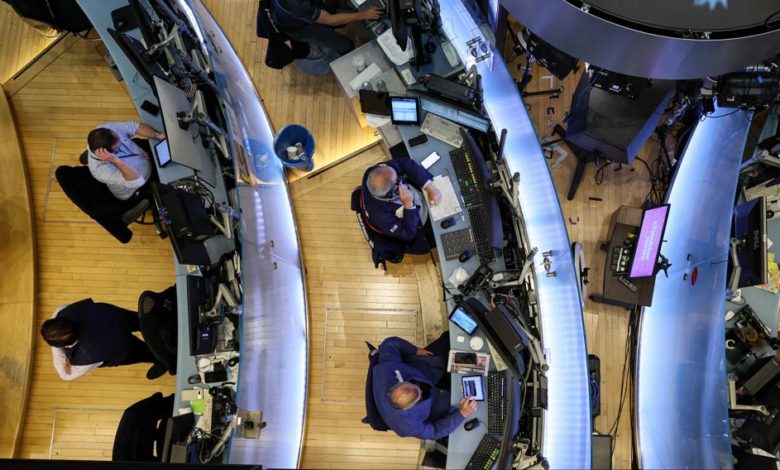
Wednesday's session on Wall Street ended with slight declines in the main indexes after the Dow and S&P 500 set historic records the day before. The investors' attention was focused on financial, energy and arms companies.
The Dow Jones Industrial dropped by 0.94 percent, or 466 points, at closing and amounted to 48,996.08 points.
The S&P 500 fell by 0.34% at the end of the day. and amounted to 6,920.93 points.
The Nasdaq Composite increased by 0.16%. up to 23,584.28 points
The Russell 2000 mid-cap index is down 0.29%. up to 2,575.42 points
The VIX index increases by 4.27%. up to 15.38 points
Finance and energy – two of the sectors that started 2026 with a bang – saw declines during Wednesday's session. Bank stocks that gave back some of their gains included JPMorgan, Bank of America and Wells Fargo
In the energy sector, the following items lost their value: Exxon Mobil, Chevron and ConocoPhillips.
Warner Bros. Shares Discovery fell slightly after the company's management said that the revised takeover offer submitted by Paramount Skydance was worse than the agreement concluded with Netflix and urged its shareholders not to sell their shares.
Strategy rose after MSCI withdrew its plan to exclude the bitcoin-collecting company and other cryptocurrency companies from its indexes.
Mobileye Global shares gained more than a dozen percent after the self-driving technology company announced on Tuesday that it would acquire humanoid robotics startup Mentee Robotics for about $900 million.
US President Donald Trump said on Wednesday that he would not allow defense companies to pay dividends to shareholders and high salaries to executives until they correct the problems with the slow production and servicing of weapons. He ordered investments in new production plants.
The president said in a post on his social media that he would “no longer tolerate” a situation in which “defense suppliers are currently paying huge dividends to their shareholders and making massive share buybacks at the expense of investments in plants and equipment.”
“Defense companies are not producing our great military equipment fast enough, and once it is produced, it is not being properly and promptly serviced. From now on, executives must build NEW and MODERN manufacturing facilities, both to deliver and maintain this important equipment, and to build the latest models of future military equipment,” Trump wrote.
“Until they do this, no director should be entitled to earnings in excess of $5 million (per year),” he added.
He also announced that until then he would not allow companies to buy back their own shares or pay dividends. Trump announced that this applies to all defense companies. He did not provide details on either his demands or how he intends to introduce bans on listed companies.
On Wednesday, investors received a large portion of the latest macro data from the American economy.
In US companies, the number of jobs increased by 41,000 in December. against a decrease of 29 thousand in the previous month, after correction from -32 thousand – according to a report by the private company ADP Research Institute. Analysts estimated that the ADP report would indicate an increase in jobs in the US by 50,000.
The number of unfilled jobs in the US, according to the JOLTS survey, in November was 7.146 million compared to 7.449 million recorded a month earlier, after adjustment. The number of job vacancies was expected to be 7.648 million.
The data came ahead of a reading on new jobs in non-agricultural sectors, which will be published on Friday. Investors are awaiting new data after the longest U.S. government shutdown in history at the end of 2025.
“The weakened labor market was a key factor behind the Fed's willingness to ignore inflation risks. Further weakness would support expectations for rate cuts, and better-than-expected data could quickly revive hawkish voices,” said Ipek Ozkardeskaya, senior analyst at Swissquote Bank.
“However, the inflation side of the US data remains unclear as recent releases… have not given a clear signal on price dynamics. If inflation unexpectedly accelerates again, expectations for interest rate cuts could quickly be overestimated,” she added.
Orders for durable goods in the US fell by 2.2% in October. mdm compared to an increase of 0.7% a month earlier. mdm, after revision – the Department of Commerce announced in the final calculation. The decline was initially estimated at 2.2%. mdm.
Orders for durable goods excluding means of transport increased by 0.1%. mdm vs 0.7 percent a month earlier, after correction. Initially estimated +0.2%.
Orders in American industry in October fell by 1.3%. mdm. Analysts estimated that orders would decline by 1.2%. mdm. A month earlier, orders increased by 0.2%. mdm.
The ISM index of activity in services in the US in December increased to 54.4 points. with 52.6 points in the previous month. Analysts expected the index to reach 52.2 points.
President Donald Trump announced on Tuesday that Venezuelan authorities will transfer 30-50 million barrels of “sanctioned crude oil” to the US. He also announced that it would be his responsibility to use the profits from the sale of the raw material.
The White House said Tuesday that Trump is considering options for taking over Greenland, including the potential use of U.S. military forces.
“The market reaction to the news from Venezuela highlights the gap between the risks reported in the media and the actual changes in valuations. The kidnapping of Maduro is a significant geopolitical event, but it has no direct impact on the supply of oil, which is the factor on which markets are really focused. Meanwhile, the pro-cyclical rally that has been ongoing since the beginning of the week reflects favorable fundamentals, including the expected increase in earnings momentum both within and outside large-cap technology companies,” said Angelo Kourkafas, senior global investment strategist at Edward Jones.
“There is sometimes a slight concern that the market is becoming complacent. However, investors have generally paid no attention to geopolitics in recent years and have been rewarded for it. Even if momentum occasionally falters, markets rely on a favorable operating environment and decent corporate earnings,” said Richard Flax, chief investment officer at wealth manager Moneyfarm.
US crude oil inventories last week fell by 3.83 million barrels, or 0.91%, to 419.06 million barrels. Gasoline stocks increased by 7.7 million barrels, or 3.29 percent, to 242.04 million barrels during this time.
Reserves of distilled fuels, including heating oil, increased by 5.59 million barrels, or 4.52 percent, to 129.27 million barrels.
On the oil market, WTI contracts for February are down by 1.45%. to USD 56.30 per barrel, and February Brent futures fall by 0.66%. up to USD 60.30/b. (PAP Business)
pr/sp/