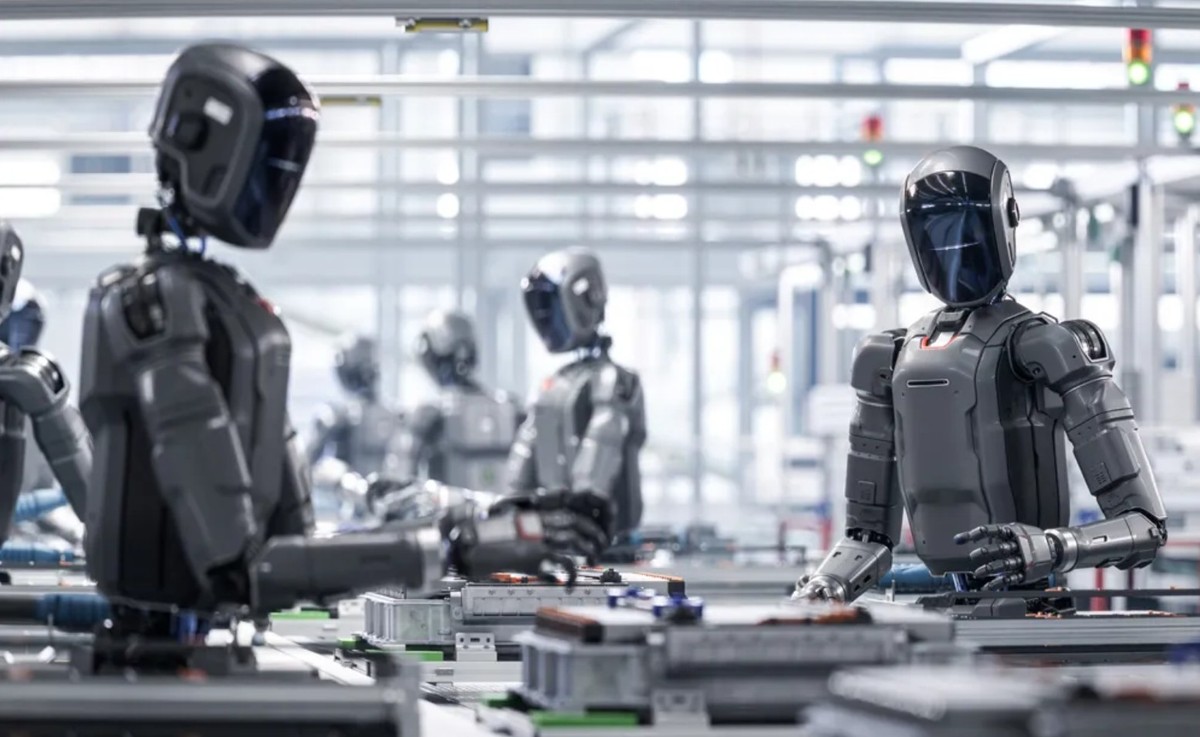
This year's CES (Consumer Electronics Show), the world's largest annual trade fair for consumer electronics and new technologies, will host many robots and devices based on artificial intelligence.
The biggest change compared to previous LG home robots is the departure from the role of a companion on wheels in favor of a design focused on the manipulation of objects. CLOiD has two motor-driven articulated arms with seven degrees of freedom – a range of motion closer to that of a human hand – and at the end of each hand there are five independently controlled fingers. This is a detail that in practice determines whether the robot can only move around the apartment on its own, or actually grab, carry and put things away without crushing, slipping or breaking them.
The next part below the video:
The brain of the device is to be a chipset placed in the robot's head, and next to it we will find a screen, a speaker, a camera and a set of sensors. needed for navigation, orientation in space and multimodal interaction (voice, image, “body language” signals). LG announces natural voice control and expressive communication, i.e. reactions not only with words, but also with movement and visual signals. For now, we have to imagine it, because there are no official presentations yet, but expectations are already high.
Check also: The line between AI and humans is blurring. We're starting to talk like chatbots
Zero Labor Home. A strategy in which the user regains time
CLOiD is to be a demonstration of a broader idea, i.e. Zero Labor Home, i.e. a home in which technology cuts out what is repetitive and time-consuming (and boring) from the day. In LG's approach, it is not only about the automation of a single piece of equipment (such as a washing machine or dishwasher), but about an ecosystem that understands context and can operate in the background – without issuing step-by-step commands.
The main slogan here is Affectionate Intelligence – artificial intelligence designed to learn and adapt to the user with subsequent interactions. LG clearly states that the system is supposed to recognize the environment, react in a natural way and improve its behavior over time, instead of sticking to rigid scenarios.
It is worth adding that Zero Labor Home is not a new slogan invented for one premiere. Already at CES 2024, LG showed a mobile AI agent that was to act as a driving hub (it could patrol the house, monitor animals, detect unusual events and control Internet of Things devices). That major focused on perception and coordination. CLOiD looks like the next step and is supposed to add capable hands to intelligent management.
Read also: YouTube massively promotes artificial intelligence. Up to 20 percent suggested videos
From cleaning to organizing. What can a home robot do?
For now, LG mainly shows hands and a description of the possibilities, and will demonstrate practical scenarios at the stand during CES 2026, which will be held on January 6-9 in Las Vegas.
However, from the parameters themselves (two arms, five fingers, a set of sensors and AI that learns habits), it is possible you can pretty well deduce what tasks are most within the reach of such a machine. The most natural applications are works that still require a human hand today, i.e. lifting and putting down objects, picking up things from the floor, putting abandoned accessories back in place, sorting small items, carrying light purchases, as well as simple activities in the kitchen, such as serving items, putting away dishes or putting things into the dishwasher.
The Verge points out that in one of the images, CLOiD looks like he's grabbing a towel. This fits well into the home logistics of many of us where what matters is a gentle grip and force control.
At the same time, the market is already relieving us of tasks that can easily be confined to a repetitive pattern. Floors are cleaned by vacuuming and mopping robots, lawns are taken care of by automatic lawn mowers, and in some homes there are also window cleaning robots. The difference is simple – these are specialized devices. CLOiD targets the gap between them, namely activities that are dispersed, unpredictable and dependent on the mess we create.
The biggest question (and the biggest barrier to mass adoption) will not be the gimmick itself, but rather safety, reliability and cost. Home is an environment full of exceptions. Children, animals, fragile objects, tight passages, cables, carpets, accidentally spilled things – these are not easy environments for robots. That's why CES 2026 promises to be even more interesting. If LG shows CLOiD in realistic, imperfect scenes, it will be a more important test than the most impressive demo. It must also be said that this may be the first important step towards automating tasks that many of us do not like and perform only out of necessity. Cleaning or washing dishes are definitely tasks in which an AI robot could do for us.
Author: Grzegorz Kubera, journalist of Business Insider Polska