Humans Could Return to the Moon After a 54-Year Absence – When NASA Launches the Artemis II Mission


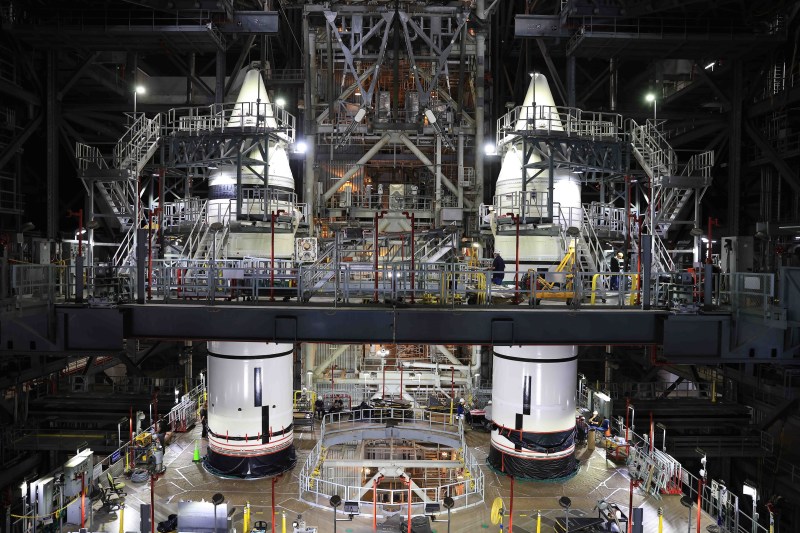
NASA's SLS rocket (Kim Shiflett/Nasa/Zuma Press/Profimedia)
NASA is expected to launch the Artemis II mission in February that will take four astronauts around the moon, where humans haven't been in 54 years. There have been numerous delays, technical problems may arise, but the ten-day mission will be the toughest test in decades for NASA.
The Artemis II mission, originally scheduled for late 2024, is to carry a crew of four astronauts around the Moon, and the whole thing will take ten days.
Reid Wiseman, Victor Glover, Christina Koch and Jeremy Hansen will become the first humans to reach the moon since the Apollo 17 crew in 1972. The team composition was announced in 2023.
The four astronauts will NOT land on the moon, this will only happen in the Artemis III mission which will take place in 2027 at best. The Artemis I mission was launched in 2022 and the Orion capsule traveled around the moon, but WITHOUT a human crew.
The Orion capsule will be launched by the SLS rocket from the Kennedy Space Center as early as February 5. On the NASA website it says that the launch will be “no later than April 2026”.
It will take four days to travel to the Moon and reach a maximum altitude of 8,900 km above the surface of the Moon.
In recent days, publications such as space.com, CNN, New York Times or NBC have written extensively about Artemis II, because this mission is meant to be a path-breaking one. Humans want to build lunar bases in the future, exploit mineral resources and launch missions to Mars from the Moon area.
The data collected from this mission will be used in future ones, and a number of equipment will be tested.
Unlike the Apollo missions, which entered low lunar orbit, Artemis II will use a flight path better suited to the design and mass of the Orion capsule. The craft will describe a wide loop around the Moon, instead of flying in tight circles closer to the surface.
NASA tested the Orion capsule around the moon three years ago, but was unable to test all the essential systems, such as those that keep the astronauts alive and the heat shield that protects the crew from the heat generated on re-entry through the atmosphere.