Hundreds of ski slopes in Europe have been abandoned in recent years, turning into so-called “ghost resorts” amid an increasingly frequent lack of snow. More and more ski areas are being forced to close, especially those located at lower altitudes, where higher temperatures make winter seasons unpredictable, writes The Daily Mail.
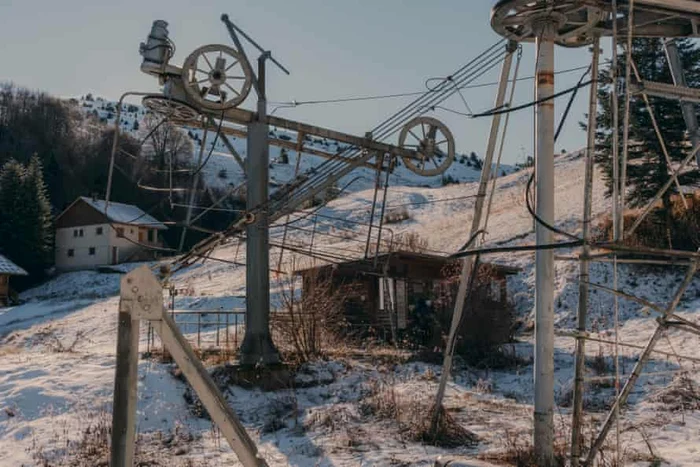
186 resorts, closed in France/PHOTO:X
In France alone, 186 resorts that once benefited from regular snowfall have definitively ceased their activity. Many others struggle to survive as snowpacks dwindle from year to year.
The start of the 2025–2026 ski season was no exception
Videos shared on social media show almost snow-free slopes in areas of France, Austria and Switzerland. Instead of the white carpet, patches of grass, rock and dirt can be seen on the slopes, including in regions considered symbols of winter sports, such as the northern French Alps or the Austrian Tyrol. Many skiers have to climb to higher altitudes to find acceptable conditions.
Although heavy snowfall has been recorded in the Pyrenees and some resorts in Italy in recent days, images from other areas show skiers descending narrow strips of frozen snow or ascending by chairlift above almost completely empty slopes.
Unusually high temperatures for the cold season
Resorts across Europe are experiencing unusually high temperatures for the cold season, a major threat to low-altitude pistes. Many of these have already been forced to close permanently.
Last month, Urs Lehmann, director general of the International Ski and Snowboard Federation, warned that melting glaciers and shrinking snowpack could have devastating effects on winter sports. Speaking from the Great Aletsch Glacier in Switzerland, he said the impact of climate change was being felt quickly in communities dependent on mountain tourism.
A report published in 2023 warned that more than half of Europe's ski resorts could face severe snow shortages if the global average temperature rises by 2°C from pre-industrial levels. At a 4°C rise, almost all resorts would be affected, with major consequences for the tourism industry.
The researchers point out that a commonly used solution – the production of artificial snow – can only partially compensate for the lack of natural snowfall and involves high energy and water consumption, indirectly contributing to greenhouse gas emissions.
186 resorts, closed in France
In France, in addition to the 186 closed resorts, around 113 cableway installations with a total length of almost 65 kilometers have been abandoned. The Céüze 2000 resort, which closed in 2018, is often cited as an example: buildings and infrastructure, once part of a spectacular alpine landscape, are now left in disrepair.
The Mountain Wilderness Association estimates that more than 3,000 abandoned structures are scattered in the mountains of France, gradually degrading the natural landscapes.
In Italy, around 90% of slopes currently depend on artificial snow, according to the environmental organization Legambiente. The situation is similar in Austria (70%), Switzerland (50%) and France (39%). But the production of artificial snow requires temperatures close to zero degrees, conditions that are increasingly difficult to meet.
The lack of snow has recently generated tension in the Dolomites as well
The lack of snow has also recently caused tension in the Dolomites, where several slopes have been closed due to the warm weather, causing huge queues at the cable car facilities. The scenes took place just weeks before Italy hosted the Winter Olympics in Milan–Cortina d'Ampezzo.
Temperatures slightly above freezing and long periods without precipitation have drastically reduced the snowpack in northeastern Italy, and artificial snowmaking systems have had limited operation. Olympic organizers recently acknowledged technical problems with the water supply for the artificial snow, including at a site in Livigno, where the freestyle and snowboard events are due to take place.
Video footage from the Dolomites shows visibly irritated skiers huddled near the lifts, while photos of packed crowds and waiting times of up to 45 minutes circulated on social media.
For many European mountain regions, the lack of snow is no longer an exception, but a clear signal of a lasting change, which calls into question the future of skiing as it has been known until now.