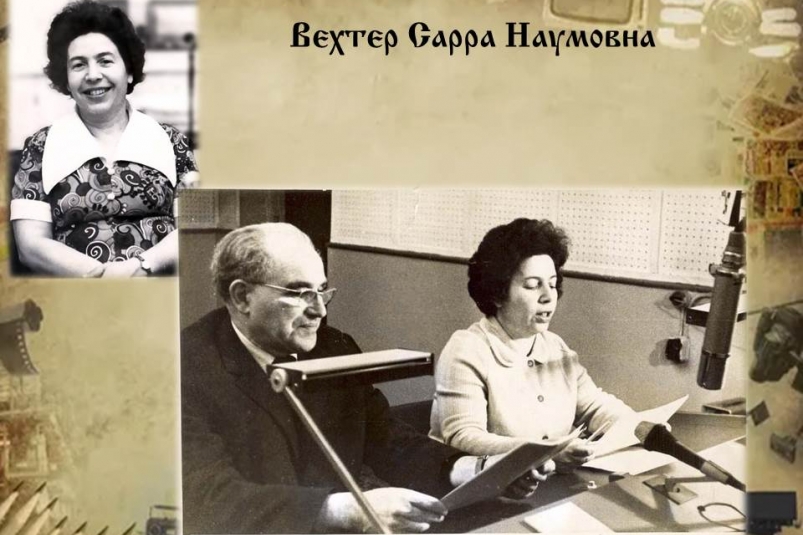
Sarra Naumovna Wekhter
Photo: Regional Library
December 31, 1928
The Jewish poetess Sarra Naumovna Wechter was born in the village of Iliya in Belarus.
Sarra Naumovna came to Birobidzhan with her parents in the post-war year 1948. The war prevented the girl from getting an education and a profession; already in Birobidzhan she entered a cultural and educational school and graduated from the library department.
Sarra Naumovna began working in the reading room of the regional library, then she headed the city library.
And since 1948, Sarah Wechter, as a person who knew Yiddish very well, was invited to the regional radio and her voice began to be heard in programs in the Jewish language.
Sarah Wechter wrote poems only in Yiddish; they were translated by Viktor Solomatov, Leonid Shkolnik, Viktor Antonov. Sarah Wechter also wrote children's poems. She has been published in the newspapers “Birobidzhaner Stern” (16+), “Birobidzhan Star” (16+), “Einikait” (16+), in the almanac “Literary Birobidzhan” (6+), in the magazine “Sovietish Gameland” (16+), in the collection “Literary Birobidzhan” (0+). In the early nineties, her family left for Israel.
In 1998, Sarah Wechter passed away. She was buried in the city of Karniel, on the monument that was installed on her grave, you can read:
“And if fate silences me,
My poem will tell everything about me.”
December 31, 1911
On this day, the Jewish writer Ikhil Shmulevich Falikman was born.
Ikhil Shmulevich graduated from a seven-year Jewish school, and in 1931 from an art college.
His first book “Stapes shitn zikh” (6+) (“The steppes are crumbling”) was published in 1931.

Ikhil Shmulevich Falikman. Photo: Photo: Regional Library
In 1932-1933 he worked in the regional newspaper of Birobidzhan “Birobidzhaner Stern” (16+), at the same time he began writing essays and stories. Impressions of life in the Far East formed the basis of his book “Among the Hills” (12+), in which he described his impressions of the Jewish Autonomous Region.
In the 1930s The Organizing Committee of the Union of Soviet Writers of Birobidzhan was formed. The organizing committee included Kazakevich, Vinokur, Dobin, Falikman, Kazakevich (son), the poet Lipkind, Marcus and others. For a closer connection with the workers, individual writers were assigned to enterprises in the region. Ikhil Shmulevich worked at the Mekhmebel plant, led the literary circle, and helped with wall newspapers.
During the war, Ikhil Shmulevich served as a war correspondent in the active army. He published front-line essays in the newspaper “Einikait” (16+).
From 1950 to 1956 was in custody. Rehabilitated.
Published in the magazine “Forpost” (16+) and the almanac “Birobidzhan” (0+). Falikman was a member of the editorial board of the magazine “Sovietish Heimland” (16+), published short stories, novellas and novels there. In 1968, Falikman’s novel “Black Wind” (16+) was published, which tells about the tragic events of the Holocaust.
Falikman's works have been repeatedly translated into other languages.
Ikhil Shmulevich died on May 1, 1977.
December 31, 1946

Day in the history of the Jewish Autonomous Region. Photo: Photo: Regional Library
The newspaper “Birobidzhanskaya Zvezda” (16+) reported that the team of the Londokovsky lime plant was recognized as the winner in the All-Union competition:
“The other day, the plant staff received a telegram from the Ministry of Construction Materials Industry L. M. Kaganovich, which reported that the plant was again awarded first place in the all-Union socialist competition, the challenge Red Banner of the ministry was left and a cash bonus of 25 thousand rubles would be given. In honor of the elections to the Supreme Soviet of the RSFSR, socialist competition unfolded at the plant with even greater force.”

Planting potatoes on the collective farm named after. Anikeeva. Nikolai Nesterovich Ostroukh, second from left, is the best potato planter operator. 1958. Photo: Photo: State Archive of the Jewish Autonomous Region
In the same newspaper, in an article by the head of the Birobidzhan state variety testing site, T. Mostkova “Some results of potato variety testing in our region” talks about how you need to choose the right potato varieties for planting in order to get a high yield:
“The task of the region’s agricultural research institutions is to test the best available potato varieties and select from them those that, in local soil and climatic conditions, are the most productive, have high taste, are resistant to cancer and late blight and are least affected by various other diseases. These varieties should be transferred to collective farms for production testing over a large area and mass reproduction. Birobidzhan state variety testing site for the study of various “Vegetable and potato varieties were tested over the course of 7 years, starting in 1940, 28 potato varieties, of which eight were early, four were mid-early and 10 were late.” This report states that the best early potato varieties are: “Cobbler”, “Triumph” and “Red Rose” and provides the characteristics of these potato varieties.
December 31, 1948
The newspaper “Birobidzhan Star” on December 31, 1948 wrote about the greenhouse of the improvement department, which is called the “Flower Factory”, that in the greenhouse under a glass roof in the middle of winter, cacti, ficus, philodendrons, lemons, primroses, and oleander grow. The branches of Chinese roses filled the greenhouse with bright crimson flowers, and openwork asparagus grew.
18+. Information agency EAOMedia, registration number IA No. FS 77 – 83168 dated 05/12/2022, registration authority – Federal Service for Supervision of Communications, Information Technologies and Mass Communications.