CCR, expected to decide on Monday on the Magistrates' Pensions Law, after two postponements and lack of quorum


The Constitutional Court is expected to make a decision on the Magistrates' Pensions Act on Monday, after the ruling was postponed twice. On Sunday, the CCR invoked the lack of quorum, after four judges left the courtroom during a session break.
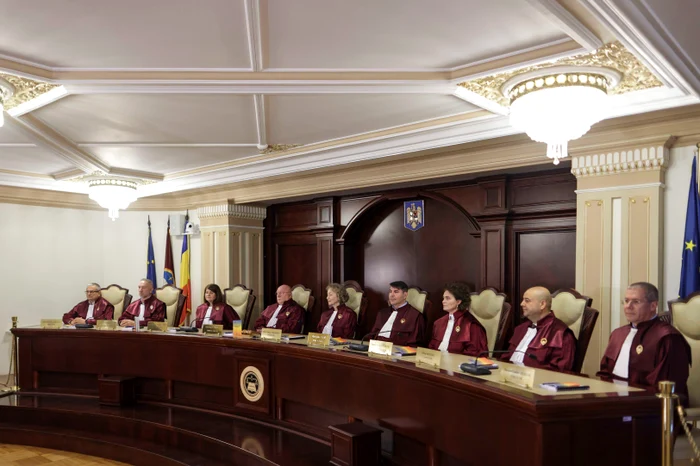
Constitutional Court of Romania/PHOTO: Inquam photos/Octav Ganea
In order for a solution to be pronounced, the presence of at least six of the nine constitutional judges is required. The contested law modifies both the method of determining the amount of the pension and the conditions under which magistrates can retire.
According to a statement from the Constitutional Court, “The Constitutional Court decided, on Sunday, to continue the deliberations on December 29, 2025, at 10:00 a.m., in the case of the objection of unconstitutionality of the Law for the amendment and completion of some normative acts in the field of service pensions, formulated by the High Court of Cassation and Justice, noting the lack of quorum in the deliberation session held on December 28, 2025”.
The Constitutional Court postponed the ruling in this case twice. On December 10, the CCR postponed taking a decision on the referral made by the High Court of Cassation and Justice (ICCJ), setting a new deadline for Sunday, December 28.
At the Sunday session, four judges of the CCR supported by the PSD left the room during a break and did not return, which made deliberation impossible. The Court consists of nine members, and the presence of at least six judges is required to render a decision.
The former president of the Constitutional Court, Augustin Zegrean, said he expected Sunday's meeting to lead to no solution. “Sunday is not judged anywhere in the world. (…) Things are complicated because they are unable to form a quorum”stated Zegrean, noting that, in the current composition of the Court, the debates take a long time.
Instead, law professor Valerius M. Ciucă, a former judge at the Court of the European Union, argued that the non-appearance of a judge in deliberation is equivalent to self-resignation. He stated that the four judges who left the room “I can no longer vote for anything valid in the CCR”.
“If, in deliberation, a 'judge' does not appear, he is automatically dismissed. Even death is not a reason for non-deliberation. On his deathbed, the judge can be questioned about his verdict. There have been numerous cases all over the world. Failure to appear in deliberation, in any jurisdictional order, is equivalent to self-resignation. The four, by way of consequence, can no longer vote. They are outside the constitutional order and outside the rules universal”Valerius M. Ciucă, a professor at the University's Faculty of Law, wrote on Facebook “Alexandru Ioan Cuza” from Iasi.
On December 5, the magistrates of the High Court of Cassation and Justice unanimously decided to refer the CCR for the control of the constitutionality of the Law on the amendment and completion of some normative acts in the field of service pensions.
What the ICCJ magistrates claim
According to the magistrates of the supreme court, the emergency character of the project was not demonstrated or was built on a counterfactual reality, the conditionality of Milestone 215 of the PNRR being invoked, “taken out of context” and “inconsistent with reality according to the documents communicated by the European Commission”.
The magistrates also claim that the Executive did not justify the invocation of the economic conditions that would have required the urgent adoption of the law, lacking data on the economic impact for the following years.
Also, the ICCJ claims the lack of clarity and predictability of the law, the use of non-existent and undefined legal terms, as well as the damage to the principle of legal security through abrupt changes to the status of the magistrate, without a real transition.
“Thus, contrary to the public discourse, by combining the rules regarding the staggering of the retirement age, the staggering of seniority and the staggered elimination of assimilated periods of seniority in the specialty, 45% of the magistrates in office have a sudden increase to 65 years, and 21% have a sudden increase to 60-64 years”, show ICCJ magistrates.
The supreme court also supports the existence of “obvious discrimination” between service pension categories, with magistrates being the only ones with constitutionally guaranteed status, but treated less favorably.
“For all other categories, the minimum standard for calculating the amount is 65% of the gross allowances, for magistrates a much lower one is proposed. Compared to the other categories of beneficiaries of service pensions, only in the case of magistrates is the capping drastic, respectively limited to 70% of the net income”say the magistrates.
They also show that the law “cancel de facto service pensions” and violates the independence of the judiciary, being incompatible with the standards established by the decisions of the CJEU, ECHR and CCR.
What the law provides
The law provides for the establishment of the retirement age by reporting to the public pension system, with the establishment of the minimum age of 49 years until December 31, 2026, the condition of at least 35 years of work experience and the gradual increase of the retirement age up to 65 years.
The amount of the pension would be 55% of the calculation base represented by the average of the gross allowances and increments of the last 60 months, with the pension capping at 70% of the net income from the last month of activity.
The draft also restricts the granting of the 1% bonus and the pension update only to persons who meet the conditions for retirement before the entry into force of the law.
The government assumed responsibility for this project on December 2, after the first form of the law was declared unconstitutional by the CCR, on October 20, due to the lack of the opinion of the Superior Council of the Magistracy. The new form of the law received a negative opinion from the CSM.