BREAKING: CCR postpones again the decision on the special pensions of the magistrates. Today's meeting, at the end after an hour and a half


The judges of the Constitutional Court met on Sunday, from 13.00, to determine whether the law that increases the retirement age of magistrates and that reduces the amount of service pension is constitutional or not.
The CCR postponed until tomorrow the decision on the law on the special pensions of magistrates.
Another break in the CCR meeting, a few minutes after the discussion was resumed
Four judges of the CCR left the courtroom again. It is about Gheorghe Stan, Bogdan Licu, Mihai Busuioc, the three judges proposed by PSD, and Mihaela Ciochină, appointed by former president Klaus Iohannis, according to some HotNews sources.
The session of the Constitutional Court was resumed after a break of approximately 15 minutes. The judges entered the courtroom again to continue the debates on the law on the special pensions of the magistrates.
Break after 45 minutes from the start of the session
The judges of the Constitutional Court took a break from the meeting in which the law regarding the special pensions of magistrates is discussed. They started the chat 45 minutes ago.
The CCR meeting has begun in which the fate of the law on the special pensions of magistrates is open.
***
In a meeting that will start at 1:00 p.m., the nine judges will rule on the referral made by the High Court of Cassation and Justice against the draft law adopted by the Bolojan government by assuming responsibility in Parliament.
The CCR judges meet again today after they decided on December 10 to postpone the ruling on the draft law. In parallel, in those days, there were street protests in Romania after Recorder's revelations on justice.
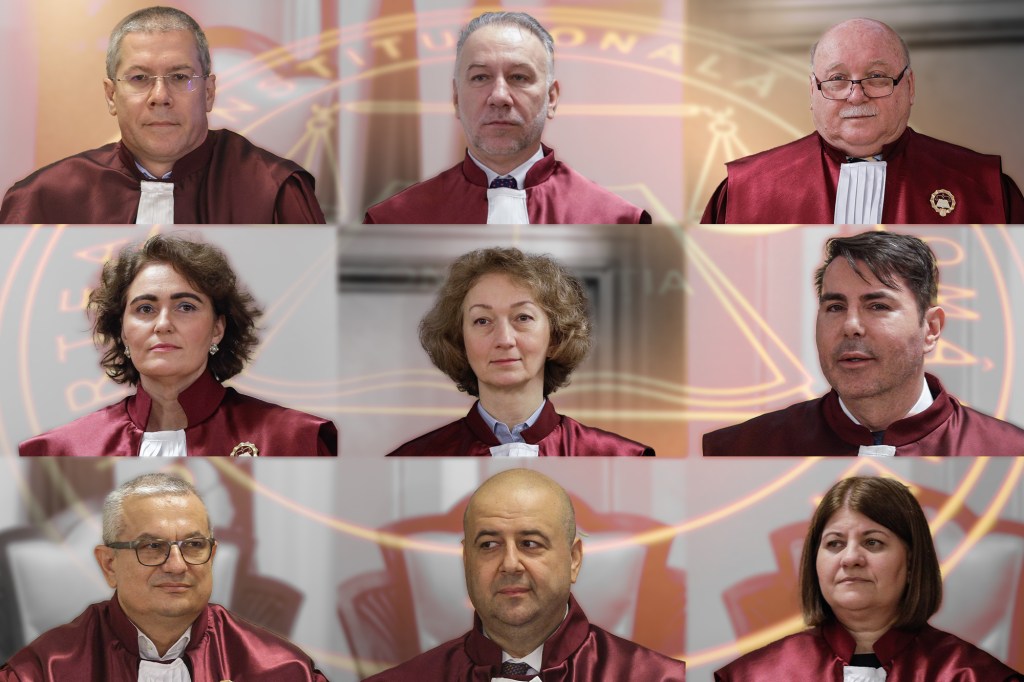 The Constitutional Court postpones, after hours of debate, the decision on magistrates' pensions / New term – Sunday, after Christmas
How the votes were split last time
The CCR judges who are going to decide on the law on the pensions of magistrates are the same ones who, with a vote of 5 to 4, failed, in October, the first version of the law on the modification of the pensions of magistrates. The law was challenged at the Constitutional Court also by the High Court, led by judge Lia Savonea.
Then, according to HotNews sources, the five judges who voted for the admission of the appeal of the unconstitutionality of the law on magistrates' pensions were: Cristian Deliorga, Gheorghe Stan, Mihaela Ciochină, Bogdan Licu and Marian Busuioc.
The four judges who voted against admitting the referral to the Supreme Court, i.e. for the constitutionality of the law, were: Simina Tănăsescu, Laura-Iuliana Scântei, Csaba Astzalos and Dacian Cosmin Dragoș.
Then the law failed for reasons of form, not substance. More precisely, the 5 judges said that the Government was obliged to wait for 30 days for the advisory opinion of the Superior Council of the Magistracy before adopting the law in Parliament through the procedure of assumption of responsibility.
Who are the nine CCR judges:
- Simina Tanasescupresident of CCR – former professor at the Faculty of Law at the University of Bucharest. After the election of Klaus Iohannis, she became a presidential adviser, and in 2019 she was appointed by the president Klaus Iohannis as a member of the Constitutional Court. In July 2025, she was elected president of the Constitutional Court for a three-year term.
- Gheorghe Stan – former chief prosecutor of the Section for the Investigation of Judicial Crimes (SIIJ) before being appointed in 2019 as a member of the Constitutional Court by the decision of the Chamber of Deputies on the proposal PSD.
- Cristian Deliorga – holds the position of CCR judge since 2019, being appointed by the Senate upon proposal PSD. Between 1982 and 2006, he served as a prosecutor in several prosecutor's offices in Constanța County, and then became a judge. He became known after pronouncing the prison sentence of Mircea Băsescu.
- Laura-Iulia Scântei – was a notary and a liberal parliamentarian before being appointed by the Senate, in 2022, as a judge at the Constitutional Court, on the proposal PNL.
- Bogdan Licu – is a judge at the CCR from 2022 at the proposal PSDby the vote of the Chamber of Deputies. He was vice-president of the CSM, after which he successively held the positions of first deputy of the general prosecutor, deputy of the general prosecutor, delegate to the position of general prosecutor and first deputy of the general prosecutor.
- Mihaela Ciochina – was appointed by the president Klaus Iohannis in 2022 at the Constitutional Court. Previously, he was, between 2015 and 2022, an advisor to President Iohannis. Before Cotroceni, Cochină worked at the Romanian Senate, where he held several executive functions.
- Marian Basuioc – judge of the Constitutional Court of Romania (CCR) appointed by the Senate upon proposal PSD from July 2025, Mihai Busuioc has held, in the last 15 years, management positions in several important institutions in Romania. He was in turn in management positions at the Court of Accounts, the Ministry of Development or the National Agency for Cadastre and Real Estate Advertising. He was also Secretary General of the Government.
- Csaba Asztalos – he was a member of the CNCD from the establishment of the institution, from 2002 until July 2025. In 2005 he was elected president of the CNCD for the first time, a position held until 2009. Between January and April 2010, he was an adviser to Marko Bela on the issue of preventing and combating discrimination, while the leader of the UDMR was deputy prime minister. In April 2010, Csaba Asztalos was re-elected as president of the CNCD, a position he held until July 2025 when he was appointed to the CCR by the Chamber of Deputies with the support UDMR.
- Dacian Cosmin Dragoș – professor at Babeș Bolyai University in Cluj, Dacian Cosmin Dragoș was appointed by the president Nicusor Dan at the Constitutional Court. In the periods 2016-2017 and 2020-2023, he was the president of the National Council for the Ethics of Scientific Research, Technological Development and Innovation, a position from which he resigned in protest after the Council's decision by which it was established that Lucian Bode did not plagiarize in his doctoral thesis, a decision that contradicted the verdict given by Babeș-Bolyai University in this case.
What does the law that changes the pensions of magistrates provide
The law for which Ilie Bolojan assumed responsibility for the second time in Parliament, on December 2, has only one major difference compared to the first version, which failed at the CCR in October. Compared to the first option, the law provides for a transition period of 15 years, and not 10.
- The draft law stipulates that the pension be equal to 70% of the last net salary, as in the previous form proposed by the Bolojan Government.
- The transition period, however, increased from 10 to 15 years. Concretely, this means that in 15 years, magistrates will retire at 65.
- Each year, the retirement age will increase by one year until, in 2042, prosecutors and judges retire at 65.
- According to the draft law, the amount of the service pension will be 55% of the calculation base, represented by the average of the gross allowances of the last 60 months, but not more than 70% of the last net allowance received in the activity.
- Magistrates will still be able to retire early, provided they have 35 years of service, but if they have not reached the age of 65, an annual penalty of “2% until they reach the standard retirement age in the public system” will be applied.
Currently, the service pension of magistrates represents 80% of the last gross salary.
For the first time, Prime Minister Bolojan assumed responsibility in Parliament on the law on magistrates' pensions on September 1. On October 20, the Constitutional Court rejected the law in its form, arguing that the Government did not wait for the opinion of the Superior Council of Magistracy.
How the ICCJ motivated the attack on the law at the CCR: “It brutally violates the independence of the judiciary”
The supreme court claims that the changes made by the Bolojan Government “discriminate against magistrates against other beneficiaries of service pensions, violate international standards, brutally violate the independence of the judiciary, de facto eliminate the service pension for magistrates, violate international standards established by the jurisprudence of the Court of Justice of the European Union, the European Court of Human Rights, also violate the binding character of the decisions of the Constitutional Court”.
The ICCJ also claims that the law “uses vague terms and presents normative gaps that make it incompatible with the standards of quality and predictability in a rule of law”.
“The law creates obvious discrimination between the categories of service pensions, being clearly unfavorable to magistrates, although magistrates are the only ones with guaranteed constitutional status (…) Compared to the other categories of beneficiaries of service pensions, only in the case of magistrates, the ceiling is drastic, respectively limited to 70% of the net. In other categories there are limitations related to the much higher net value, from 80% upwards. The discrimination is obvious and unjustified, according to the reasons cited in the statement of reasons of the Executive”, accused the spokesperson of the supreme court, Victor Alistar.
The CSM gave a negative opinion: “The governors who created this situation did not understand to apologize”
On November 27, the law received a negative opinion from the Superior Council of the Magistracy, an advisory opinion.
The President of the CSM, Elena Costache, accused, in the Council meeting in which the opinion was issued, that the magistrates were “subjected to a veritable siege by political leaders”:
“They came to influence public opinion in such a way that we became a real target of a campaign of hate, denigration, misinformation, in which all our natural reactions in such a struggle were presented in a manner that did not conform to reality.
You all know and it is well-known that, for at least six months, we have been operating under conditions that I don't know if the Council, as an institution, has faced before, maybe only the old council, during the 2018-2019 period, with the changes to the Laws of Justice”.
She said that it has come to the point that “justice represents the main problem in this country, that justice is treated as a matter that must be removed from any democratic system, that must be demonized, and without solving this problem the country cannot go on its European path”:
“We didn't run after privileges because we don't have such privileges. We didn't run after money, we didn't run after anything that could strengthen our so-called power, because our power is the one given by the constitution and if we did anything during this whole period it was only to fight for the defense of independence, the preservation of which has a direct impact on the citizen, on the litigant, as the one who benefits from the act of justice.
(…) Those who started this whole situation, who generated it even until this hour did not understand to come out publicly and tell the truth and did not understand to apologize, in my opinion”.