This is how Putin destroys the next generation. “Are we allowed to breathe?”


Russian teenagers joke that media regulator Roskomnadzor has turned December into an Advent calendar of restrictions, announcing a new ban every day. However, within 2025 young people were dealing with more than just blocked websitesbecause politicians, activists and officials changed their daily lives through patriotic education, cleanliness lessons and harsh prison sentences for teenage “extremists”.
“Thank you, another part of my life was destroyed… If this continues, soon I won't have any friends.”
The comment appeared under a video discussing the blocking of popular gaming platform Roblox by Russian authorities, following earlier restrictions on Discord and YouTube in 2024.
Discord, which allowed users to make audio and video calls, quickly gained popularity among gamers. Users could also create open and closed chats and communicate with large groups of people from all over the world. Roskomnadzor expressed concern that such chats contain extremist material.
“Sometimes it seems that Russian students are smarter than the entire Roskomnadzor,” wrote another teenager, referring to the speed with which instructions on how to bypass blocks, including using special software or VPN services, appeared on the Internet.
Problems with the Russian Internet
Nadezhda, the mother of an 11th-grade student from the Khanty-Mansiysk Autonomous Okrug in the Urals, says her family also uses VPNs. – My son has various programs and VPNs on his laptop that allow him to bypass locks, so Roblox works for him – he explains.
Oksana, a mother from Moscow, also uses a VPN. — I have two children, aged 12 and 5. After blocking YouTube, we installed a VPN. The oldest did it himself, and I installed it for the youngest, who can now use it easily, she says.
Another concern for teenagers is the pressure to install the state-backed MAX messaging app, which is advertised as alternative to WhatsApp — whose traffic is down 70-80% this week. as part of a gradual reduction of the service – and Telegram.
Experts describe MAX as a convenient way for authorities to collecting user data in one place and they claim that it is quite vulnerable to hacker attacks. “Even if you ignore the surveillance issue, the MAX app is just not good. It doesn't have any of the chat features, channels, or stickers that Telegram offers,” one user commented online.
Nadezhda claims that her son stayed forced by teachers to download messenger. — I bought him a very simple Samsung phone. He installed the MAX application, registered where necessary, turned off the phone and threw it in a drawer, he says.
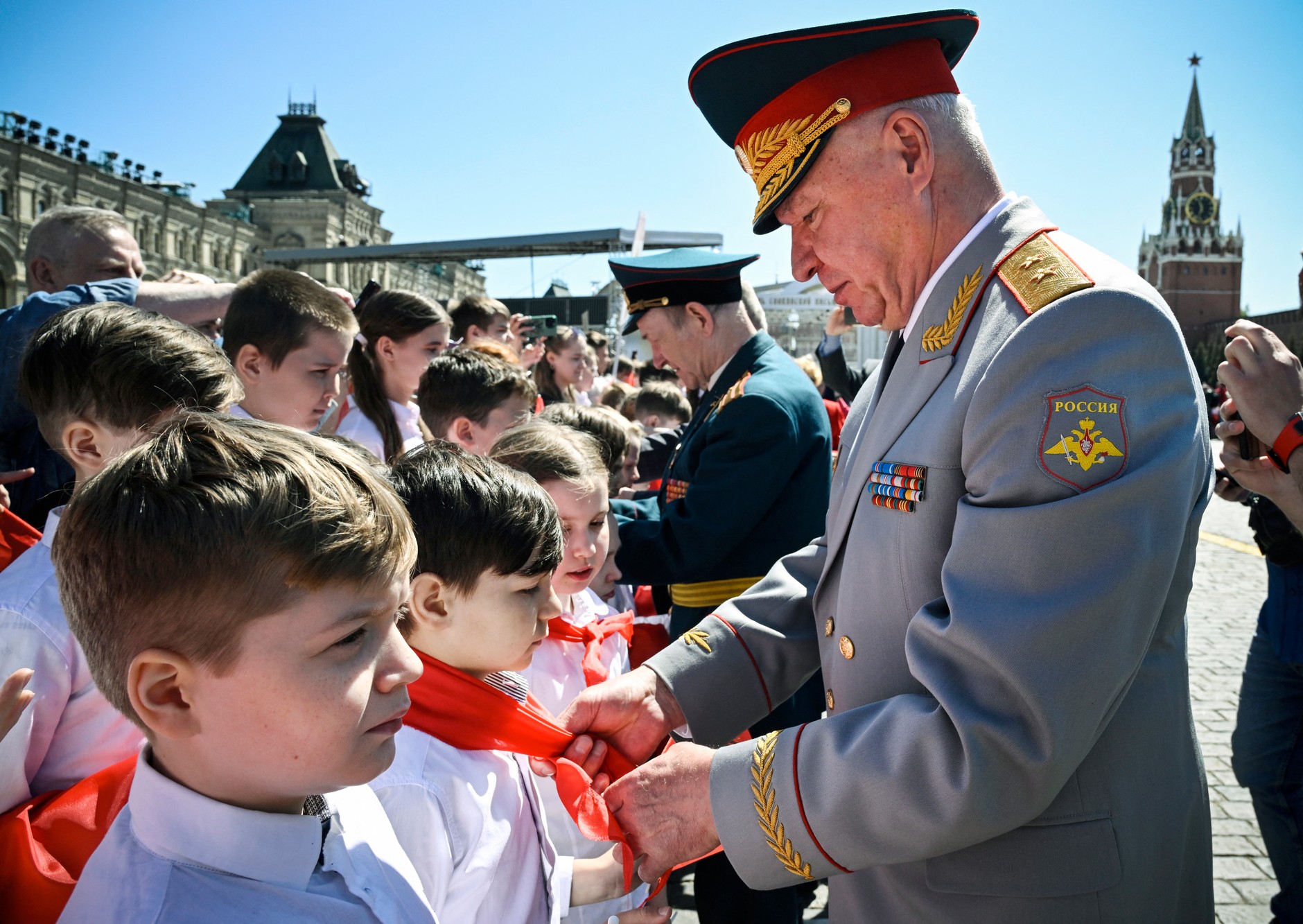
Children during a state ceremony in Moscow, May 19, 2024.Alexander Nemenov / AFP
— Nobody but my grandmother installed MAX, says Oksana from Moscow, a mother of two children. — The kindergarten told us to install it, but everyone uses Telegram instead.
Patriotism according to the Kremlin
Since September, kindergartens in 22 regions of Russia have been taking place “Important Conversations” classesduring which teachers use a specially developed textbook. According to the footnotes, each lesson has a purpose promoting “civic, patriotic and ethical” values.
Children are told that all countries except Russia are small. They are asked to imagine that they are “guards on the Kremlin walls” and “play soldiers.” Other chapters focus on friendship, “good deeds,” and polite language. “Russia has always defended its land and citizens against its enemies and has always won,” the curriculum for grades 10 and 11 states.
“Important Conversations” has been part of the curriculum for over three years. The classes focus mainly on patriotism and “service to the homeland and responsibility for its fate”, although they also touch on less political topics, such as responsible treatment of animals and conflict resolution.
One of the lessons for older students, titled “Russia – the country of winners”, focuses on the so-called “heroes of a special military operation”, which is the Kremlin's preferred term for the war in Ukraine.
“Russia has always defended its land and citizens from its enemies and has always won.” states the curriculum for grades 10 and 11. In it, the authors cite historical battles such as the Battle of Borodino during Napoleon's invasion of Russia, World War II and the ongoing invasion of Ukraine as symbols of Russia's “indomitable spirit.”
In the case of first-grade students, the wording is simpler, but the message is similar. “In the history of our homeland, there were many battles during which our ancestors had to defend their land. The enemy was never able to defeat them,” we read in the curriculum.
“Traditional values”
One teacher from Moscow, who asked to remain anonymous, says that much depends on the approach taken in individual schools. Some teachers can turn “Important Conversations” classes into really useful discussions without strictly following the guidelines. However, the interlocutor adds that there is inevitably a conflict between the Kremlin's ideological propaganda and the more humanistic values taught in Russian literature classes.
Another important event this year was visits of Orthodox activists to schools and universities. In St. Petersburg, the diocesan Center for the Protection of Maternity regularly reports on meetings with students on chastity, traditional values and the importance of large families.
During one such meeting, the students learned that “contraception doesn't work” and they were to “behave” for their husbands.
In Chuvashia, Father Boris, an Orthodox priest, told students that marriages break down because of premarital sex and that “love in marriage is when one partner sacrifices himself for the other.”
In a village in the Nizhny Novgorod region, 14-year-old schoolgirls looked at embryo models as part of a discussion about the place of women in the modern world.
The Sphere Foundation, a human rights organization, surveyed teachers and social workers and found increased pressure in schools on reproductive issues. “About 68 percent of respondents reported an increase in the activity of Orthodox representatives in schools and social institutions. Officially, these visits take place under the guise of spiritual and moral education, but the conversations focus on condemning abortion and sexuality.”
Juvenile “extremists”
The state also continues to punish students who express their political views or identity. In April, 15-year-old Sevastyan Sultanov from Tatarstan was banned from going out after curfew, attending public events and leaving the city without prior permission from the authorities for graffiti depicting murdered opposition leader Alexei Navalny.
In September, a Moscow teenager who kissed another young man was charged with endangering “public safety and morals” and promoting what officials called “propaganda of non-traditional sexual relationships.”
Meanwhile, state television repeatedly broadcast reports of teenagers accused of sabotage or terrorism. “Two students from Yekaterinburg were ordered online to set fire to a train,” one program reported, describing similar cases in Stavropol in southern Russia.
Since the beginning of the war at least 158 teenagers have been convicted of sabotage or terrorism-related offenses, and this number is likely to increase. At the end of October, State Duma deputies unanimously supported lowering the age of criminal responsibility for such crimes from 16 to 14, opening the way to life sentences.
Only one deputy, co-author of the bill and member of the Communist Party, Yuri Sinelshchikov, expressed doubts. “If a person does not understand the nature of the charge, how should he or she be punished?” he asked.
On the Internet, teenagers still react with dark humor. “If they block Minecraft, I will bite Roskomnadzor's cable,” reads one of the comments.
“Are we allowed to breathe?”.