Russia has been trying to destroy Ukraine since launching a full-scale invasion in February 2022 — although fighting in Donbas has been going on since 2014. The Kremlin's main attention is still focused on the Donetsk Oblast, which Ukraine still controls about 25%. However, since this is Ukraine's strongest defensive front, we should not expect much Russian progress in this area.
Currently, the last two large cities in Donbas that remain under Ukrainian control – Slovyansk and Kramatorsk – are located approximately 25 km from the front.
It is possible that Russia will reach the administrative borders of these agglomerations. Conquering them would tip the scales of victory in Moscow's favor. However, there is a huge “hole” in Putin's plan – one factor is key.
Only a few observers consider it likely that these two metropolises will be captured in the coming year. The prediction can be made based on the pace of progress of Putin's army in 2025.
In 2025, Russian troops occupied approximately 4,400 square kilometers of Ukrainian territory, i.e. 1%. the rest of the country, losing approximately 100,000. soldiers (only those killed). During the summer offensive, the Russians gained approximately 0.3 percent. area of Ukrainian territory. Their progress accelerated somewhat in the following months.
Nevertheless, it can be said that if the pace of progress of Putin's army continues in 2026, the Russians will not be able to achieve their main goal, which is to subjugate the entire Ukraine.
Therefore, 2026 may be another year of a devastating Russian-Ukrainian war, with each side supported by China and the West, respectively. A sudden change in Moscow's attitude is an unlikely scenario. The pro-peace party in the Russian elite would eventually have to triumph, but that does not appear to be the case for now.
Putin's plan for 2026? Another war of attrition
The probable scenario is as follows: Russia, as in 2025, will disperse its offensive activities to attack Ukraine where its defense lines and forces are the weakest.
The article continues below the video
Using this strategy, Putin's army is advancing in the southern Zaporizhia Oblast. He is also trying to create a breach in the Ukrainian defense in the central Dnipropetrovsk region. Therefore, it is likely that in 2026 the small cities of Huljajpole, Orichiv, Stepnohirsk, as well as Pokrovsk, which Ukrainians have been bravely defending for many months, will fall victim to Russian invaders.
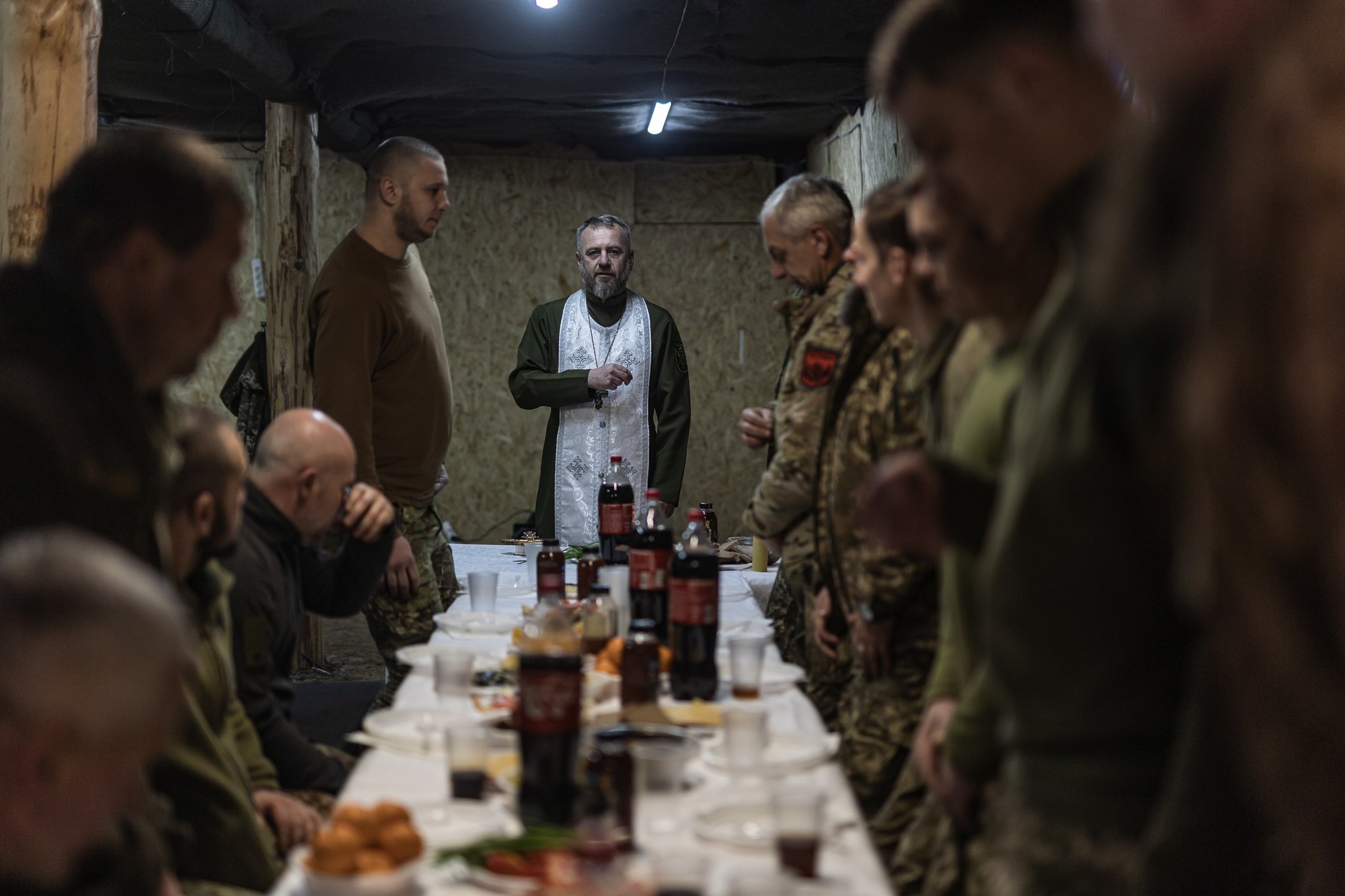
Ukrainian soldiers celebrate Christmas Eve near Pokrovsk, December 24, 2025 (illustrative photo)Diego Herrera Carcedo/Anadolu via Getty Images / Contributor / Getty Images
The key city of Zaporozhye, which has a population of 700,000 inhabitants, it would then be only 15 km from the front line. Pavlohrad (100,000 inhabitants) would, in turn, be within the range of drones and glide bombs. The city is only 50 km away from the front line.
Russia is also continuing its project of moving the border in the Kharkiv and Sumy oblasts under the guise of creating a “buffer zone”. This further increases the pressure on the Ukrainian army, stretching the front line as much as possible and straining the Ukrainians' ability to defend themselves.
In recent days, Putin's army has carried out several cross-border incursions in these two oblasts. It is quite possible that in 2026, a whole series of new “buffers” will appear near the border, but within Ukraine.
Ukraine, in turn, will most likely continue to exploit the enormous size of the Russian Federation, turning Russia's advantage into its greatest weakness. Russia is unable to effectively protect its entire territory, which makes it easier for Ukrainians to attack key installations throughout the country.
I’m Ashley Davis as an editor, I’m committed to upholding the highest standards of integrity and accuracy in every piece we publish. My work is driven by curiosity, a passion for truth, and a belief that journalism plays a crucial role in shaping public discourse. I strive to tell stories that not only inform but also inspire action and conversation.