How Fire Point became a strategic bet for Kyiv. The story of the most enigmatic defense company in Ukraine


Fire Point, a relatively young Ukrainian company in the defense industry, has in just a few years become one of the main suppliers of long-range attack drones for the Ukrainian military. At the same time, its rapid rise, massive funding and rocketry ambitions have drawn attention, but also controversy.
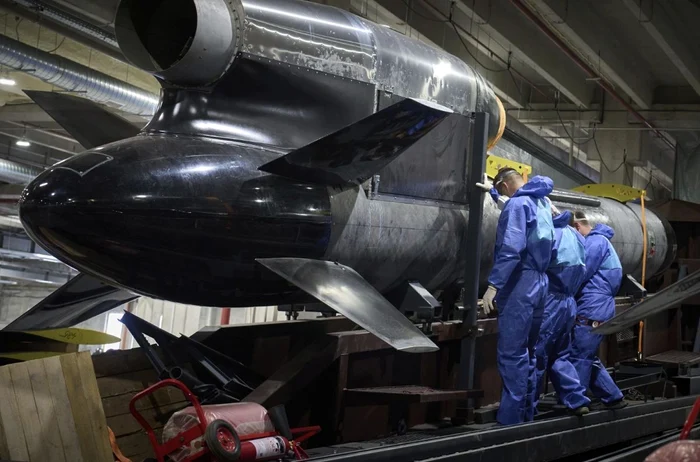
Flamingo rocket developed by Fire Point/FOTO:X
A discreet production, in crowded spaces
The visit to Fire Point's production facilities is strictly controlled. Journalists were shuttled between locations blindfolded and their time in the factories was limited. According to the technical director, Irina Tereh, only a small part of the real capabilities of the company could be presented.
In contrast to the promotional images, the production of the FP-1 drones takes place in cramped spaces, where the cases are stacked, including in corridors, and employees work very close to each other. Components are quickly assembled, tested, disassembled and shipped, arriving at the front within days.
According to the General Staff of Ukraine, the FP-1 is currently the main Ukrainian long-range attack vector, and production is set to reach hundreds of units per day.
The “cheap and mass” philosophy
Drones are made of simple materials, easily found in civilian life. Fire Point's strategy is to produce cheap weaponry in large quantities without over-reliance on very rare specialists or sophisticated technological chains.
In just three years, the company did not limit itself to assembling drones. It has developed its own engines, CRPA aerials for anti-electronic warfare navigation protection, rocket fuel, launch accelerators and even industrial machinery. In parallel, Fire Point began working on large rockets and their engines.
Rapid growth, financed including from the West
Fire Point has benefited significantly from external financial support. Contracts for the FP-1 are financed through the so-called “Danish model”, which allows Western states to pay directly for weapons produced in Ukraine. Germany, the UK and the Netherlands have publicly announced such funding.
The Ukrainian authorities actively promoted the company in discussions with Western partners, and Fire Point became one of the companies repeatedly presented to foreign delegations.
From discretion to public exposure
For a long time, Fire Point was one of the most closed private companies in the defense sector. The situation suddenly changed after the emergence of suspicions of indirect links with a central figure in a corruption case in the energy sector.
Although there is no direct evidence of illegal ties, the company has been forced to go public, hold lengthy press conferences and respond to the allegations. Fire Point also requested the correction of some international press articles that it considered inaccurate.
From drones to missiles
Fire Point is best known for its “deep strike” drones, used for strikes on Russian territory. Although only a small fraction reach the target, they force Russia to invest considerable resources in the defense of critical infrastructure.
But the company also attracted attention by presenting the FP-5 “Flamingo” missile, an ambitious project designed according to the same principles: simple technology, low cost and potentially high production. The missile has a very large payload, but uses repurposed Soviet engines and a relatively basic navigation system.
Specialists warn that the missile is still experimental, visible to Russian radars and far from being a “game changer”. Representatives of the Ukrainian military confirmed that the project is in an early testing phase.
Questions without a clear answer
Fire Point's rapid success, hundreds of millions of dollars in contracts and consistent political support have raised questions about the selection criteria and level of control. Officials involved in procurement, however, claim that the company delivers on time, has real production capabilities, and there are no official complaints about product quality.
Fire Point plans to expand its operations in Europe, including building a rocket fuel plant in Denmark, and partially open the FP-1 design to other Ukrainian manufacturers.
A test for the defense industry of Ukraine
The Fire Point case illustrates both the potential and vulnerabilities of Ukraine's war-torn defense industry. The balance between speed, efficiency, transparency and control remains fragile.
For Ukraine and its Western partners, the stake is that massive investments in armaments translate into real advantages on the battlefield, without military development being undermined by political scandals or a lack of oversight.