China is spoiling Putin's expansion plans, but the Kremlin does not want to admit it


On December 15, 2025, Liu Sensen, an analyst from Shanghai, published an article on NetEase, one of China's key information platforms. NetEase does not publish content that is contrary to China's main strategic interests, so even critical texts carry great weight there.
Liu Sensen explains how Russian destabilization creates a vacuum, opening the field for strategic actions by Beijing. The text is not an official position of the Chinese government, but it reflects the range of acceptable opinions about Russia, its role in the region and China's position – so it is worth looking at and understanding carefully. This is a signal of what China really wants. Beijing is preparing for the worst, because the US and Japan also view Russia pragmatically.
Liu Sensen immediately determines the scale of the problem: Russia's Far East covers almost 7 million square kilometers, or nearly 40 percent. territory of the country, and less than 8 million people live there and this number is falling. “The region is vast but almost empty, and the war against Ukraine has only deepened the demographic crisis: combat-ready units have been sent west and the military presence in the Far East has been reduced to a minimum,” the text reads. Liu warns that “if Russia ever experiences an internal disruption, this strategic region will be at risk.”
The article continues below the video
The contrast with China's northeast is striking — over 100 million people live on the other side of the border in a region with developed infrastructure and a strong economy, which highlights the huge differences in mobility and human capital. Liu recalls that in the 19th century, territories were incorporated into empires through force and unequal treaties, which strengthened control but left regions vulnerable if central power weakened.
Liu emphasizes the strategic importance of the region. “This territory with an area of 7 million square kilometers must not be lost under any circumstances. China sees this area not only as an economic resource, but also as a political arena to expand its influence, especially over key regions such as Primorsky Krai, Ussuri and Sakhalin,” we read. External actors are also important: — The USA and Japan are closely monitoring Russia's Far East. China must prepare for the worst. Liu points to the active interest of Washington and Tokyo, which forces Beijing to strengthen its presence and economic control through energy and infrastructure projects as tools of influenceThe analyst argues that the illusion that the problem can be “waited out” or solved with concessions from Ukraine only brings scenario of global instability.
China's pragmatic integration
Liu emphasizes that “control over flows, infrastructure and markets is more important than formal sovereignty.” The point is that China systematically includes the region in its strategy.
One third of Russia's coal and water resources, 30 percent forests, as well as gold, diamonds, platinum, oil and gas, are drawn into China's economic and strategic logic. Yakutia supplies 25 percent. world diamond production, and the Kovykta gas field contains 1.8 trillion cubic meters. gas.
China signs long-term contracts and builds infrastructure: The Power of Siberia gas pipeline supplies up to 380 billion cubic meters. gas per year, and the memorandum signed in 2025 provides for the construction of Power of Siberia 2, which is to pump 50 billion cubic meters. annually through Mongolia. Implementation depends on trade agreements, financing and construction, and deliveries could realistically start no earlier than 2030-31. Liu emphasizes that China retains flexibility and control over key resources. “Today, China has enough economic and strategic assets to strengthen its position in this territory. Control over key resources is more important than nominal status,” we read.
China's infrastructure investments go beyond energy: it is actively involved in building roads, bridges, ports and local enterprises, providing technology, jobs and putting the yuan into circulation more broadly. This creates de facto control over the region's economy and becomes an important tool of political influence without formal annexation..
The internal fragility of the Russian Federation and the Budanov map
It is also important to understand that China is already using Russia as an intermediary state. At the same time, they are modernizing their military potential and gradually increasing their political and economic presence in the Russian Federation. Control over resources, infrastructure and strategic points is quietly expanding. The current Kremlin regime and inherited imperial logic leave no room for the democratization of the Russian Federation or for the sustainable economic and social development of its regions. The center focuses not on development, but on maintaining control, which condemns the periphery to degradation, dependence and growing internal tensions.
In this context, the famous map of Budanów takes on a new meaning. Formerly considered a meme or trolling, it is neither about imaginary boundaries nor fantasy. The map shows the internal structure of the Russian Empire, showing that it consists of different regions with different economic, ethnic and historical characteristics. It indicates where the Kremlin has real power and where regions are potentially weak and autonomous, susceptible to destabilization if the central authority is weakened.
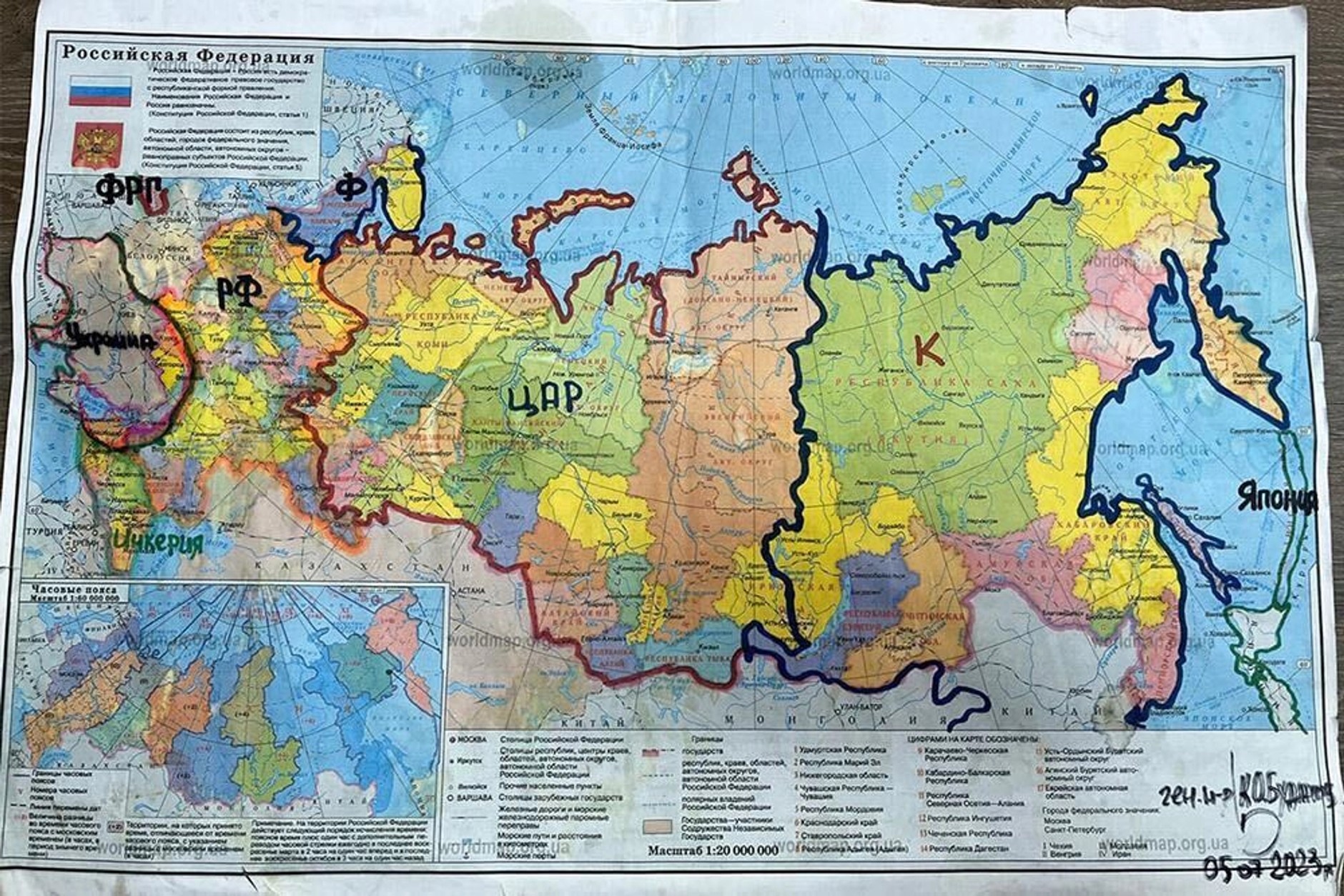
Map of Kyrylo Budanov (head of the Main Intelligence Directorate of the Ministry of Defense of Ukraine) taking into account the potential division of the Russian Federationmat. press releases
Indeed the map visualizes points of tension and possible breakdowns: areas where conflicts, civil wars, local separatism or other crises may arise. In other words, the Russian Federation is held together only by the centralized power of the Kremlin, which is increasingly strained by the war in Ukraine, as the criminal regime has diverted all its resources to achieving the goals of the so-called “special military operation”.
It's only a matter of time and form: civil wars, internal conflicts on the periphery and palace coups in the Kremlin can at any time trigger a chain reaction of disintegration. In this context, US attempts to manage the region to its own advantage through territorial concessions or de facto sacrificing Ukraine's sovereignty to Russia seem dangerous, illusory and bloody. Continuing such a policy will only weaken the West's position and sharply increase existing threats in Europe.
For the West, an active approach is key.
The illusion that the problem can be “waited out” or resolved with concessions from Ukraine only brings closer the scenario of global instability.. Support for Ukraine, preparation for the potential fragmentation of the Russian Federation, and coordination with allies in the region have nothing to do with morality or good will. This is a matter of Europe's long-term security, the transatlantic alliance and the ability of the US and the EU to oppose Beijing's monopolistic ambitions in a region crucial to world stability.