Many pro-Putin stars in Russia use Instagram to make money, although the Meta company is banned in the country / What new name the network received


The situation of Facebook and Instagram in Russia is a bizarre one. Although the company Meta, which owns the two platforms, is considered “extremist” and has been banned by law in the country, many Russians continue to use them with the help of VPNs. Moreover, pro-Putin celebrities in Russia publish sponsored posts on Instagram from which they receive substantial income.
The company Meta Platforms Inc., the owner of Facebook and Instagram, was classified as an extremist organization and banned on the territory of the Russian Federation by the decision of the Tverskoi Court in Moscow on March 21, 2022, almost a month after the beginning of the invasion of Ukraine.
The reason cited by the judges was that Andy Stone, a representative of the company Meta, said on his Twitter account on March 11, 2022, that the company “temporarily allowed the expression of the death wish for the presidents of Russia and Belarus, Vladimir Putin and Aleksandr Lukashenko, as well as calls for violence against the Russian military involved in the Russian invasion of Ukraine.”
Stone was also sentenced, in absentia, by a Russian court to 6 years in prison for “publicly justifying terrorism.”
Currently, Instagram is officially blocked on the territory of the Russian Federation, and the mention of its name in videos, podcasts and publications on the Internet must be accompanied by a footnote stating that “Meta is considered an extremist organization on the territory of Russia.”
Wishes for Putin, published on an “extremist” network
However, many stars in Russia, even those invited to the concerts of “Pervîi Canal”, the main state television in Russia, and to events in the Kremlin, use this network extensively. Here are some examples.
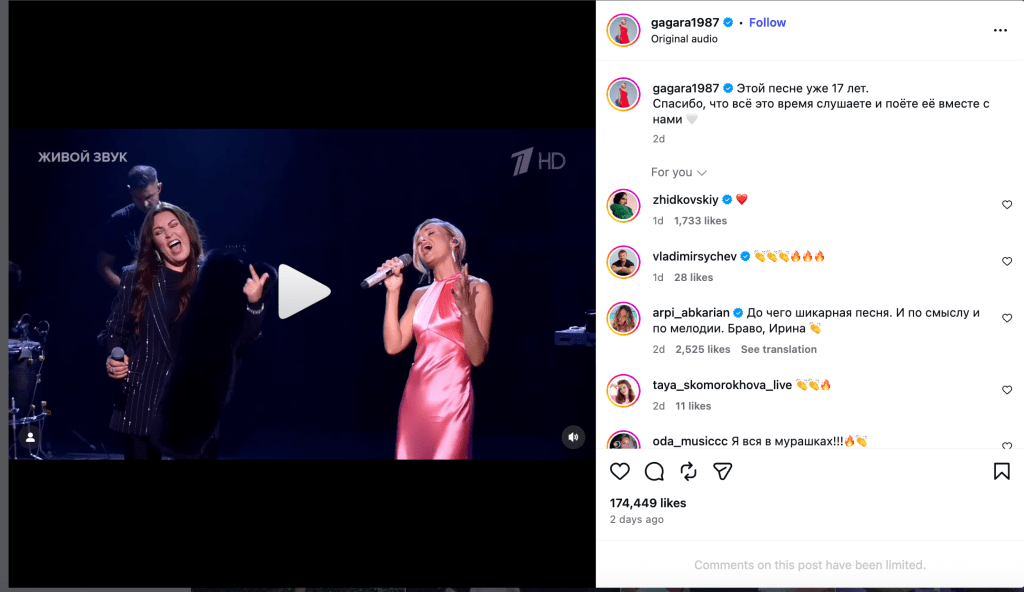
Singer Oleg Gazmanov is one of the well-known voices of the Kremlin, who, after the invasion of Ukraine, revived an older, more patriotic song called “Officers”.
Gazmanov has repeatedly expressed his support for Putin and his country's military actions in Ukraine. He actively publishes sequences from his concerts broadcast by federal TV stations, but also sends messages to Putin on the occasion of his birthday. “Happy birthday, Mr. President!
May God grant you health, patience and will to lead our country to Victory with dignity!”, writes Gazmanov on Instagram in a post to which is attached a video including Russian soldiers participating in Russian aggression in Ukraine.
On Instagram, Gazmanov congratulates Russians on both Constitution Day and the Great October Revolution Day.
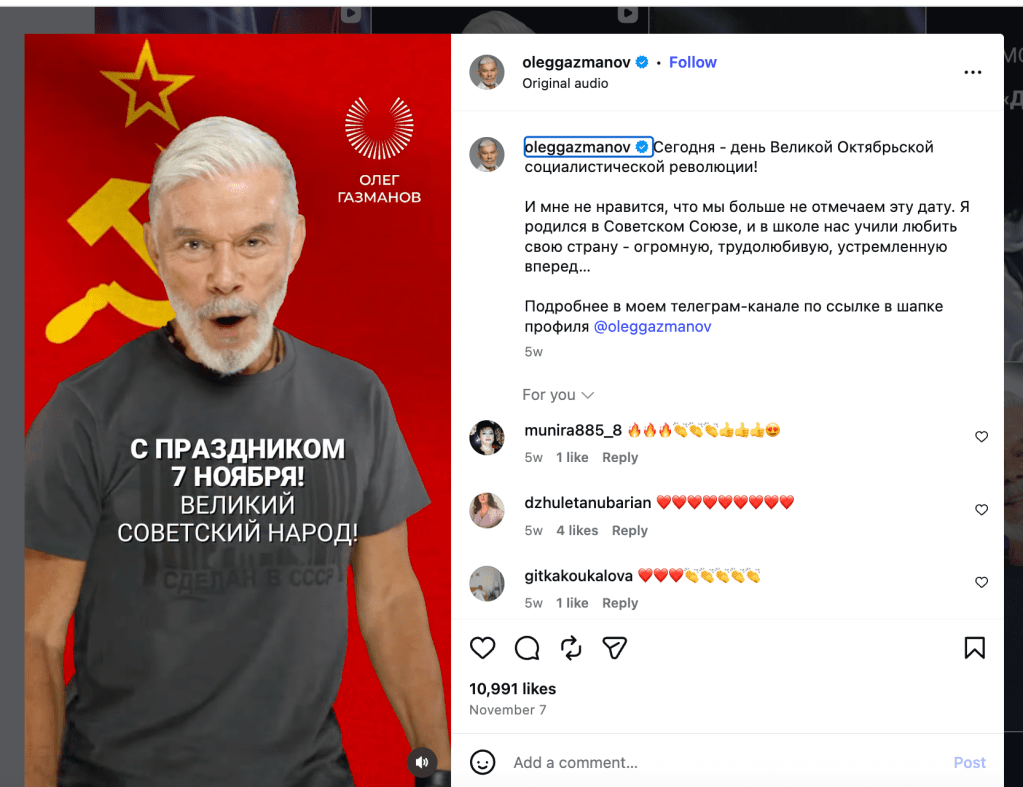
The singer Shaman became popular in Russia after the start of the war, thanks to his songs that practically glorify the war in Ukraine.
Shaman, whose real name is Yaroslav Dronov, became famous especially for the song “I'm Russian” which has collected over 44 million views on his YouTube channel.
Recently, during a concert, Shaman played this song, and at the end he pressed the “red button”, brought in a black box. According to several experts and commentators, the moment, which was greeted with cheers from the public, represented an allusion to atomic weapons, which Russian propaganda is increasingly discussing.
Even so, he did not give up using Instagram, a network considered extremist by the Kremlin. Also on this platform, the Russian singer announced his wedding with Ecaterina Mizulina, who is the president of the “League for Safe Internet in Russia”, the organization that “banned” several public figures, including because of their “inconsistent” attitude towards the Russian authorities. It is important to note that the wedding of the two took place, symbolically, in Donbas, the intentional thing mentioned in the Instagram post. The two were dressed in clothes similar in color to military uniforms.
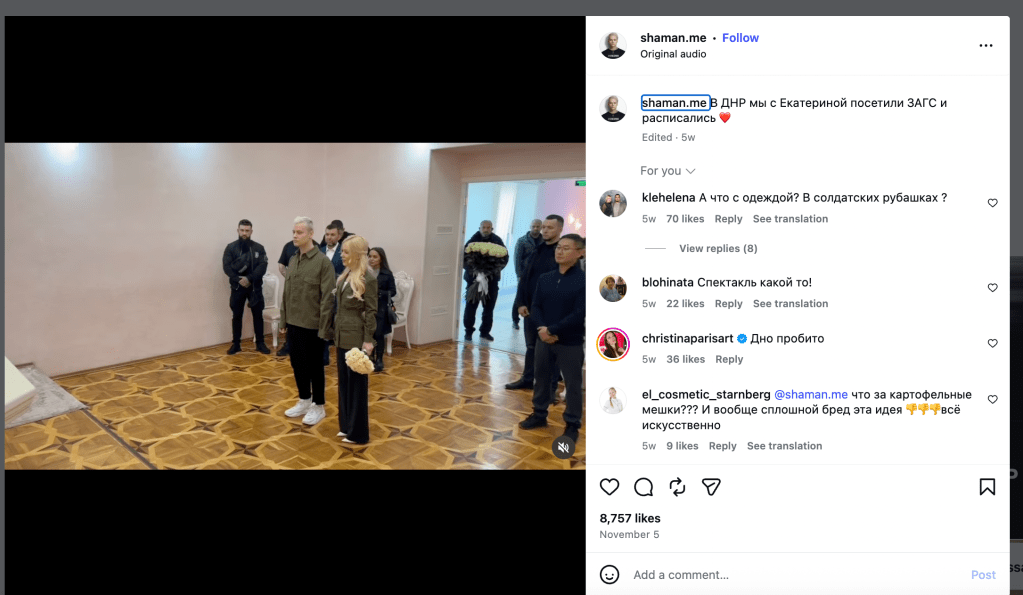
Another popular singer is Polina Gagarina, who recently became a member of the Presidential Council for Culture and also performed at concerts organized directly by the Kremlin, on the occasion of Russia Day and National Unity Day. And she is also very active on Instagram. On her account, Polina Gagarina publishes sequences from her concerts, including those broadcast by “Pervîi Canal”, but also congratulates the Russians on “Victory Day”, a holiday used by Russian propaganda to emphasize the so-called military superiority over the West.
Journalist Ksenia Sobchak is the founder of a media holding, with a YouTube channel that has over 4 million subscribers, as well as several Telegram channels, actively uses Instagram.
Sobchak is the daughter of the former mayor of St. Petersburg, close to Putin, and a former presidential candidate in 2018. Sobchak's Instagram account has 10 million subscribers. There, the journalist publishes sequences from interviews, photos and videos from everyday life, but also actively places advertising.
It is true that, in his interviews, where the word “Instagram” is mentioned, every time a note is added about the fact that “Meta is considered an extremist organization in Russia”. Even so, practically all of his guests mention this network as part of public life in the country.
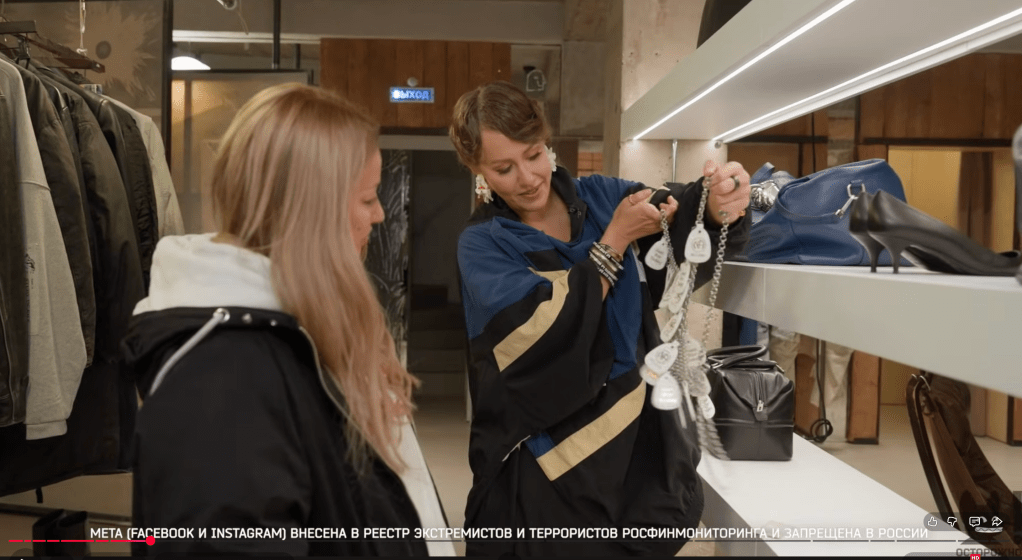
A new name for Instagram
However, in several shows, but also on social networks, some people decided not to mention the name Instagram and call the network “prohibited gram”/zapreshenogram, which means in Russian – forbidden-gram.
Incidentally, on the social network “Vkontakte” in Russia, which was supposed to replace Facebook and Instagram, some users urge followers to visit their “forbidden-gram” accounts as well.
Putin banned advertising on Instagram. No effect YET
In April, Putin signed a law banning advertising on Instagram. The explanatory note noted that some Russian citizens continue to use Instagram and Facebook by circumventing the ban, which “creates for the owners of these illegal information resources the opportunity to obtain income from the dissemination of advertising, which, in the total receipts, can represent between 50 and 90%.”
“The obtaining of advertising revenue by the owners of illegal information resources allows them to create new content, including prohibited information, and to maintain the interest of users in their resources,” the law's information note also says.