If you've ever driven on any of the many highways that crisscross the world, you've probably seen one of the truck emergency ramps. Some emergency ramps slope upwards. Others are flat. Some have sand, others gravel.
Regardless of their design, they all serve one purpose: to safely stop vehicles with faulty brakes.
Read also: Elon Musk said he would sell everything. But his empire is growing faster than ever

Emergency ramps are crucial to highway safety
|
Business Insider
How does a truck rescue ramp work?
When designing a new ramp, authorities take into account road-specific factors such as slope and road conditions at the foot of the hill.
While they may look different depending on your location, rescue ramps from around the world have a few things in common. Most ramps use braking surfaces, sand or gravel pools.
The base material is selected for its low coefficient of interparticle friction, which means that when a wheel or axle touches the ground, the overlying material moves away from itself, allowing the truck to sink.
Like swimming pools, rescue ramps are shallow at the beginning, starting at 7.5 cm deep. They become deeper and deeper, and at 30-60 meters they are about 1.2 m deep. When the truck hits the ground, it initially encounters little resistance, which increases as it travels further.
This means the truck slows down gradually, reducing the risk of driver injury, rollover or rollover.
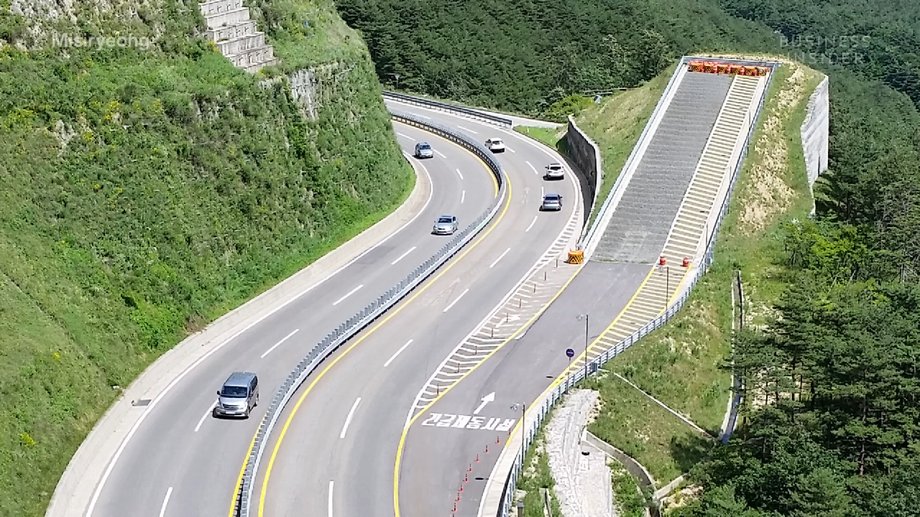
Rescue ramps are a simple idea that stops 40-ton trucks
|
Business Insider
Types of emergency ramps
There are three types of ramps:
- ramp with sand surface,
- gravity ramp i
- mechanical ramp.
Here is the ramp with a sand surface. This type of rescue ramp contains loosely arranged rows of sand placed perpendicular to the direction of travel.
When the truck collides with the pile, the truck's energy is transferred to the sand.
When sand is thrown at high speed, an equal and opposite force acts on the truck, reducing its speed. However, the collision with the pile is bumpy, which puts the driver at greater risk of injury.
This takes us to gravity rampsj, distinguished by a gradually increasing slope. In addition to the friction of the material on the road surface, gravity acts on the truck, pushing it down and backward.
An inclined gravity ramp is more effective than a flat ramp. Slope at an angle of 10%. helps the truck stop up to 25 m earlier.
Gravity ramps are most profitable to build in places where there are natural hills near the road. In some areas, it is simply not possible to build a gravity ramp.
Read also: Overload breaks pilots' spines. This is how catapulting works [WIDEO]
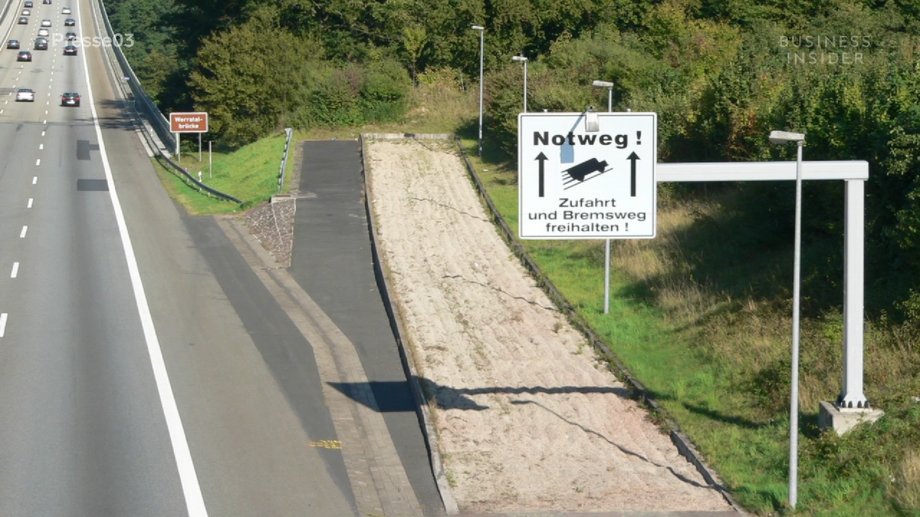
These gravel strips along the highway are not accidental
|
Business Insider
Stopping trucks safely. Sometimes it's a one-way trip
Therefore, the authorities turned to a more experimental form rescue ramp. The mechanical ramp can be installed on flat ground or even on downhill slopes.
Unlike other structures, this ramp has no floor. Instead, it contains stainless steel meshes that absorb the impact energy of the truck.
Like a tight rubber band, the force exerted on a truck increases exponentially with the distance the vehicle travels.
A mechanical ramp can stop the truck faster than a ramp with gravel or sand.
Entering the braking ramp is a one-way trip for trucks. If the ramp operates properly, the truck will be submerged in the material or damaged and will need to be towed.
Despite the high costs, authorities are encouraging truck drivers and other drivers to use emergency ramps.