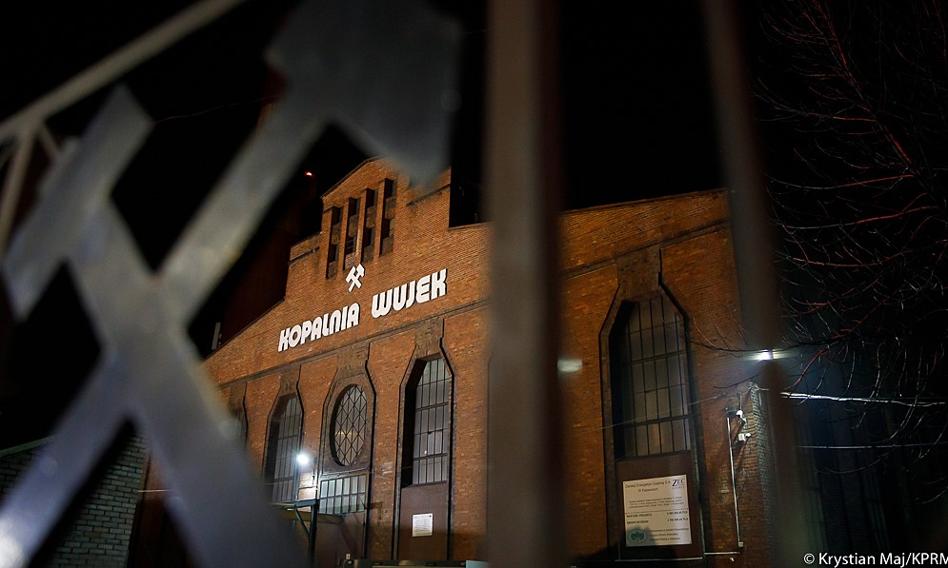
The Wujek mine disappears from the map. The city has an ambitious plan for 100 hectares of land

2025-12-20 12:00
publication
2025-12-20 12:00
The local government of Katowice announced a competition to develop an urban concept for the redevelopment of 100 hectares of land after the Wujek mine and around the plant. The liquidation of Wujek is to begin soon, and then the revitalization of this part of the city will begin.
According to the Katowice city hall, the competition just announced concerns the area bounded by railway tracks to the south and west, Ligocka and Mikołowska streets to the east, and the A4 motorway to the north. Applications to participate in the competition can be submitted until January 14, while local authorities will wait until March 2 for competition entries.
The Mayor of Katowice, Marcin Krupa, reminded that the city has extensive experience in the revitalization of post-industrial areas. A decade ago, the land of the former Katowice mine, which operated in the 1990s, became a Culture Zone with the buildings of the Polish National Radio Symphony Orchestra, the Silesian Museum and the International Congress Center. A gaming and technology hub will soon be built on the former Wieczorek mine site in another part of the city, and the local authorities want to build a municipal swimming pool on the plots that once belonged to the Boże Dary mine.
Today, we must ensure that numerous post-industrial areas are used in the best possible way for the next generations of residents of our city. The announced competition is intended to be a starting point for discussions on the development of the areas of KWK Wujek and the vicinity of this mine – said the president, quoted in the press release.
The Wujek Mine is a symbol of the city
The Wujek Mine is a symbolic place of special importance for the city. The miners who went on strike at this plant at the beginning of martial law were brutally pacified on December 16, 1981. Nine of them died from ZOOM bullets. The memory of the victims is maintained by the Silesian Center for Freedom and Solidarity, which operates in the former mine buildings, which – as local government officials point out – already has a strong impact on the neighborhood of this place.
“However, due to the need to shape new connections with the surroundings, the studios participating in the competition are required to propose urban solutions for an area covering 100 hectares,” added local government officials. The local authorities want this place to be modern and green, with respect for the historical and cultural heritage, to be alive and attract people.
As announced by Jerzy Pogoda, head of the spatial planning and urban planning department at the Katowice City Hall, vice-chairman of the competition jury, when assessing the competition entries, the following criteria will be taken into account: the quality of the proposed spatial solutions, the economics of these solutions and the quality and degree of advancement of pro-ecological elements.
In addition to the city representatives, the competition jury also includes representatives of: the Silesian Center for Freedom and Solidarity, the Polish Mining Group, KWK Staszic-Wujek Ruch Wujek and the Silesian Branch of the Society of Polish Urban Planners in Katowice. The winner of the competition, in addition to the financial prize, will also be invited to negotiate a contract for the preparation of a draft local development plan based on the winning entry.
The Wujek Mine has over a hundred years of tradition. At the beginning of 2021, it was connected with the Murcki-Staszic plant, creating the current Staszic-Wujek combined mine. Mining in the Wujek operation was completed in 2021. According to information from Polska Grupa Górnicza, its liquidation – based on the amended mining act by PGG's own forces – will begin in the second quarter of 2026.
Signed by the president on December 15 this year. The amended Mining Act allows mining companies to independently liquidate mines and cover miners who leave their jobs with protective benefits. The Act also allows for the transfer of property related to closed-down plants, among others. local government units as donations. (PAP)
kon/ mtb/ mrr/