December 19, 1984
The Plenum of the Oktyabrsky District Committee of the CPSU approved the results of the October (1984) Plenum of the CPSU Central Committee and determined the tasks of the district party organization arising from the decisions of the Plenum.

It was noted that after the March (1965) Plenum of the CPSU Central Committee, tens of millions of rubles of capital investments were allocated for the development of agriculture in the region. The main agricultural production assets increased 1.6 times compared to 1975. The energy output of labor increased by 1.3 times.
Average annual volumes of agricultural products increased from 10.5 million rubles in the ninth five-year plan to 13.6 million rubles in the tenth.
The plenum obliged the district party committee and primary party organizations to raise the level of party leadership in land reclamation and improve organizational and political work among land reclamation workers.
December 19, 1948
The newspaper “Birobidzhan Star” (12+) on December 19, 1948 wrote that in the red corner of the locomotive depot of the Birobidzhan-II station during the lunch break there was a concert (6+) by the soloist of the State Order of Lenin of the Academic Bolshoi Theater of the USSR Pyotr Tikhonovich Kirichek.
“The concert program included arias from operas, songs by Soviet composers, Russian and Ukrainian folk songs. In the evening, Comrade Kirichek performed at the railway club, where he gave a big concert.”
December 19, 1956
The Birobidzhan Star newspaper reported that the number of innovators in the region is growing. One of the articles gives an example of senior fireman Strechin, working at the Khinganolovo plant; he designed an electrical contact pressure gauge that improves the safety of boilers:
“A team of innovators, which includes the technical manager of the power plant, Comrade Teplov, the shift manager, Comrade Antonievsky, and the head of the boiler room, Comrade Nikitin, is now developing a method for collecting cooled water and directing it into the circulation system.”
In the note of the spinning and weaving factory technician B. Illarionov, “The ranks of innovators are growing,” it is said that in 1956, 35 workers and specialists made 50 proposals aimed at improving production, increasing labor productivity, more efficient use of equipment and introducing the experience of advanced workers.

Day in the history of the Jewish Autonomous Region. Photo: Photo: Regional Library
“The proposals of innovators provide 22 thousand rubles in savings. In addition to the implementation of the proposals of our innovators, the most valuable improvements made at other enterprises are borrowed. Thus, clutches in carding machines have been improved, which allows saving 5.5 thousand rubles annually. The reserves of our enterprise are far from exhausted. Identifying and using them will significantly increase the productivity of labor and equipment, save tons of coal, hundreds of kilowatt hours of electricity. We are working on this now The factory innovators are working.”
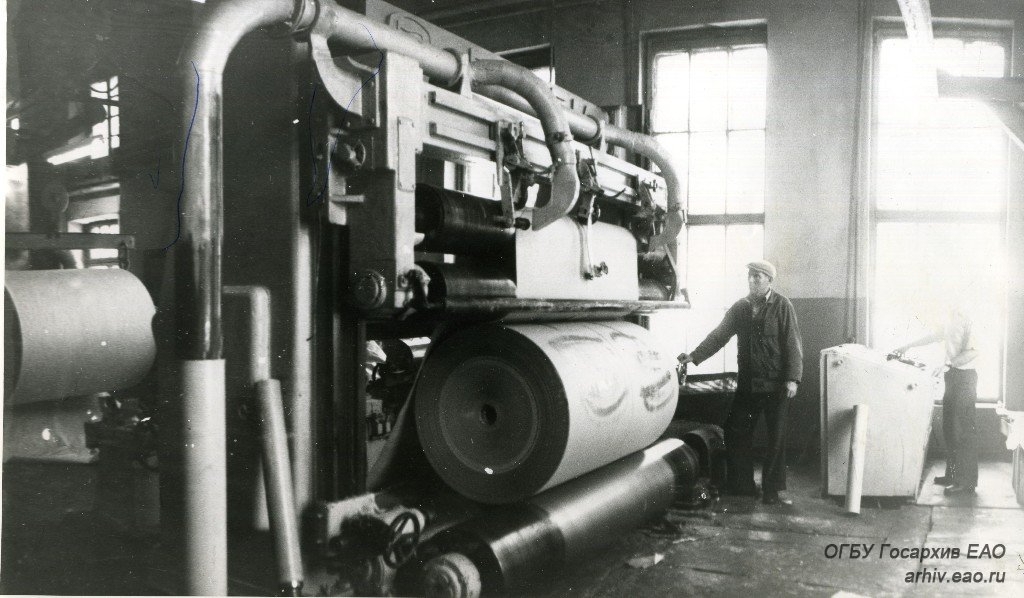
Workshop of the Birakan paper mill in 1978. Photo: Photo: State Archive of the Jewish Autonomous Region
December 19, 1967

Day in the history of the Jewish Autonomous Region. Photo: Photo: Regional Library
The newspaper “Birobidzhanskaya Zvezda” on December 19, 1967, in the article by Ts. Tsyrulnik “Above-Plan Paper Is Going” wrote about exceeding the plan at the Birobidzhan paper mill:
“From the outside it seems surprising: in just 1.5 hours, waste paper is converted into rolls of wrapping paper. This is the result of a high level of production and skillful organization of labor. The papermaking machine is operated 23.6 hours a day and moves at a speed of 140 meters per minute. Papermakers have successfully fulfilled their obligations in honor of the 50th anniversary of the Great October Revolution and continue to work ahead of schedule. Over 11 months, labor productivity has increased by 2.4 percent against the plan. More than 10 thousand rubles of excess profit were received.”
December 19, 1999
The first wooden church with a bell tower, built in the region according to Orthodox canons, was consecrated by Bishop Mark of Khabarovsk and Amur on December 19, 1999, the day of the patronal feast.

Church of St. Nicholas. Photo: Photo: Orthodoxy of the Jewish Autonomous Region
Shrines of the Temple of St. Nicholas – Icon of St. Innocent, Metropolitan of Moscow and Kolomna with a particle of his relics; an ark with particles of the holy relics of the venerable fathers and elders of Optina Leo, Macarius, Anthony, Hilarion, Ambrose, Anatoly I, Isaac I, Barsanuphius, Anatoly II, Nektarios. A large temple image of St. Nicholas the Wonderworker, 17th century (a gift from Bishop Joseph of Birobidzhan and Kuldur for the 10th anniversary of the consecration of the temple in 2009). An exact Athonite copy of the miraculous icon of the Mother of God “Quick to Hear” (a gift from Bishop Joseph in 2009).
December 19, 2002
The newspaper “Birobidzhan Star” wrote on December 19, 2002 that a meeting of Russian and Chinese border representatives was held in Birobidzhan. At this meeting, the results of 2002 were summed up, and the situation with border violations on a more than 500-kilometer section of the border between the Jewish Region and the Chinese counties of Minshan and Tongjiang, Heilongjiang Province, was analyzed.
The same newspaper published news that employees of the regional department of internal affairs were presented with state awards for their courage, bravery and dedication in the performance of their official duties in the North Caucasus region.
December 19, 2006
On December 19, 2006, the newspaper “Birobidzhanskaya Zvezda” published information on the front page of the newspaper that the heads of state of the Russian Federation and the People's Republic of China agreed to consider a project for the construction of a railway bridge across the Amur, which would connect the Russian village of Nizhneleninskoye and the Chinese city of Tongjiang.
The same article also states that a private investor intends to build a mining and processing plant in the Jewish Autonomous Region and invest in social infrastructure. Rubicon LLC, a subsidiary of the Russian company Aricom, intends to invest in the development of the project and construction of the Russian part of the bridge in full.