Greece is no longer Europe's chain. She pays off her debts faster than she promised. Investors are looking at Athens with interest again


Over the years, mostly negative financial news has come from Greece. However, this week, a remarkable success story unexpectedly came from Athens: the country had repaid loans from the first rescue package to its eurozone partners in the amount of EUR 5.3 billion (PLN 22,339 million) – ahead of schedule.
These debts, dating back to 2010, i.e. directly from the period of the public debt crisis, were to be repaid only after 2031. Thanks to the early repayment, the government saves, as it claims, approximately EUR 1.6 billion (PLN 6,744 million) in interest costs – and at the same time announces a reduction in the debt ratio below 120 percent by 2029. GDP.
This repayment is not an isolated incident, but part of a strategy.
Since 2022, Greece has prepaid a total of almost EUR 30 billion (PLN 126,447 million) of crisis loans, thus saving approximately EUR 3.5 billion (PLN 14,752 million) in interest. The goal is to systematically improve debt servicing capacity and flatten the interest burden curve.
The contrast to the initial situation could not be greater. Let us recall: in 2009, a new government came to power in Athens, which stated that its predecessors had “embellished” public finances for years. The budget deficit and debt were much higher than reported. Investors lost confidence, yields on Greek government bonds soared, and Greece was no longer able to finance itself on the capital market.
The time has come for the so-called a troika consisting of the European Commission, the European Central Bank (ECB) and the International Monetary Fund (IMF). In the years 2010–2015 it has prepared three rescue packages with a total value of approximately EUR 280–290 billion (PLN 1,200 billion). The aid came with stringent conditions: Athens had to cut pensions, lay off state workers, raise taxes and privatize state-owned enterprises – a radical package of austerity programs and structural reforms.
The economic consequences were dramatic. The Greek economy shrank by more than a quarter, unemployment temporarily rose to over 25% and was even higher among young people. Hundreds of thousands of people left the country. The crisis policy was met with mass protests and general strikes. Meanwhile, the situation became critical and emerged threat of “Grexit” — Greece's withdrawal or expulsion from the euro area.
Greece is bouncing back
In 2012, the debt of private creditors was reduced: banks and insurers had to give up some of their receivables. However, because gross domestic product declined so sharply, the debt-to-economic performance ratio remained extremely high. It was only in 2018 that Greece left the last aid program and began to finance itself again through the capital market. However, the stigma remained for a long time: the highest debt ratio in the euro zone, junk rating, banks in crisis.
Today the situation is completely different. At the height of the coronavirus pandemic in 2020, the debt ratio was still around 210%. GDP, and has now fallen to approximately 150 percent. — which is a decrease of over 50 percentage points. The current early repayment is part of this trend: by 2027, this rate is expected to fall below 140%, and by 2029 below 120%.
The article continues below the video
Also in terms of economic growth Greece is no longer the ball and chain of the eurozonebut rather a positive example. The Organization for Economic Co-operation and Development (OECD) and the European Commission expect growth of over two percent in 2025 and just above that in 2026 – both well above the average for the monetary union.
The improvement in the situation was also reflected in the ratings of rating agencies. Greece has gradually returned to the investment league.
Ratings agency S&P re-rated it investment-grade in 2023, with additional agencies following suit in 2024 and 2025. Moody's recently joined them. A symbolic highlight is the fact that the Greek Minister of Finance now serves as President of the Eurogroup, the group of eurozone finance ministers. Just a few years ago, Greece was a problem there, and today the country is the president: from a child causing trouble, she has become the president of the class.
This turn is particularly visible in the stock market. The most important indicator for the Greek stock market is the MSCI Greece index, which reflects the situation of large and medium-sized enterprises. If you look at recent years, taking into account dividends, i.e. the so-called total return, you can see a real swing in sentiment: in 2018, a decline of 36%, in 2019, an increase of 44%, and in 2020, a decline of 27% again.
Then the mood changes: in 2023, the index increases by almost 50%. and this year it is again growing by about 80 percent. On a one-year basis, MSCI Greece records a total return of over 82%. Over three years, this translates into an annual rate of return of over 46 percent, and over five years, almost 28 percent. annually.
The risk still remains
However, the long-term story remains difficult. Over a 10-year period, the index reaches approximately 10%. return per year – roughly the same as the MSCI World global equity index over the same period. However, over a 15-year period, MSCI Greece continues to record losses – on an annualized basis, they amount to almost seven percent per year. Those who invested during or shortly after the crisis have, in many cases, still not fully recovered from their losses.
Nevertheless, the current trend is clear: Greece makes an impressive comeback. You can invest on a relatively large scale.
Early repayment of aid loans is possible more than a symbolic gesture. It shows that Greece is able to repay its debt: the country runs a budget surplus, i.e. it has more revenues than expenses, if interest payments are not taken into account. At the same time, Athens is finding investors who buy new government bonds on quite reasonable terms.
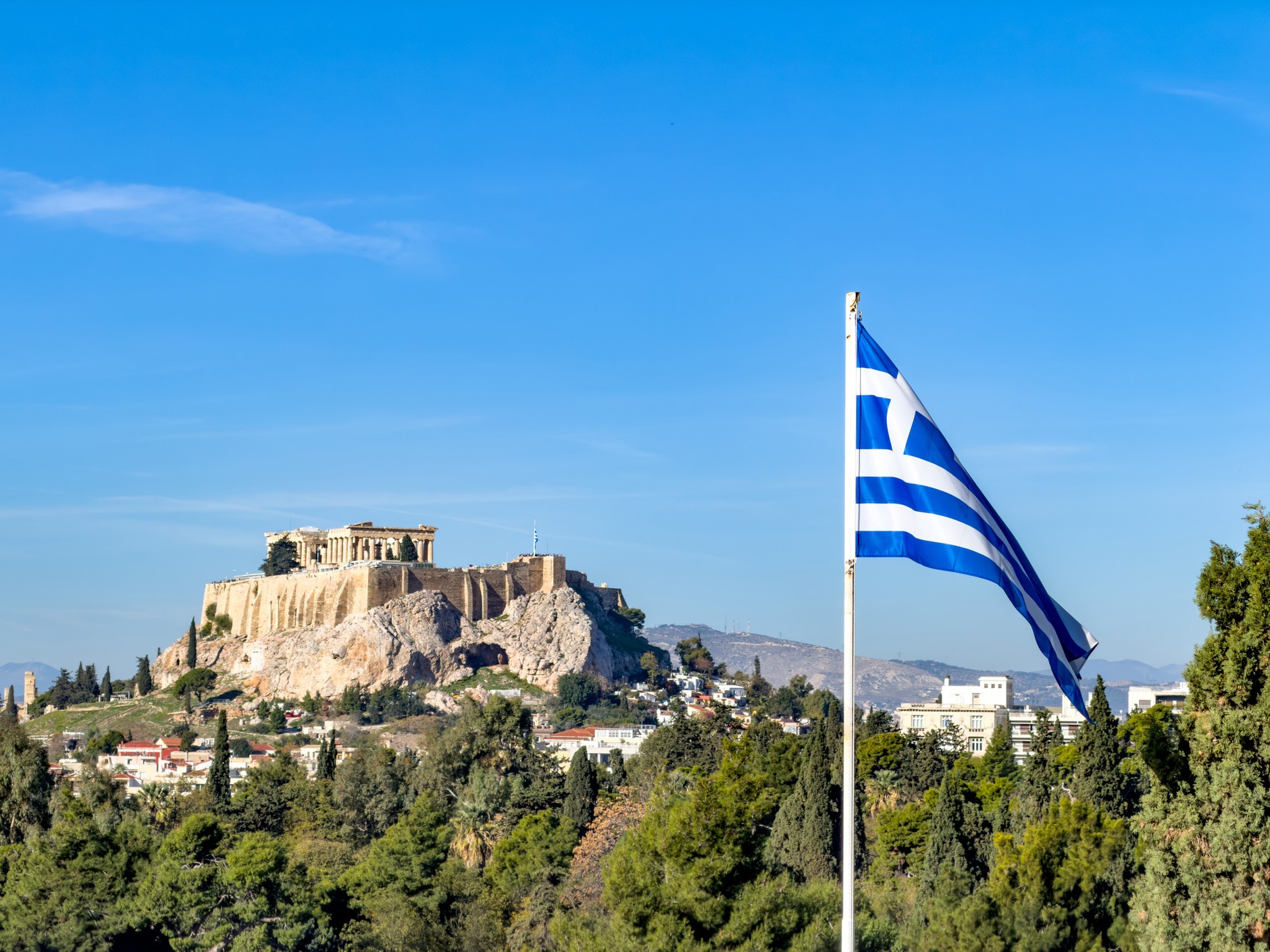
The Greek flag flying next to the Acropolis hill in Athensrawf8 / Getty Images
This was the biggest fear during the euro crisis: that a country like Greece would never be able to repay its debt in full and that taxpayers in the northern part of the eurozone would ultimately have to foot the bill. Now it turns out that the aid loans are actually being repaid – and faster than expected.
In the case of Greece itself interest costs fall and the debt curve becomes flatter. This makes the country much more resistant to another shock. Improving debt sustainability is one of the reasons why rating agencies are re-assigning Greece an investment grade rating.
While these numbers look promising, there is still some risk. First, the debt ratio remains high. With a debt of approximately 150%. GDP, Greece far exceeds most other eurozone countries. If economic growth collapses or interest rates rise sharply, the situation could quickly deteriorate.
Secondly, the stock market is small and highly concentrated. Investing in it involves significant risk. Third, the recent increase is mainly due to revaluation. After years of remaining in the shadow, Greek shares were valued very low. Now investors are returning because the rating, economic growth and reform record look better. This may continue to drive prices up for some time, but declines are possible at any time.