A new scandal in Parliament upon the adoption of the law on combating extremism / The law had been challenged by President Nicușor Dan and the opposition


The law that tightens the punishments for fascism, legionaryism, racism or xenophobia passed the Chamber of Deputies on Wednesday, decision-making body with 173 votes “for”, 101 “against” and 6 abstentions. The law now goes to the president, who has challenged it, to be signed into law.
The law was voted again by the Chamber of Deputies after, on December 4, President Nicușor Dan sent it back to the Parliament. The Senate, the first chamber referred to, rejected the observations of the head of state.
The president said that the law is insufficiently clear in defining certain crimes and “amplifying tensions” in society. In today's vote, the Senate rejected the president's request.
“It's one thing to agree and like a poem, a prose written by a great Romanian, a great patriot. And it's quite another to agree with the fact that that Romanian, that poet, that man of great culture, made mistakes and said stupid things. In an anti-Semitic era, we had a bunch of personalities who had anti-Semitic actions that created the fertile ground for Antonescu and other criminals to kill innocent people.” said USR deputy Emanuel Ungureanu after the plenary vote.
“We recognize the extraordinary work of fantastic people of culture, but who in a toxic environment made mistakes. A strong people respects its history with good and bad, recognizes them, asks for forgiveness,” added the deputy.
Scandal with the pictures of some Romanian personalities
The debate on the project was marked by the scandal surrounding deputy Silviu Vexler.
After the vote, from the podium, George Simion said that in the plenary hall there was a serious slip-up towards Romania:
“The AUR party has strictly implemented the policy of President Donald Trump in terms of combating anti-Semitism. But we must take into account that any citizen, regardless of his religion, must feel protected and respected by the Romanian state. The tearing of photos of Iorga and Eminescu by deputy Vexler in the Romanian Parliament is an insult that cannot be tolerated.”
Simion refers to the fact that, during the debates on the bill on the podium from which the deputies speak, Alecu Robert, elected on the AUR lists, currently unaffiliated, pasted a photo with the portraits of Mihai Eminescu, Vasile Alecsandri, Mircea Eliade, Octavian Goga, Bogdan Petriceicu Hasdeu, Nicolae Iorga, Mihail Kogălniceanu, Nicolae Paulescu, Ioan Slavici and AD Xenopol.
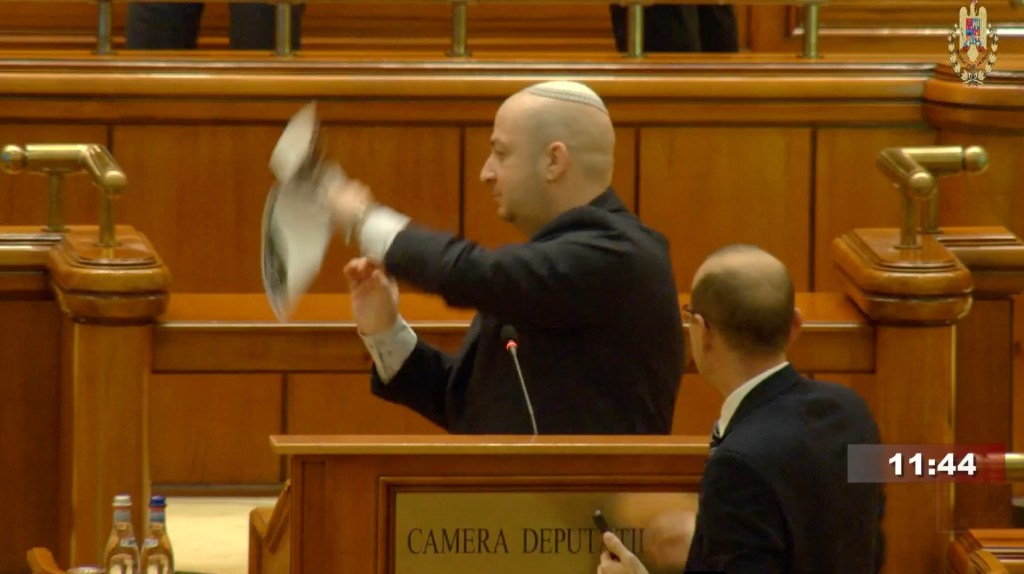
When it was his turn at the lectern, Silviu Vexler tore up the photo, a gesture that made several opposition MPs surround him and chant “Freedom! Freedom! Freedom!”. A new photo was then pasted on the podium, which USR MP George Gima peeled off.
The moment can be watched in the video below from 1:36:06.
7 months on the legislative route
The project, initiated by the president of the Federation of Jewish Communities in Romania, Deputy Silviu Vexler, was adopted by the Parliament in June. The normative act was challenged, on June 20, at the CCR by parliamentarians of AUR, SOS Romania and POT, the Court rejecting the referral.
Later, after reaching the president's desk, the law was sent again to the CCR by Nicușor Dan for the lack of clarity of the terms “legionary” and “fascist” and the notion of “fascist, legionary, racist or xenophobic materials” in the law's content. The Court rejected his objections, which is why the president sent it back to Parliament.
“Some articles can be interpreted abusively, which could turn people unrelated to extremism into criminals. For example, the new law provides prison sentences of one to five years for the distribution of any material containing xenophobic ideas, without distinguishing between extremist propaganda materials and literary works or historical texts. Romania needs both firmness and balance. Both are essential for the defense of democracy,” the president said.
Now, Nicușor Dan has no recourse and will have to promulgate the law.
What the law against extremism provides
The law adopted by the Parliament states that “distributing or making available to the public, in any way, fascist, legionary, racist and xenophobic materials constitutes a crime and is punishable by imprisonment from one to 5 years and the prohibition of certain rights”, and if the act is committed through a computer system, “the punishment limit is increased by half”.
Previously, the law also did not provide for legionary materials, being only specified: “Distributing or making available to the public, in any way, through a computer system, racist and xenophobic materials constitutes a crime and is punishable by imprisonment from one to 5 years”.
The law also introduces a penalty of 3 months to 3 years for people who publicly promote the cult of people “who were part of the leadership of fascist organizations”.
“The act of the person promoting, in public, the cult of persons guilty of genocide, against humanity and war crimes of persons who were part of the leadership of fascist, legionary, racist or xenophobic organizations, as well as the act of promoting, in public, fascist, legionary, racist or xenophobic ideas, concepts or doctrines is punishable by imprisonment from 3 months to 3 years or a fine and the prohibition of certain rights”, according to the law adopted.
Previously, the law also sanctioned “the fact of the person promoting, in public, the cult of persons guilty of crimes of genocide against humanity and war crimes, as well as the fact of promoting, in public, fascist, legionary, racist or xenophobic ideas, conceptions or doctrines, within the meaning of art. 2 letter a), is punishable by imprisonment from 3 months to 3 years and the prohibition of certain rights”.
Another change is that for “denying, contesting, approving, justifying or minimizing obviously, by any means, in public, the holocaust on the territory of Romania or its effects is punishable by imprisonment from 6 to 3 years and the prohibition of certain rights”. Before, the law also provided for the possibility of a fine, instead of a prison sentence.