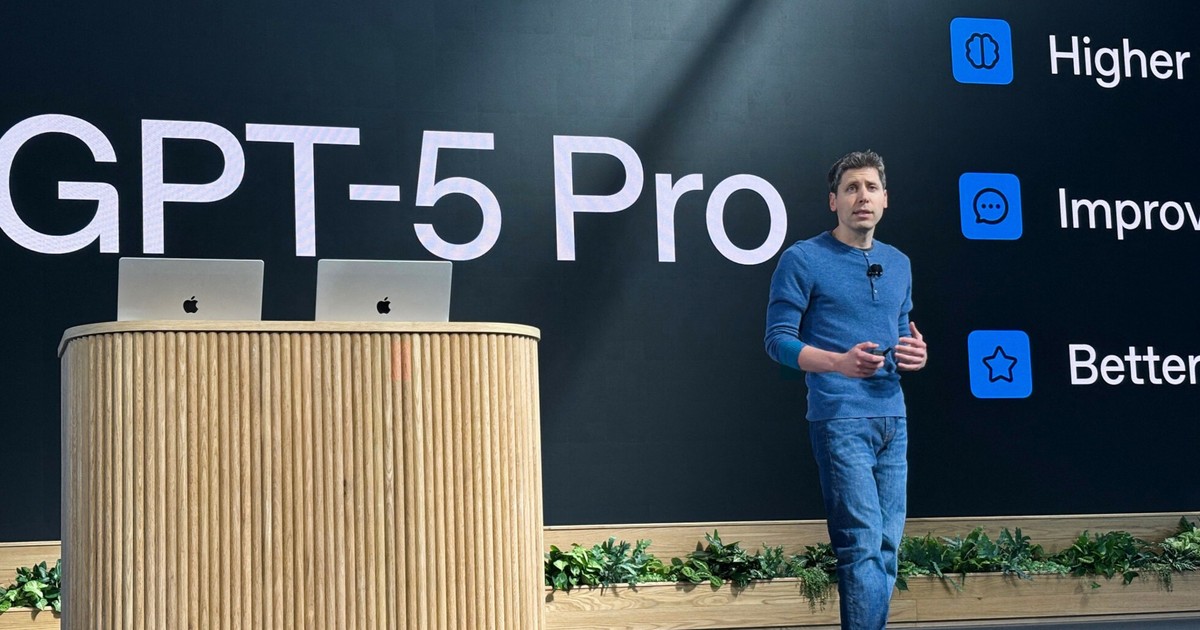
“Code red” wasn't just a motivational message, but reaction to a specific stimulus. What? Google is making rapid progress in its Gemini family of models and is increasingly distributing these capabilities across the services people and businesses use every day.
Google announced that Gemini 3 comes to Search “from day one”, and in parallel it develops access for developers and companies through its own tools and the cloud. This is a significant advantage – even if the model is only comparable to OpenAI, it can be used wherever there are users already accustomed to Google services.
Distribution versus innovation
OpenAI responded quickly, introducing a new release of the model (GPT-5.2) in December, precisely in the logic of a counterattack on Google's momentum. Reuters described this move as the result of the “code red” directive intended to speed up work at a time of pressure from Gemini. In other words, OpenAI did not so much accidentally accelerate the launch, but decided that it had to maintain the impression of technological leadership. Perception and pace of iteration are part of the advantage in the technology sector, especially AI.
The next part below the video:
The classic pioneer fear also appears in the background. OpenAI did something first on a mass scale, it educated the market, built a category (“ChatGPT” became a synonym for chat with AI), and then large players can use a ready map of needs.
In AI this means two things. First, big tech has a distribution that cannot be easily copied. These are operating systems, search engines, browsers, office suites, cloud and a network of partnerships. Secondly, it has the budgets, infrastructure and enterprise sales channels that allow it to sell AI as a feature in a package, rather than as a separate product with a separate user acquisition cost (and the need to build business relationships from scratch).
This can be seen in how Google distributes Gemini through the cloud ecosystem and partners – Reuters described, for example, the agreement in which Oracle is to sell access to Gemini models in its cloud offering and business applicationswhich increases Google's reach in enterprises.
Check also: Are you using ChatGPT? It's worth changing these settings
Netscape and Kodak lesson. The pioneer wins history, but not always the market
This mechanism can be deadly for companies that have paved the way. Netscape popularized the browser and helped build the Internet boom, but lost the distribution war with Microsoftwhich had Windows and could ship Internet Explorer bundled.
This year, the history of Netscape was directly compared to today's AI market as a warning to pioneers that large infrastructure and capital can take away the lead from those who have created a new category on the market.

The “Person of the Year” according to TIME 2025 is not one, but several people, the so-called AI architects. Among them is Sam Altman, head of OpenAI
|
TIME/AFP/East News
Similarly, Kodak – a company that was a symbol of photography and also played a part in the digital breakthrough – ultimately lost the transformation. “The Guardian” recalled on the occasion of the company's bankruptcy that the problem was, among others, reluctance to invest in one's own invention that harmed the existing business.
Xerox PARC is yet another version of this story. There, groundbreaking ideas (GUI, mouse, networks) were created within the organization, but commercial victory went to others, which Forbes described as a lesson that innovation alone is not enough if there is no execution and a value capture model.
Read also: New ChatGPT Atlas browser from OpenAI. Is Google Chrome something to be afraid of?
How could this end for OpenAI? The most the down-to-earth scenario is that OpenAI will remain a top laboratory and consumer brand, but will no longer be the undisputed leaderbecause the advantages will shift from model quality to distribution, integration and bundling in products that already have billions of users.
The second option is to maintain the position thanks to ChatGPT becoming a “work operating system” (a tool that connects tasks, applications and agents) and defending itself through force of habit and an ecosystem of tools. OpenAI has the advantage of adoption scale here – in 2025, research based on ChatGPT data indicated hundreds of millions of users and a huge volume of messages per weekand this usually helps solidify the category.
The third, most difficult variant is the “Netscape moment”. What would that mean? That OpenAI will still be seen as a pioneer, but the market (consumers and companies) will start to associate “default AI” with Google, because it will be in the search engine, Chrome, office suite and enterprise channels. OpenAI will then be left with expensive infrastructure and the need for more aggressive monetization to finance this race.
Therefore, whether OpenAI defends its position will depend not only on who has the best benchmarks in a given week, but also on who has the best benchmarks in a given week who will build the hardest advantage outside the model. That is, distribution, partnerships, integration into employees' daily workflows and the ability to finance infrastructure. “Code red” suggests that OpenAI considered this stage of the race to be in earnest. At stake is the status of the market's default AI platform. For Sam Altman, head of OpenAI, there is simply no higher stakes.
Author: Grzegorz Kubera, journalist of Business Insider Polska