“This dirty head that sticks out and interferes in other people's business must be cut off.” Although in recent months politicians from almost all countries and political parties have uttered words that would have been unimaginable or taken seriously a few years ago, such statements still arouse controversy. Especially if they are said by someone who is, at least nominally, a diplomat. And such a person is Xue Jian, consul general of the People's Republic of China in Osaka, Japan. In the quoted entry on the platform, X referred to the new head of government in Tokyo, Sanae Takaichi.
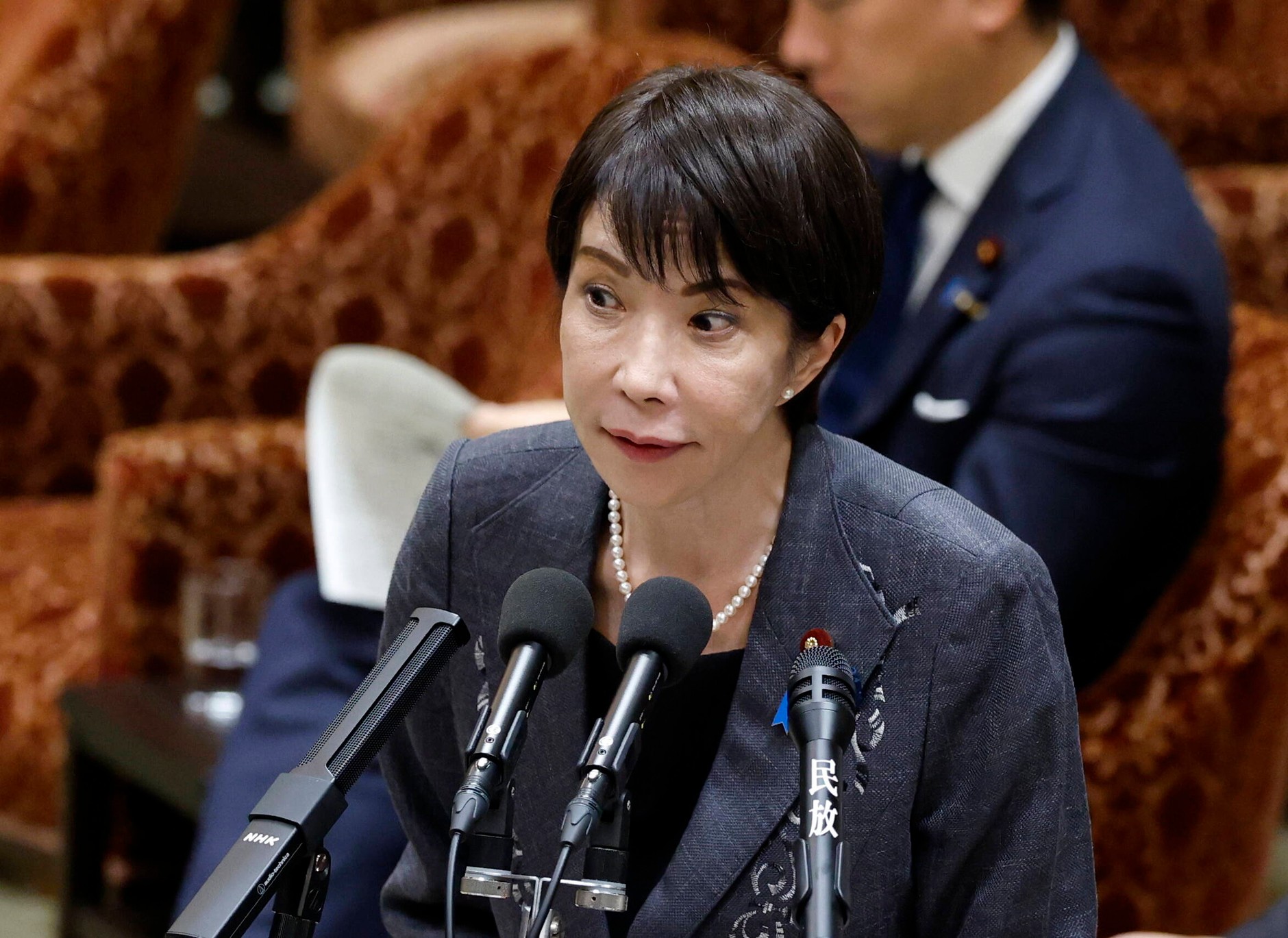
The first woman in history to hold this position, an ambitious and conservative politician, but also decisive and well-suited to today's trends towards expressive diagnoses and declarations, riding the wave of enormous popularity. According to public opinion polls from early December, cited by Nikkei Asia, 76% have a positive opinion about her government. respondents. Considering the fact that her predecessor Shigeru Ishiba left office when public satisfaction was below 30 percent, her result is spectacular – although her rule lasts only a month and a half.
The article continues below the video
What are China's imperial ambitions?
What do American diplomats think about Trump?
What is Sanae Takaichi's stance on Taiwan's security?
What consequences could a possible lifting of the American protective umbrella over Japan have?
Defense? Only theoretical
Sanae Takaichi has clear views on many things, including what she called an “existential” issue in a recent speech to the Japanese parliament: Taiwan's security. She then stated that a possible Chinese invasion of the island could pose a threat to Japanese statehood, which in turn would justify the activation of the “right to self-defense.” This is a term introduced by the Japanese legislature in 2015 as a kind of military backstop.
Japan, forcibly demilitarized by the Allies after World War II, theoretically has no armed forces — at least not in the traditional Western sense of the term. The local units, with significantly limited offensive capabilities, are called self-defense and on a daily basis they perform tasks that can hardly be called military. They assist in rescue operations after natural disasters, support the protection of public events and monitor the situation on Japanese coasts.
In accordance with the doctrine in force since the post-war period Japan can therefore defend itself quite effectively – but only for a short time. Offensive operations are not possible in the current system.
The debate on Japan's remilitarization remained largely theoretical for years because so were the threats. Even the constant escalation of nuclear activities by North Korea, manifested in regular tests of missiles falling into the sea halfway between the peninsula and the Japanese islands, did not cause panic among the political class in the Land of the Rising Sun. However, times have changed, also for decision-makers in Tokyo.
It is not North Korea, but China that is most destabilizing the peace order in Asia. And Taiwan is only 100 km from the Japanese coast.
The diplomatic crisis caused by the consul's post on social media (later deleted) is not only a story about the Japanese waking up from lethargy or rowdy Chinese officials. This is one of the most important elements of the global geopolitical reshuffle, in which the old rules – written and ethical – no longer apply. Alliances become transactional and temporary, the rigid boundaries of ideological blocs give way to multi-vector diplomacy in which everyone is ready to talk to everyone. Well, almost everyone.
Since the early 1950s, Japan, although located far to the east, it was considered an integral element of the Western camp. The West, as Stewart Patrick wrote in an essay on its steady decline in Foreign Affairs magazine, was “a system itself.” Not a geographical concept, but a system based on the domination of three basic concepts.
On the political level, the West was defined by liberal democracy as a system, in the economy by the free market, and in state-citizen relations by the central role of human rights, considered from the point of view of the individual. Japan embraced this entire triad, even if some of its elements (especially civic individualism) were completely at odds with its own cultural heritage.
After the war drama, the country entered the path of growth, technological development, innovation and trade expansion. He dominated because he was a good and honest partner, but also because the issue of security was not a variable in the Japanese political equation at all. To this day, approximately 55,000 are stationed in Japan. American soldiers and support staff at 15 bases and military units, and even more.
The Americans gave the Japanese a nuclear umbrella, trained civil defense forces, and protected them against threats, even imaginary ones. Japan was able to grow because there was an older brother watching over his back, always friendly.
Paper alliance
Of course, this alliance has not been officially broken, but only the most naive observers believe that in the times of the second Trump administration, the world remains the same as under Clinton, Bush or Obama. For example, no one is talking about the withdrawal of American units from Japan.
However, the United States is withdrawing from external involvement, and what's worse from Tokyo's point of view, no one really knows what Trump's China policy is. 55 thousand soldiers may be a lot, but they mean nothing if no one orders them to defend Japanese territories.
Trump is unpredictable. A former high-level American diplomat associated with the Obama administration, speaking anonymously for the purposes of this text, even admitted that There is panic in Washington after Trump's latest meeting with Chinese leader Xi Jinping. In the administration, or at least in its technocratic part, dominated by supporters of transferring American resources to a much greater extent to the Pacific theater, the prevailing belief is that China must be contained. Not necessarily through direct confrontation, but at least within the framework of “strategic ambiguity”, i.e. not ruling out helping the Taiwanese. However, there is no certainty that Trump views Beijing in the same way.
“People like Elbridge Colby [szef planowania polityki w Pentagonie] They are tearing their hair out because they have no idea whether Trump will sell their China policy for several billion dollars in profits from the export of soy products,” says the diplomat.
Ivan Krastev, one of the most important political scientists and intellectuals in contemporary Europe, spoke in the same tone during the recent “Time To Decide Europe” conference organized by the ERSTE Foundation in Vienna. Therefore, it seems that an increasing number of decision-makers, scientists and commentators are beginning to realize that with Trump in this term, anything is possible.
The head of the government in Tokyo is also starting to think in these categories, as evidenced by the above-mentioned statement in parliament. And if he is really considering reorganizing the military structures in Japan without taking into account the role of the Americans, he is going in the right direction.
Trump first remained silent on the issue of Taiwan in a recent telephone conversation with Xi Jinping, and then, as reported by Reuters, he told Sanae Takaichi to “lower her voice” when speaking about China. It is difficult to find a more eloquent declaration of the views of the American president, who once again shows that he does not intend to defend anyone, at least not for free.
Sanae TakaichiFRANCK ROBICHON / PAP
The possible lifting of the American protective umbrella over Japan will have both regional and global consequences. Firstly, as Robert Pszczel, former director of the NATO Information Office in Moscow, noted many months ago, Tokyo and Seoul are in a much worse situation than, for example, European countries, because the nature of security alliances in Asia is bilateral, not multilateral. Everything there is based on relations with the United States, democratic countries in Asia do not have mutual defense obligations towards each other.
Washington's ambivalence clearly emboldens the Chinese, who are starting to practice again wolf warrior diplomacy — Warrior Wolf Diplomacy. This much more confrontational form of diplomacy, initiated in the first years of Xi Jinping's rule, later faded into the background and was replaced by a conciliatory policy of trade expansion. But now China is rhetorically biting because it has no reason not to.
China – a fallen myth
Thus, as James Kynge, former correspondent of the Financial Times in China and today a researcher at the Chatham House think tank, notes, The myth of China as a “rational superpower” is beginning to collapse. For the first few months after Donald Trump's return to power, many people, including in the West, succumbed to the dangerous fantasy of Beijing's potentially beneficial influence on the international order shaken by the MAGA movement.
Suddenly, in the eyes of some, Chinese communists began to appear as predictable, mercantile, and even devoid of ill will politicians, who make the world dependent on their industrial overproduction, but at least they will not be physically aggressive. As a result, especially in some circles of the Western left – in Great Britain, Spain, Italy – there have been calls for increased trade with China, more intensive bilateral diplomacy, and even – as in the case of British Chancellor of the Exchequer Rachel Reeves – positioning Beijing as the engine of economic growth for the entire country.

Weekly Review
I don't think anyone needs to be told that this image of China has nothing to do with the truth. Of course, as in any non-democratic regime, parts of the establishment are allowed to say more than those in its mainstream – and perhaps the consul in Osaka belongs to this group. However, this does not change the fact that publicly writing threats against the prime minister of the country where you are accredited has little to do with diplomacy – rather, it is an announcement that if necessary, China will not retreat even an inch.
Especially since – as the fiasco of Trump's customs policy showed – we are dealing with a completely different China today than during his first term. Today's China is a much more assertive China that has no problem dealing with the tariffs imposed by the Americans. They will be able to replicate this in other markets without any problem, not to mention the fact that in key technologies of the future, such as quantum computing, artificial intelligence, and renewable energy, if they do not dominate the West in terms of quality, they already do so in terms of scale.
Beijing currently has the world's largest number of PhD students in engineering, with over 200 university specializations devoted to rare earth metals, producing 80 percent of all solar panels sold globally and is on the way to energy autarky, while making Europe, Africa and a large part of Latin countries dependent on each other. Xi Jinping's China is aware of its own power and is willing to project it outside.
However, their domination, including military, in the Asia-Pacific region is not certain. China may have a large, modern and ambitious army, but it is an army with no battlefield experience. The Chinese produce a lot of military equipment, but they do not know whether it works in combat conditions. Therefore, for this purpose they use conflicts that, from this perspective, are proxy wars – such as the clash between Pakistan and India in May or even the conflict in Ukraine. Chinese technologies are used everywhere, on the Pakistani and Russian sides.
Japan, probably increasingly aware of China's offensive tendencies, should be there everywhere – so as not to have to analyze the remains of Chinese drones when they fall on its territory.