Argument number 2 from the Romanian Academy regarding the “new alliance” between AI and humans


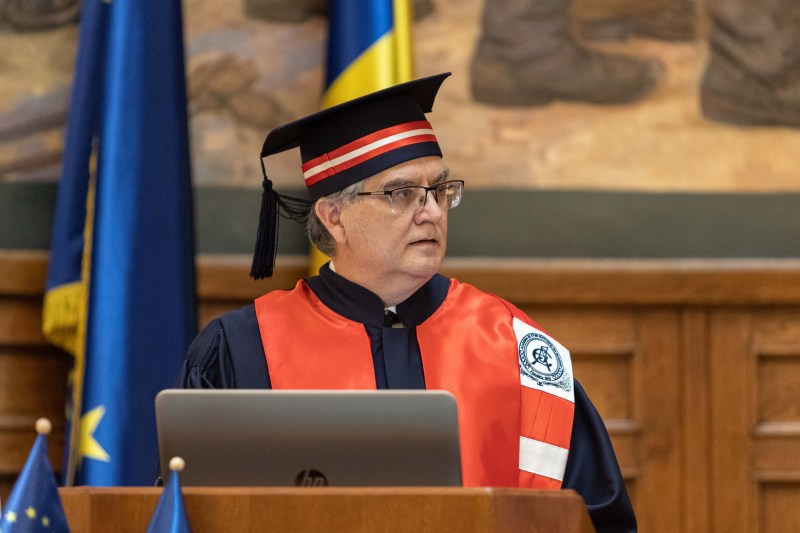
The ceremony of awarding the title Doctor Honoris Causa to the academician Mircea Dumitru, president of the Section of Philosophy, Psychology, Theology and Pedagogy of the Romanian Academy, at the University of Bucharest, on April 7, 2022. PHOTO: Cosmin Enache / Inquam Photos
The vice-president of the Romanian Academy, university professor Mircea Dumitru, said on Friday, during the conference “Human intelligence vs. Artificial intelligence: about speed and abductive reasoning (in medicine)”, that people have a chance to gain from artificial intelligence (AI) if they know how to adapt.
“It's a very topical and very interesting topic, with a stake, with politics in the largest and cultural sense, in the broadest sense for each of us, not just for those who work in universities or research centers. The main title is formulated in an antithetical-adversative manner, it is that “versus” that would suggest a certain opposition between the two dimensions: human intelligence, which is natural biological, physiological, cultural, historical intelligence and artificial intelligence, which is intelligence created by us, by people”, said the academician, in the conference held at the “George Emil Palade” University of Medicine, Pharmacy, Sciences and Technology in Târgu Mureș.
“I would like my argument to be clear and convincing enough for you to understand that I do not have in mind such an opposition and rather a “new alliance” (…). I think that we, the people, will benefit, if we know how to adapt and use it well for our purposes, we will benefit from artificial intelligence”, added Mircea Dumitru, according to Agerpres.
In the view of the vice-president of the Romanian Academy, this kind of “alliance” must be thought of while preserving both the identity of human intelligence and that of artificial intelligence.
“Before coming I had a very interesting discussion with the rector about how artificial intelligence has already penetrated many branches of medicine and how probably some of them will be totally reconfigured, absorbed by this new technology and will look completely different from what we know at the moment”, he stated.
“This kind of “alliance”, however, must be thought of, preserving what is specific, what gives identity, on the one hand, to human intelligence and, on the other hand, to these algorithms, to these programs that we call today, for lack of more suitable terms, intelligent machines or artificial intelligence (…). To what extent will we be able to adapt to this astonishing speed not only of information processing, but also the speed with which all these researches immediately reach the technical environment and become more or less consumer goods?”, said Mircea Dumitru.