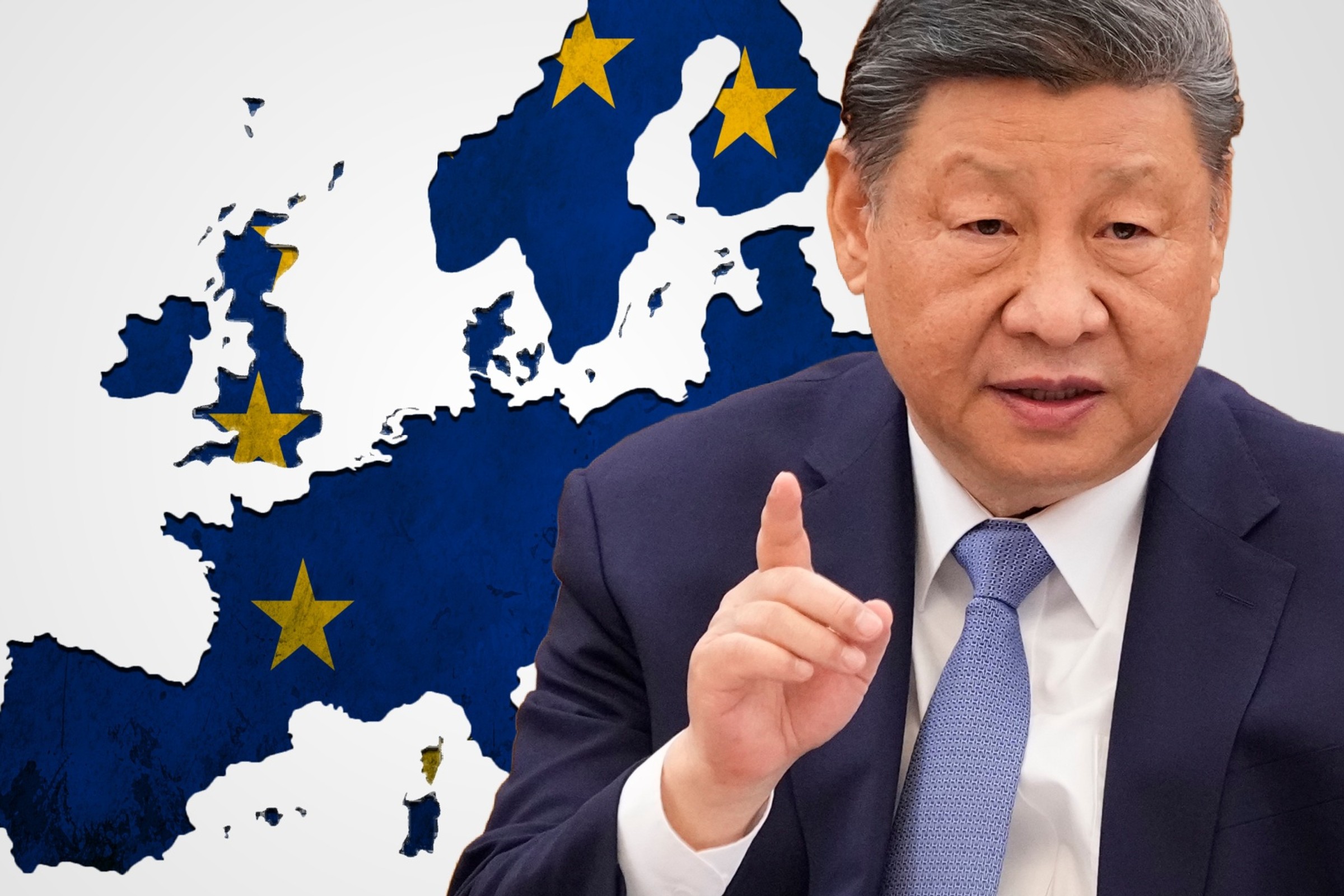
This is all bad news for European industrial manufacturers and the automotive industry, who are lobbying Brussels for the EU to introduce more aggressive tariffs to stop trade diversion.
There are three reasonsfor which the EU will probably not decide on a large-scale escalation of the conflict with China. First, Europe is highly dependent on China.
There is also the other side of the coin. So-called “trade diversion” could allow the European Central Bank to cut interest rates more aggressively than markets expect, resulting in GDP growth in 2026 while maintaining inflation at around 2%.
Chinese overcapacity and a decline in demand in the United States due to the introduction of tariffs in 2025 have revived fears in Europe of a second China shock, which could be much worse than the first.
The article continues below the video
When the continent was flooded with cheap consumer goods after China joined the World Trade Organization (WTO) in 2001, today's disruption affects Europe's industrial core: cars, machinery and high-tech equipment.
This year, the European Commission established a surveillance task force to monitor trade diversion – more precisely defined as price dumping.
The group's data shows that Chinese exporters increasingly send clothing, household appliances, furniture, industrial raw materials and high-tech products to the EU.
The numbers don't lie. In the last 12 months until October this year. imports of industrial robots from China increased by 171% and prices dropped by 31%. Imports of integrated circuits increased by 84% and prices fell by 6%. Car imports more than doubled and prices dropped by 15%.
As a result, margin pressure is mounting for European producers of high-tech goods, who must now contend not only with weak demand from China and US tariffs, but also with competition from cheaper Chinese products in their domestic markets.
Why Brussels is definitely not responding
The EU has threatened to introduce targeted tariffs on Chinese imports to level the playing field, similar to the 2024 measures on Chinese electric vehicles (EVs).
However, tariffs on electric vehicles are a cautionary tale: they reduced China's price advantage, but did not eliminate it. Chinese electric vehicles continue to gain market share in the EU, although at a slower pace.
This is all bad news for European industrial manufacturers and the automotive industry, who are lobbying Brussels for the EU to introduce more aggressive tariffs to stop trade diversion.
There are three reasonsfor which the EU will probably not decide on a large-scale escalation of the conflict with China.
1
Europe is highly dependent on Chinamuch more so than the United States, both as an export market and as a source of necessary raw materials. China's retaliatory tariffs could hurt EU producers abroad more than higher EU tariffs would help them at home.
2
The EU desperately needs to reduce energy costs. According to the International Energy Agency, average industrial electricity prices in the EU are EUR 0.199 [84 gr] per kilowatt hour, which is twice as much as in the United States and 50 percent. more than in China. One way to solve this problem is to accelerate the development of wind and solar energy, but both of these fields are highly dependent on Chinese components and equipment. Aggressive tariffs threaten to slow or reverse the ecological transition and raise its costs.
3
Finally, and perhaps most importantly, some EU leaders are increasingly advocating Europe's pivot towards Beijingas several Member States benefit from large Chinese investments. In particular, Hungary, Spain and Germany are now home to large Chinese factories producing batteries and electric vehicles. These plants create jobs and generate tax revenue, but also shift political influence from traditional European producers to their Chinese competitors.
A blessing in disguise
While this latest China shock is clearly negative at the sector level, there is a possible twist.
Over the past 12 months to October, prices of Chinese imports fell by an average of 20%. This import has a direct impact on prices of approximately 23%. euro zone inflation basket.
In a recent blog post, ECB economists estimated that redirecting Chinese trade could reduce euro zone inflation by up to 0.15 percentage points in 2026.
Unlike the United States or Great Britain, inflation in the euro zone is already close to the central bank's target of 2%. and even without an additional deflationary impulse from China, it is expected to fall below this level. However, additional downward pressure on prices may help.
In this situation, the ECB may be able to cut interest rates more aggressively than currently expected. Softer monetary policy should then support stronger GDP growth in 2026.
So while a second China shock in Europe will deepen the structural challenges facing the bloc's industrial base, it may – at least in the short term – prove to be a blessing in disguise.
I’m Ashley Davis as an editor, I’m committed to upholding the highest standards of integrity and accuracy in every piece we publish. My work is driven by curiosity, a passion for truth, and a belief that journalism plays a crucial role in shaping public discourse. I strive to tell stories that not only inform but also inspire action and conversation.