Lyubov Wasserman
Photo: Regional Library
December 5, 1907
On this day, Lyubov Shamovna Wasserman, a famous Soviet Jewish poet, was born. She wrote in Yiddish.

Her biography is full of inaccuracies. Here's what we found out from various sources of information. The future poetess was born in the town of Slovatich, Poland. In 1925 she emigrated to Palestine, where her first collection of poems, “Evenings” (6+), was published. In the late 1920s, she was arrested by British colonial authorities for participating in anti-British protests. After liberation in 1931, she came to Moscow, and in 1932 she moved to Birobidzhan.
Lyubov Shamovna worked for some time at the regional library named after. Sholom Aleichem, head of the children's department of this library. She also worked as an editor for artistic broadcasting in Hebrew at the regional radio committee, in the newspaper “Birobidzhaner Stern” (12+).
In January 1940, a local writers' group was formed, and Boris Miller became its chairman. Among the members of the regional literary association was L. Wasserman.
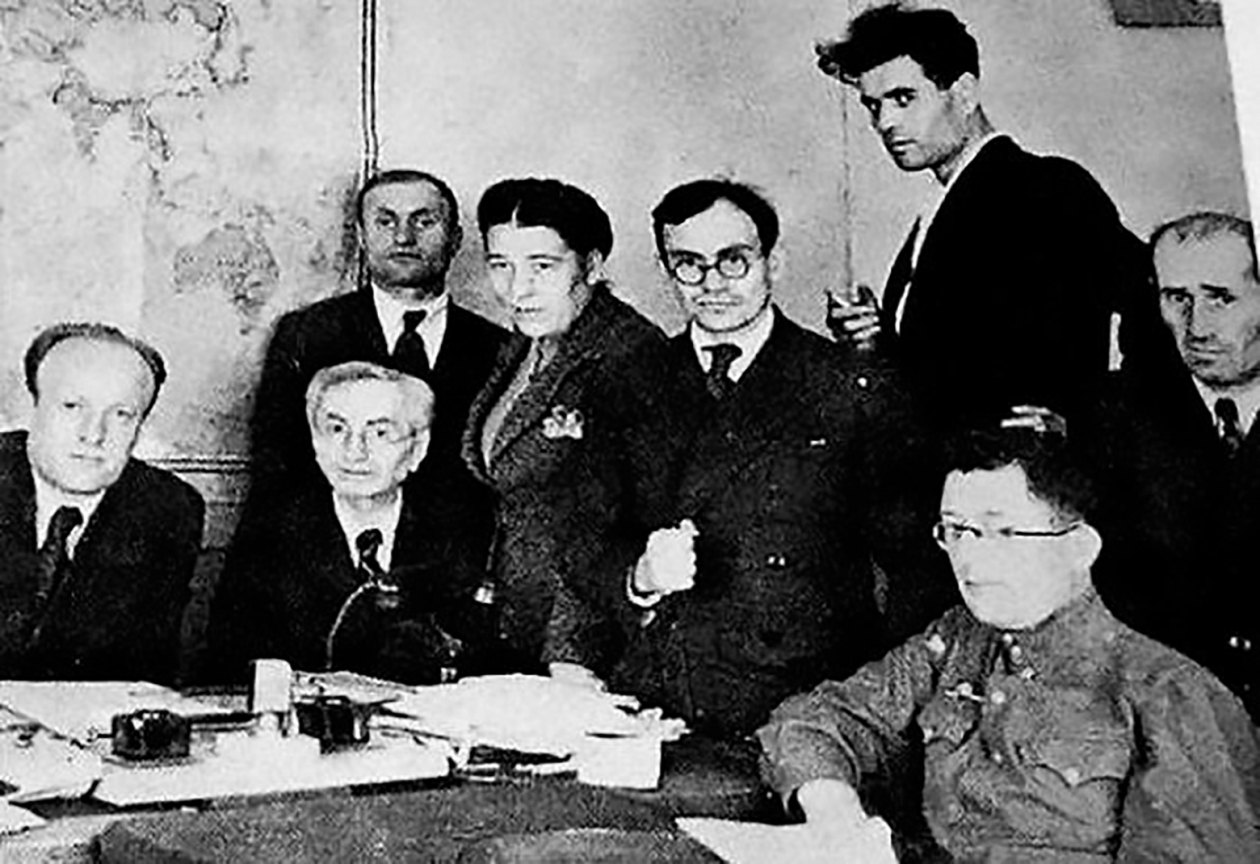
Birobidzhan writers, 1948. From left to right. B. Miller, B. Slutsky, N. Fridman (in a tunic) are standing, I. Bronfman, L. Wasserman, G. Rabinkov, I. Kerler, S. Borges are standing. Photo: Photo: State Archive of the Jewish Autonomous Region
Her essays, poems and stories about the formation of the Jewish Autonomous Region and its people were published in the regional newspapers “Birobidzhaner Stern” (12+) and “Birobidzhan Star” (12+), in the regional newspapers “Pacific Star” (12+), “Young Far East” (12+), in the magazines “Forpost” (12+), and others.
In July 1949, Lyubov Shamovna Wasserman was arrested in the Birobidzhan Case No. 68. She was found guilty of “engaged in organized anti-Soviet activities aimed against the national policy of the Communist Party of the Soviet government, to isolate the Jewish Autonomous Region from other regions of the USSR, to undermine the unity of friendship of the peoples of the USSR, pushing through nationalist views in her works.” Lyubov Shamovna was sentenced to 10 years in the camps. L. Sh. Wasserman was transported to Taishet, where she remained until 1956.
After her release in 1956, Lyubov Wasserman returned to Birobidzhan, was rehabilitated for lack of proof of the charges, and worked in the Birobidzhaner Stern newspaper and on the radio.
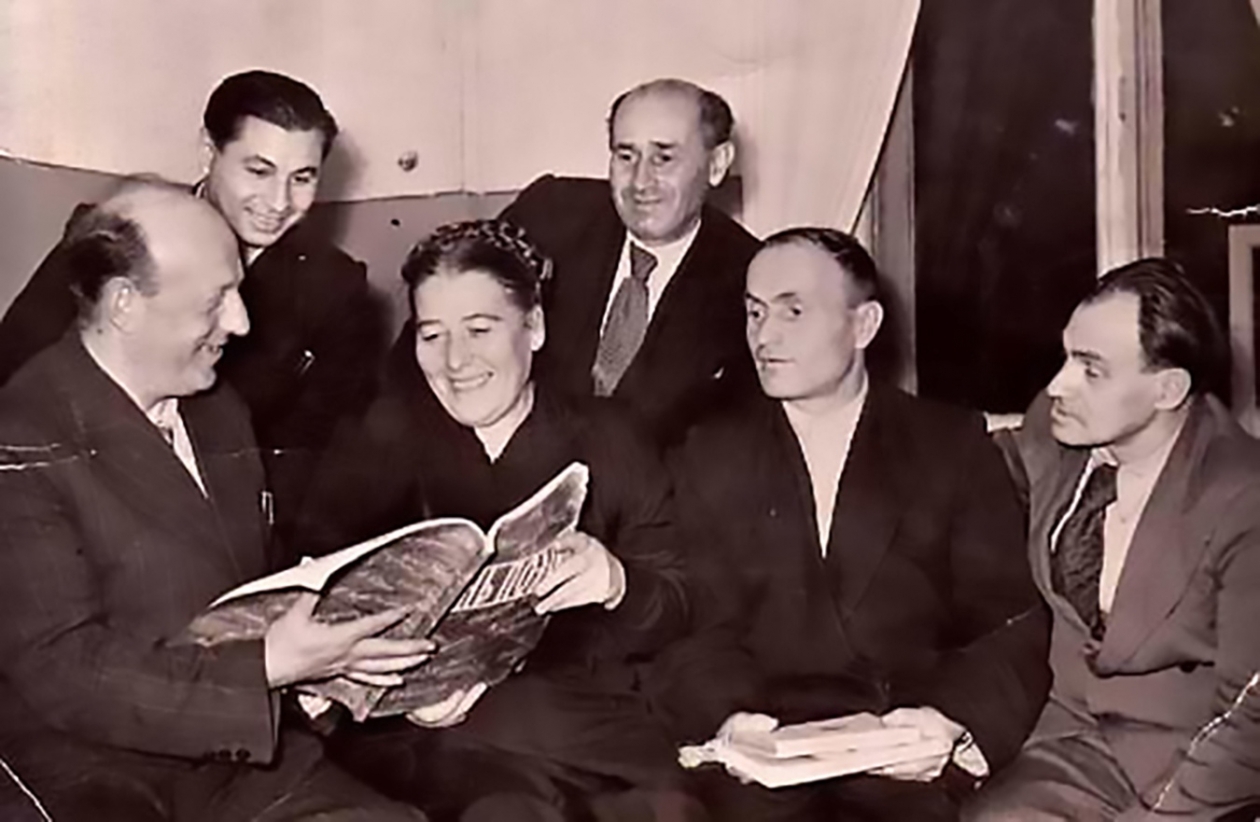
Birobidzhan writers, 1958. From left to right, Busie Miller, Max Riant, Lyuba Wasserman, Salvador Borges, Itzik Bronfman, Gershel Rabinkov. Photo: Photo: State Archive of the Jewish Autonomous Region
The years spent in the camps greatly undermined the health of Lyubov Shamovna.
In 1971, L. Wasserman's husband, Moses Bengelsdorf, died. After this, Lyubov Wasserman, already very ill by that time, went to Chisinau to visit her son, where she spent the last years of her life.
Lyubov Wasserman died on March 5, 1976. The tombstone on her grave is made in the form of an open book, on the marble pages of which is inscribed the poem “My Home” (6+) in Yiddish – a poem about Birobidzhan, which Lyubov Wasserman considered her real home.
In 1968 and 1987, the Khabarovsk Book Publishing House published two books of poems by L. Wasserman translated into Russian, “Horizons” (6+), “I Bless Life” (6+). In 1980, the Moscow publishing house “Raduga” published a collective collection of Jewish poets of Birobidzhan “Native Land” (6+) with a translation into English, which included poems by Lyubov Wasserman.
L. Wasserman's poems were translated from Yiddish by such poets as: L. Shkolnik, R. Dobrovensky, Yu. Pavlov.
In Birobidzhan, on Teatralny Lane, in the three-story house where the poetess lived, a memorial plaque with a bas-relief of the poetess in her honor is currently installed.