Russia is testing a giant nuclear missile to intimidate the West. It collapsed after a few hundred meters


A Russian intercontinental ballistic missile, touted by the Kremlin as one of its most advanced weapons, crashed shortly after launch, according to images and information emerging online. The incident, which occurred on Friday, November 28, raises new questions about the modernization program of the Russian nuclear forces.
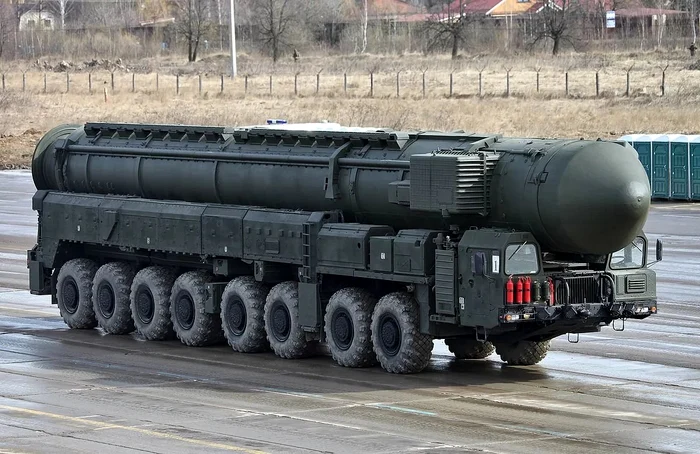
Russian nuclear missile Srmat/PHOTO:X
The missile was launched from an underground silo in southern Russia, near the Dombarovsky Air Base, Orenburg Region, near the border with Kazakhstan. The test was supposed to send the payload to an area more than 6,500 kilometers away. Instead, video footage published on the MilitaryRussia.ru Telegram channel shows that the missile veered immediately after launch, lost altitude and crashed, forming a fireball visible from a distance.
The images also show a dense, reddish cloud, indicating the premature burning of the hypertoxic fuel used by such rockets — a mixture based on hydrazine and nitrogen tetroxide. Satellite photos also reportedly show a crater formed near the silo.
Suspected to be Sarmat missile
Military analysts believe that this is probably a new test of the RS-28 Sarmat missile, the central component of the future Russian nuclear triad. Designed for a range of more than 18,000 kilometers, the Sarmat could carry up to ten nuclear warheads or maneuverable hypersonic vehicles, according to data published by the Center for Strategic and International Studies (CSIS).
So far, however, the system faces numerous technical difficulties. Although the first major test, in 2022, was announced as a success, the program has since experienced several incidents, including an explosion in 2024 that reportedly damaged a silo.
Tensions between stated ambitions and industrial reality
In public statements, President Vladimir Putin has described the Sarmat as “a unique weapon” designed to give Russia an unprecedented deterrent capability. However, the repeated failures put pressure on Moscow's plans to gradually replace the aging R-36M2 missiles, originally manufactured in Ukraine.
“If we are really talking about a new Sarmat failure, the consequences could affect Russia's deterrence capacity in the medium term”explained Etienne Marcuz, weapons expert at the Fondation pour la Recherche Stratégique, quoted by the French press. He points out that maintenance of older missiles is already uncertain, given that technical cooperation with Ukraine ended in 2014.
Amid the war in Ukraine, a significant part of Russia's industrial and military resources is directed to the production of ammunition and conventional equipment, which limits Moscow's ability to invest in complex strategic programs.
Additional testing planned
Russia still has operational intercontinental ballistic missiles that are lighter and capable of carrying a single warhead. Moscow is expected to test-fire the Yars missile next week, according to aerial notifications published on December 1.
Last month, President Putin said the Sarmat would enter the “combat test” phase before the end of the year, with integration into active service slated for 2026. If the Nov. 28 test did indeed target the system, Russian authorities may have to reconsider the timing and role the Sarmat will play in Moscow's nuclear strategy.