The American peace plan in Ukraine, perceived by many as a concession to Vladimir Putin, has failed. But for many European capitals, the moment also signaled a wake-up call: reliance on US protection may be about to end.
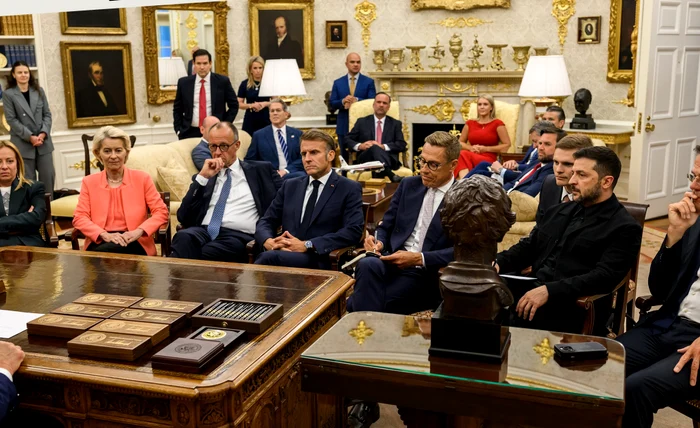
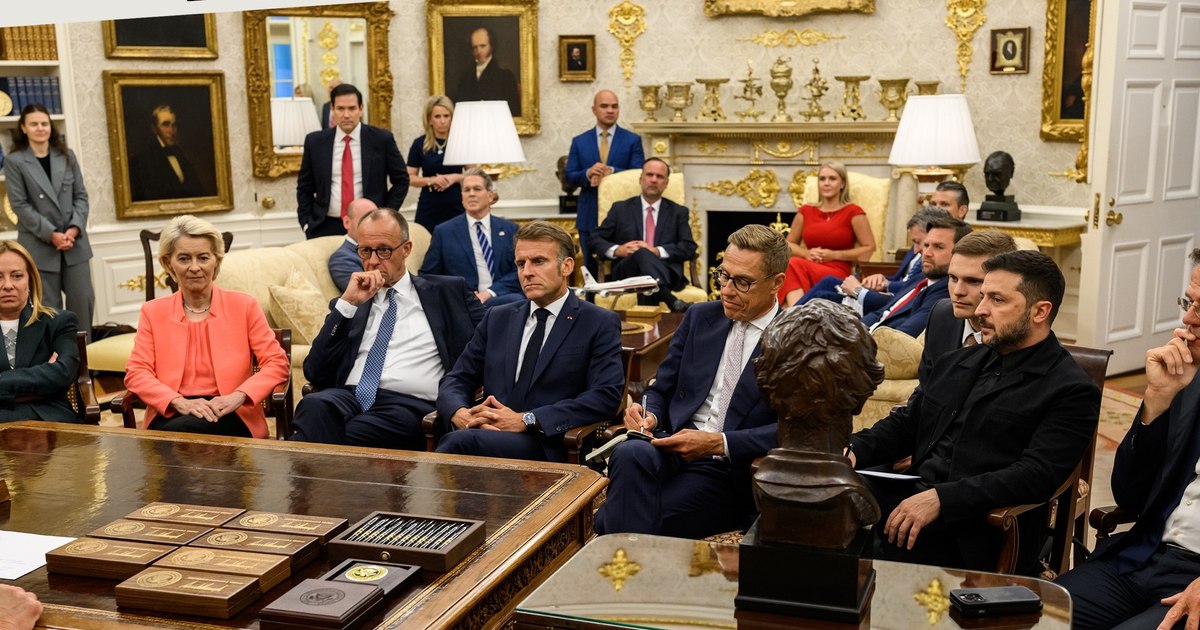
European leaders in the Oval Office/PHOTO:X
Kaja Kallas, the new head of European diplomacy, called for an inventory of the situations in which Russia – under different regimes – invaded other states in the 20th and 21st centuries. The result: 19 countries attacked on 33 occasions. Her move was not just a historical exercise, but an argument about the deep divergences between Europe and part of the American establishment over the nature of the regime in the Kremlin.
The American Isolationist View
This perspective contrasts sharply with that of American isolationists. Steve Witkoff, the New York businessman involved in shaping the US position on the conflict and reportedly advising Russia on Donald Trump's approach, has admitted to supplementing his historical knowledge with “Netflix documentaries”. Although he has visited Moscow four times, he treats Putin as an ordinary international leader. He told Tucker Carlson that he does not believe in the scenario of Russia continuing its expansion into Europe if it gets four Ukrainian regions: “I think it's a ridiculous idea.”
Witkoff insisted that Putin is “not a bad man” and the war in Ukraine is “a complicated situation.” A vision shared, to a certain extent, by Donald Trump, as well as by his vice president, JD Vance, who considers the idea of Russian expansionist ambitions exaggerated. On Thursday, Putin even suggested he was willing to guarantee in writing that he would not invade another European country.
For Europe, such statements indicate one clear thing: no matter how hard they try to convince Trump of Russia's aggressive character, the political pendulum is constantly swinging towards a lenient approach towards the Kremlin. Trump remains convinced that Ukraine cannot win the war and should accept territorial losses, Patrick Wintour, diplomatic editor, writes in The Guardian.
The US-Russia plan that shocked Europe
The emergence earlier this month of a 28-point plan to end the war – and revelations about Witkoff's role – caused consternation in European capitals. For many leaders, the document showed how certain US officials envision a new European order: one in which Russia is rewarded, not punished, for its illegal invasion of Ukraine.
Former French President François Hollande spoke of “a historic and dramatic moment”: “The plan not only means the capitulation of Ukraine, but also the reduction of Europe to the status of a spectator under the tutelage of a Russian-American condominium.”
Josep Borrell, the former head of EU diplomacy, said that the initiative reveals the failure of the European strategy of concessions to Trump: “The United States can no longer be considered an ally on topics that directly concern the security of Europe.”
Other analysts compared the plan to the armistice imposed on France in 1940. John Bolton, Trump's former national security adviser, was even more blunt: “Trump is not interested in Ukraine and never will be.”
In Germany, foreign policy expert Norbert Röttgen pointed out that the moment marks a major break: “The United States is siding with Putin, sacrificing Ukraine's sovereignty and Europe's security.”
How European leaders reacted
For European leaders, the priority was to quickly understand what exactly had been negotiated in parallel channels. At a dinner in Berlin on November 18, German Chancellor Friedrich Merz, French President Emmanuel Macron and British Prime Minister Keir Starmer exchanged first impressions on the scope of the initiative.
Meanwhile, Witkoff had been talking to Russian officials since September, and contacts had intensified after he told Yuri Ushakov, Putin's top adviser, that he wanted to broker a new deal after the one in Gaza. Later intercepted communications showed that the Russian side perceived Witkoff's willingness to work on the basis of a draft originally drawn up in Moscow.
Against the backdrop of these events, Ukrainian President Volodymyr Zelensky acknowledged, in a message to the nation, the gravity of the moment: “Ukraine may be forced to choose between the loss of dignity and the loss of an essential partner.”
The European effort to limit the damage
Three elements enabled Europe to respond coherently:
1. The American plan was so unbalanced that it could be rejected en masse, without proposing an alternative. The Europeans preferred to gradually eliminate the problematic points, formally keeping the framework initiated by Washington.
2. Divisions within the US administration became evident, especially the conflict between Rubio and Vance, which gave the Senate room to maneuver.
3. Europe managed, despite the rivalries, to remain united, after successive meetings in Johannesburg, Luanda, Geneva, Abu Dhabi and in a video conference of a “coalition of those willing to help”.
Of the original 28 points, only 19 were in effect as of Monday evening. Gone are sensitive paragraphs, such as the readmission of Russia to the G7, the lifting of sanctions, or the idea that frozen Russian assets in Europe be used unilaterally by the US.
Emmanuel Macron insisted that any agreement must include “solid security guarantees, not just on paper”. Some of this could be provided by a group of states willing to contribute militarily to Ukraine's defense, although the role of the US remains uncertain.
Three Ukrainian red lines will require additional negotiations: ceding some areas of Donbas, limiting military capabilities and definitively blocking Ukraine's accession to NATO, notes The Guardian.
Europe, facing an uncomfortable reality
Regardless of the ending of this episode, the transatlantic relationship is affected. Many leaders believe that Europe must accept that it will stand alone in the face of the fundamental question: How can Russia be deterred?
The plan demonstrated that Washington can be drawn into a solution that serves Moscow's interests. And this, warns historian Françoise Thom, risks turning the US into an actor complicit in undermining international law.
For some eastern European leaders like Kallas, however, Russia can be brought back to economic breaking point if its frozen assets – more than 210 billion euros – could finance a reparation loan for Ukraine. But as more and more officials note, the biggest threat to Europe may not be Russia, but its own inertia.
WSJ reveals discreet negotiations between Trump's people and Russian tycoons to take over some Russian assets
Tycoons close to Donald Trump and US energy companies have begun confidential negotiations to take over some Russian assets blocked by sanctions. It is, according to The Wall Street Journal, the unspoken part of the so-called Russian-American “peace plan”: the lifting of sanctions in exchange for access to Russian resources, transferred to corporations and sponsors close to the future American president. A scheme that could reshape the global energy market — and directly hit the interests of Ukraine and Europe.
It all starts with Trump's repeated promises: “We will put America first by integrating Russian resources into our economy.” For now, they are just statements, but the people in his entourage have already started turning them into concrete projects.
Negotiations with Novatek, with Nord Stream and with Rosneft — and all in silence
One of the close associates of the Trump family, Gentry Beach — a longtime friend of Donald Trump Jr. and a financier of the former president's campaign — is discussing with Novatek the purchase of 9.9% of the Arctic LNG-2 project. The value is in the order of billions, but the project is frozen by US sanctions. The formula is simple: if Trump relaxes restrictions, Beach becomes co-owner of a Russian gas giant.
On the same line is Stephen Lynch, another major sponsor. This year, he paid $600,000 to lobbyist Chase McDowell, close to Trump Jr., to obtain a license from the US Treasury Department. The stake: buying part of Nord Stream 2, auctioned in Switzerland following bankruptcy proceedings. Lynch essentially wants to reactivate a symbol of Europe's dependence on Russian gas — now, under the American flag.
Exxon Mobil is no exception. In Qatar, Vice President Neil Chapman met with Igor Secin, the head of Rosneft, to discuss the US company's return to the Sakhalin project, which Exxon had frozen at the start of the war. The condition is, of course, the relaxation of sanctions. Sakhalin-2 remains one of the keys to access to the Asian market.
And another hot direction is Lukoil, Russia's second largest oil player. Although the US imposed sanctions on the company in October, Exxon, billionaire Todd Boehly and other investors close to Trump are already considering taking over some assets. It would be the first test of Trump's promised “grand deal” — and the beneficiaries are clearly outlined.
Who wins and who loses
For Ukraine, the scenario in which Trump's people contribute, even involuntarily, to the reconfiguration of the Russian economy in a “civilian” sense is alarming. The relaxation of sanctions would give the Kremlin a breath of financial oxygen just as the pressure on its war machine was starting to work. Europe, for its part, has paid huge prices to escape energy dependence on Moscow; a return to business with Russian giants would undo years of effort and investment.
Trump, in his style, is already boasting: “We're making deals like no one has done before.” For Europe, such an “understanding” could become the new chapter of a toxic addiction.
The “peace” that risks leaving Ukraine without leverage
Jamie Dettmer, editor at Politico Europe, recently warned that the peace plan discussed in Washington — however controversial — could still be the maximum that Kiev can hope for, at least if it does not involve territorial concessions in the east of the country.