A joint attack on the Iranian nuclear program in June this year. Israel and the United States wanted to definitively prevent the threat posed by Iran possessing nuclear weapons. Five months later, it is still unclear how severe the actual damage to nuclear facilities is. One thing is certain, however: Tehran has by no means given up on its ambitionssaid Iran expert Raz Zimmt during last week's meeting with a German delegation that visited Israel to mark the 60th anniversary of German-Israeli relations.
— The position of Iran and the pro-Iranian axis in the region has been significantly weakened, said the director of the Iran research program at the Israeli Institute for National Security Studies (INSS). According to him, before the twelve-day war, Iran would have been able to enrich uranium to 90% in a few days, sufficient for military purposes. “The country was only a few months away from developing the first atomic bomb,” he said.
Israeli-American attacks significantly delayed the implementation of the program. The reconstruction of the three most important facilities, mentioned by Iranian President Massoud Pezeshkian at the beginning of November, will therefore take from one to two years. “Iran is no longer on the threshold of nuclear power,” Zimmt said, adding: “Yet [irański] the nuclear program has not been completely destroyed.
Iran still holds at least 400 kg of uranium enriched to 60 percent. and hundreds of advanced centrifuges. The knowledge and technology necessary to restart the nuclear program is also still available. Moreover, according to INSS, “Iran's motivation to develop nuclear weapons is greater today than before the Twelve Day War.”
Even before the June attacks, there were voices in Tehran calling for a change in nuclear doctrine because it could no longer rely on ballistic missile deterrence and regional allies such as Hezbollah. “After the war, these voices became even louder.” According to media reports in September this year. 71 members of the Iranian parliament demanded that they build their own nuclear bomb.
According to Zimmt, so far Iran has not started re-enriching uranium or exporting remaining fissile materials outside the country. A step towards expanding its nuclear program would be extremely risky for Iran, given the determination of Israel and the US to retaliate. – However, we cannot completely rule out this possibility – concluded the expert.
The article continues below the video
The conflict between Israel and Iran: another escalation is only a matter of time
Currently, Zimmt “feels neither in Jerusalem nor in Tehran the desire to start another war.” However, if no solution is found, another escalation will only be a matter of time. “I fear that the next round of war with Iran will be even worse and more dangerous,” Zimmt said. First of all, because both sides have learned from recent attacks and adjusted their capabilities.
In addition Next time, Israel will likely attack not only nuclear facilities, but also oil installations or symbolic targets of the Iranian regime. – This would increase the likelihood that Iran will attack targets in the Persian Gulf or the Arab countries of the Persian Gulf, and the war will turn into a regional confrontation, the expert warned.
As for Iran-backed militias in the region, particularly Hezbollah in Lebanon, there is no sign of any change of course in Tehran so far, Zimmt adds. It is true that some Iranian voices consider the strategy of using Iran's “representatives” in the region – which avoids direct confrontation with Israel and the US – as a failure after the Twelve-Day War and want to instead invest more money in building their own military capabilities.
“However, there is no real departure from this strategy so far,” Zimmt said. On the contrary: According to the current report of the US Department of the Treasury, since the ceasefire between Israel and Hezbollah a year ago, Iran has invested the equivalent of approximately $1 billion. [3 mld 653 mln zł] in rebuilding the seriously weakened militia. “Even though the Lebanese army shows determination to disarm Hezbollah, its reconstruction is progressing faster than Israel's attempts to prevent it,” Zimmt admitted.
It is almost impossible for the Lebanese government to offer an economic and social alternative to Hezbollah. However, this militia is much more dependent on the regime in Tehran than, for example, Hamas in the Gaza Strip. “Without Iran's support, the survival of Hezbollah's military forces would be difficult, if not impossible,” Zimmt said.
However, there are currently no signs that the stability of the regime is under serious threat. The authorities around spiritual leader Ali Khamenei continue to struggle with a “serious crisis of legitimacy” and are supported by a small part of society.
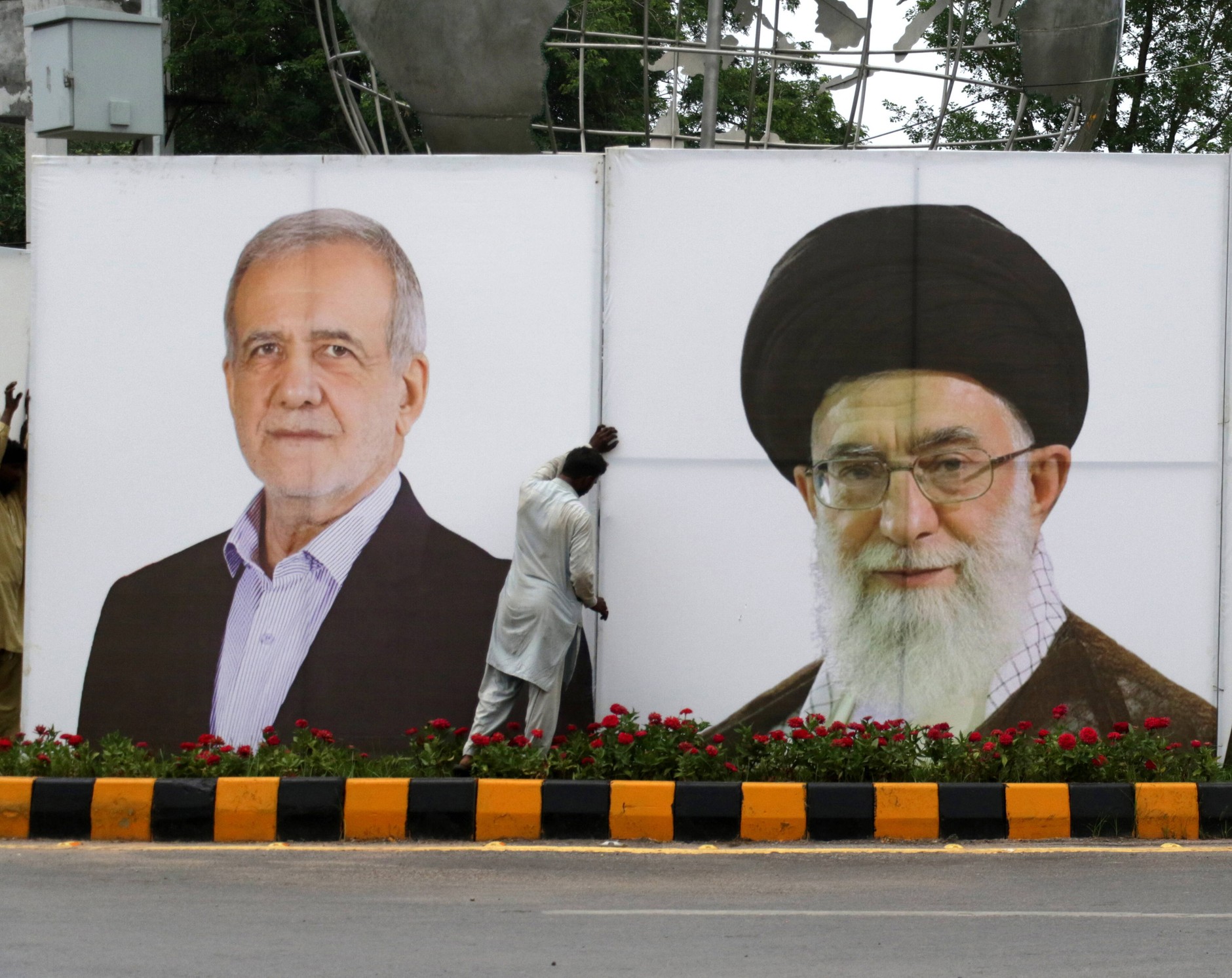
A billboard with photos of Iranian President Masud Pezeshkian (L) and Iranian Supreme Leader Ali Khamenei in Islamabad, Pakistan, August 1, 2025 (illustrative photo)Sohail Shahzad / PAP
Moreover, in the event of a change at the top of the regime, it is difficult to predict how the situation in the country will develop. Zimmt believes it is likely that the next spiritual leader will be weaker than Khamenei and that the Revolutionary Guard will play a greater role. — I'm not sure if that would make it better or worse. However, it is difficult to imagine a scenario much worse than the current one, he said.
Since there is little chance of regime change and Iran's nuclear program has not yet been able to be dismantled through military strikes, Zimmt hopes to make progress diplomatically. “I believe an agreement between Iran and the United States is the best solution to prevent Iran from regaining nuclear capabilities,” he said.
In his opinion, it is also important for Israel and Iran to re-establish some kind of communication channel between themselves that will reduce the risk of incorrect assessments. To improve the overall security situation in the region, the expert also hopes to conclude a security agreement between Israel and Syria and normalize relations with Saudi Arabia.
I’m Ashley Davis as an editor, I’m committed to upholding the highest standards of integrity and accuracy in every piece we publish. My work is driven by curiosity, a passion for truth, and a belief that journalism plays a crucial role in shaping public discourse. I strive to tell stories that not only inform but also inspire action and conversation.