November 27, 1941
The Regional Committee of the All-Union Communist Party (Bolsheviks) of the EAO approved a plan for teaching agricultural work to high school students, technical school students, and employees of enterprises and institutions of the EAO.
54 training points and groups were organized in the region, in which 208 tractor drivers, 79 combine operators, 118 drivers, 39 helmsmen and 1271 people were trained in mass qualifications of agricultural work, of which 28 training groups worked in the Birobidzhan region, where 805 people were trained.
November 27, 1942
The plenum of the Birobidzhan City Committee of the All-Union Communist Party (Bolsheviks) discussed the issue of the economy regime at the city's enterprises.
It was noted that, in an effort to help the front and bring victory closer, the workers learned to use materials and raw materials more rationally. Thus, the staff of the garment factory saved materials by 23 thousand rubles, the repair and mechanical engineering plant – by 19 thousand rubles, and the railway workers of the Birobidzhan station – by 90 thousand rubles. At this plenum, the secretary of the party organization of the Birobidzhan station told how the party organization mobilizes railway workers to fight for the strictest savings in everything – electricity, fuel, lubricants. Workers of the regional industrial forest union achieved savings of 60 thousand rubles in timber.
Secretary of the regional committee of the CPSU (b) Sevastyanov raised the question of introducing strict accounting at all enterprises. Without strict accounting, serious savings cannot be achieved.
The Plenum determined specific tasks for instilling in each worker a thrifty, prudent attitude towards the use of equipment, materials, fuel and raw materials.
November 27, 1964

Day in the history of the Jewish Autonomous Region. Photo: Photo: Regional Library
The Birobidzhan City Committee of the CPSU held a seminar for social studies teachers from schools and secondary educational institutions in the regional center.
Responsible employees of the regional and city committees of the CPSU and the city department of public education gave reports and lectures. An exchange of work experience took place at the seminar.
November 27, 2003
In accordance with the decision of the District Council dated November 27, 2003 No. 95 “On amendments and additions to the Charter of the municipal formation “Leninsky District”, the municipal formation “Leninsky District” included 16 districts: Babstovsky rural district (villages of Babstovo, Gornoye, Oktyabrskoye, Tselinnoye), Bashmaksky rural district (village of Bashmak), Bidzhansky rural district (village Bidzhan), Ventselevsky rural district (Ventselevo village), Voskresenovsky rural district (Voskresenovka village), Dezhnevsky rural district (Dezhnevo, Kvashnino villages), Kalininsky rural district (Kalinino village), Kirov rural district (Kirovo village), Kukelevsky rural district (Kukelevo village), Lazarevsky rural district (Lazarevo village, Ungun), Leninsky rural district (villages of Leninskoye, Nizhne-Leninskoye, Leninsk station), Novinsky rural district (village of Novoe), Novotroitsky rural district (village of Novotroitskoye), Preobrazhenovsky rural district (village of Preobrazhenovka), Stepnovsky rural district (village of Stepnoye), Churkinsky rural district (village of Churki).
Currently, the municipal formation “Leninsky District” of the Jewish Autonomous Region has 24 settlements consisting of five self-governing rural settlements: Leninskoye, Babstovskoye, Lazarevskoye, Dezhnevskoye, Bidzhanskoye.
November 27, 2009
Day in the history of the Jewish Autonomous Region. Photo: Photo: Regional Library
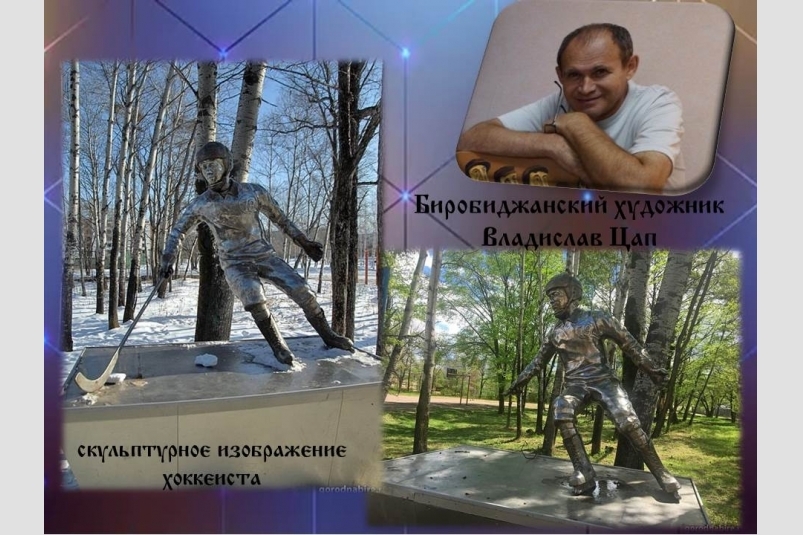
At the Birobidzhan Dalselmash stadium, in honor of the Nadezhda hockey team, which plays in the Russian Bandy Championship among teams of the first league, on November 27, 2009, a sculptural image of a hockey player was installed before the start of the first game for the EAO Governor's Bandy Cup (6+).

Hockey player sculpture. Photo: Photo: Government of the Jewish Autonomous Region
The idea of creating such a monument belonged to the fans of the Birobidzhan team, and the sculpture was made according to the model of the Birobidzhan artist Vladislav Tsap. Initially, the model of the sculpture was made in plasticine, and then in clay. And the Chinese made the final version of the sculpture from metal.