Britain raises taxes. The left-wing government is breaking promises under pressure from financial markets


The Labor government has proposed a major tax increase aimed at plugging the massive budget hole that has been troubling Britain's creditors for several years. This means breaking pre-election promises not to raise taxes on the “working class”.
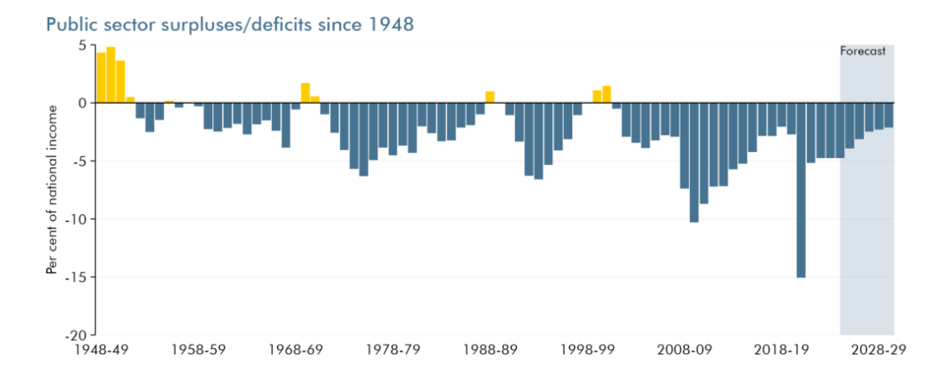
On Wednesday, November 26, Chancellor Rachel Reeves presented the main assumptions of next year's state budget. Next year's budget deficit is expected to amount to 28.8 billion pounds, but a surplus is expected “already” for 2028. As a result, British borrowing needs, which have worried investors so much in recent months, are expected to be reduced. It is estimated that HM Government will need to borrow £138.3 billion in the current financial year, £112.1 billion next year and £67.2 billion in 2031.
Of course, these are only forecasts based on the assumed path of economic growth and inflation. However, these have been reduced again. The Office for Budget Responsibility (OBR) assumes that in 2026 the UK's GDP growth will be only 1.4% and will “accelerate” to 1.5% in the next four years. All these estimates have been lowered compared to the spring forecast.
The most taxed Britons in history
The Labor government was forced to introduce a second strong tax increase in a row. A year ago, Chancellor Reeves increased taxes by approximately £40 billion and it was the highest increase in decades. Labor then publicly promised it would no longer raise taxes “for working people”. On Wednesday, that promise was broken.
The announced new taxes are expected to bring the British treasury £26 billion over the next 5 years. As part of the increase, PIT tax thresholds will be frozen, which in the conditions of permanent inflation means de facto an increase in rates for some employees. Tax on properties worth over two million pounds will be increased. The exempt amount (currently amounting to £2,000) in the “contribution” to the British equivalent of the National Health Fund will disappear. This is clearly a tax increase for the “working class”. The relief for couples with two children will also disappear.
Savers and investors will also be affected. The capital gains tax-free savings limit will be reduced from £20,000 to £12,000 in ISA accounts. Taxation on dividends will be increased. The rate will increase by two percentage points, with the maximum basic rate increasing from 8.75% to 10.75% and the maximum rate increasing to 35.75%. Taxation on savings (i.e. income from bank deposits) from April 2027 will be 22%, 42% and 47% depending on the amount.
It doesn't end there. The tax rate on online gambling will increase from 21% to 40%. The tax imposed on owners of electric cars will increase. Owners of electric cars are to pay a somewhat absurd levy of three pence for each mile driven. (and plug-in hybrid owners have to pay 1.5 pence/km). In addition, Britons still pay the usual road tax, which averages around £225 a year. The only “good” news is that there will be no increase in fuel similarity, which is currently subject to a rate of 52.95 pence per liter. Even milkshakes and lattes are to be taxed – under the pretext of subjecting them to sugar tax. As every year, excise tax rates on alcohol and cigarettes will also increase.
These (and others not mentioned in this article) tax increases will make According to OBR, the share of taxes in GDP will increase to a record 38.3%. This is a consequence of the constantly growing expenditure of the United Kingdom government, which already exceeds 40% of GDP. As a result, for several years the UK fiscal deficit has exceeded 5% of GDP, which is unsustainable in the long run.
Creditors forced tax increases
This year's tax increase means the ruling Labor Party has broken all tax promises. It was forced by financial markets. The United Kingdom's creditors widely demanded tax increases and curbing the public finance deficit. The Gilt market was concerned that the fiscal decline that has been ongoing since 2020 is leading to an uncontrolled increase in public debt. At the end of 2024, it amounted to 93.6% of GDP.
The initial reaction of financial markets to the British budget was positive. The pound strengthened against the dollar – the GBP/USD rate increased by 0.6% on Wednesday after an increase of 0.5% the day before. Long-term Gilts also gained. The yield on 10-year British bonds decreased to 4.47%, although in September it reached 4.85%. 30-year securities also reacted slightly positively, their yield decreased to 4.65% compared to 4.75% recorded a week ago.
– This is not entirely good news for investors – said ING economists. They indicated that fiscal consolidation is postponed and will not start until 2027. Moreover, the size of tax increases across the economy (estimated at 0.75% of GDP) may prove to be insufficient. All this may not be enough to convince investors about the financial stability of the United Kingdom.
It is also worth adding that tax increases are not accompanied by cuts in bloated budget expenditure: all kinds of benefits, subsidies and broadly understood “social” benefits. All this means that, looking in the longer term, the situation in Great Britain has not changed significantly. It is still a country plagued by a crisis of excessive public debt, high taxes, the pathology of the “welfare state”, with practically zero economic growth, increased inflation and a crazy energy policy pushing for “zero emission”. This has little chance of ending well.