
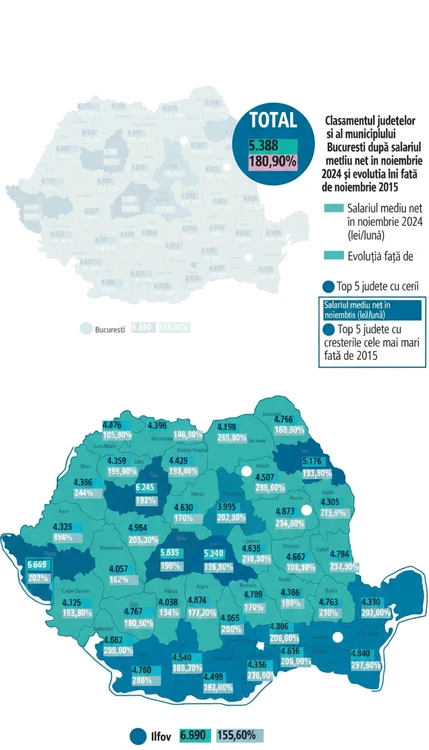
Although the average net salary increased in September by 4.1%, compared to the same period last year, to 5,443 lei, according to INS data, its value actually decreased if we refer to inflation. And from the leaf, an average employee in Romania remains with almost 57% after the application of taxes.

The salary has increased this year, but relative to inflation we are receiving less. Archive photo
“According to INS data, the average net salary in Romania increased by 4.1% in September 2025 compared to the same period last year and by 1% more compared to August. If we refer to August 2015, the increase was more than 254%, an impressive increase, both in nominal and real terms. However, although the growth, both in nominal terms and in real terms, has been impressive in the last years, Romania remains at the tail of European countries when it comes to hourly wages.
Thus, in our country the average gross salary per hour is 10.8 euros, compared to 24 euros, which is the European average. However, we also have among the highest taxes on salaries, which is why an average employee in Romania remains with about 57% of this money“, explains Ion Soltinschi, consultant and financial planner.
Source mr.finance
According to INS data, in September, the biggest increases in average salary were:
- 16.4% in auxiliary activities for financial intermediation, insurance activities and pension funds;
- 14% in crude oil and natural gas extraction;
- 7-8.5% in service activities related to extraction, telecommunications;
- 2.5-6% in other industrial activities.
In the top of the best-paid professions, according to the average gross salary per industry, are those from the sectors: crude oil and natural gas extraction (21,036 lei), information and communications (18,003 lei) and financial intermediation and insurance (14,517 lei).
At the opposite pole, the most significant decreases in the average net salary were registered in the field of air transport (14.9%). Decreases between 2% and 6.5% were also recorded in the fields: manufacturing of other means of transport, production and supply of electricity and thermal energy, gas, hot water and air conditioning, water transport, printing and reproduction of records.
As for inflation, it was 9.88% in September, after it was 9.85% in August. In October, inflation eased slightly to 9.8% from 9.88% in September.
How do we protect ourselves from inflation?
“Average salaries in Romania, after a period of stagnation in the previous months, increased in September, but only in nominal terms. In real terms, i.e. adjusted for inflation, the average salary decreased in Romania compared to last year. Thus, there is a real need to protect ourselves against inflation”states Ion Soltinschi.
The specialist recommends, in order to reduce the effects of this phenomenon, investments in instruments with a yield above the inflation rate. According to him, the best method of protection is to place the money in instruments that offer interest or returns higher than the rate of inflation.
Depending on the risk profile, they can be:
- State securities, especially those issued in lei with a fixed interest rate of 6-7%, because they are safe and guaranteed by the state, even if the interest rate offered is lower than the inflation rate;
- Diversified investment funds, combining stocks and bonds, suitable for medium-long term capital protection.
Another recommendation is to diversify your portfolio into real assets, which tend to hold their value while prices rise. Such as, for example, real estate investments – in apartments, land, commercial premises, the prices of which usually increase with inflation – or in gold and precious metals, considered safe-haven assets in periods of instability.
“Over the long term, investing in stocks or mutual funds is among the most effective forms of inflation protection. Companies adjust their prices and earnings based on inflation, and the value of stocks tends to reflect these increases“, says the financial consultant.
The recommendations in this case are direct investments in shares listed on the Bucharest Stock Exchange or on international exchanges and those in mutual funds or ETFs that track indices such as BET, S&P 500 or MSCI World. Average annual returns on these long-term investments are 8-10%, therefore beating inflation and providing real capital growth.
The evolution of interest rates on government securities
Returning to government bonds, the interest rates offered vary depending on the program (Fidelis or Tezaur), maturity and whether they are aimed at blood donors.
For example, Fidelis issues in February had interest rates of up to 7.95% (lei) and 6.25% (euro), and Tezaur issues in December 2024/January 2025 had interest rates of up to 7.60%. There are also special installments for blood donors with higher interest rates.
Fidelis program
Interest in lei:
February issue: 6.95% (1 year), 7.65% (3 years) and 7.95% (5 years).
May issue: 6.75% (1 year), 7.40% (3 years) and 7.80% (5 years).
Tranche for blood donors (1 year maturity): 7.95%.
Special tranche for blood donors (expiry 2 years): 8.35%.
Interest in euros:
February issue: 4% (2 years) and 6.25% (7 years).
Thesaurus program
Interest:
December 2024/January 2025 issue: 6.45% (1 year), 7.20% (3 years) and 7.60% (5 years).
Interest can reach up to 7.90% on other issues, such as the one in July 2025.
October 2025 issue: included interest of up to 7.30%.