She turned the maternity ward into a training ground. “It was the best decision of my life”


When the first bombs fell on Ukraine in February 2022, Kamila Raczyńska was sitting in her apartment in Warsaw and talking to her then-husband about the emergency plan. — He said: we're leaving. And then, for the first time, I thought: I'm staying. I couldn't run away – he recalls.
She knew she reacted differently than most of her friends. She emphasizes that she perfectly understands her friends who have children and say that in the event of a war they would leave the country. — I'd probably do the same if I had a family, but I don't.
She thought that it was people like her – without family obligations, but with a need for action – who should stay. And this thought gave her no peace. Since she already said out loud that she wouldn't leave if “W” happened, then she wanted to know as much as possible so as not to be helpless as a civilian. Because what's the point of sitting in the basement with the neighbors if he knows as much as they do? He'll be able to handle a nosebleed, but what should he do if he cuts off someone's limb?
— I have such a temperament that when I'm interested in something, I just have to work my way through it. I started to consider various courses that would prepare me for civil defense in the event of an armed conflict, and there are many of them. The army launches various training courses for civilians. It finally dawned on me that there was no point in fighting, that I really just wanted to join the army
It took her a year to come to terms with this decision. It was so different from the environment she was in, so far from soft training about emotions and psyche. But somewhere inside she felt it made sense. After all, half of her family on her mother's side were former soldiers – her great-grandfather, Lieutenant Czesław Dylewicz, played an important role in Operation Tempest in Siedlce, and her grandmother was an AK liaison.
See also: What would Poles do in case of war? There is a new survey
Previously, she trained, among others, employees of prisons in the field of stress management. While getting to know the uniformed officers, she discovered work stylethat suits her. Communication dynamics, directness, pacewhich suits a person who does everything quickly. Type loyalty and sense of belonging in groups that work together and depend on each other. That's what she wanted.
— No soldier or any other uniformed officer can do anything alone. Police officers, medics in ambulances, firefighters going into the fire – no one works alone. And this is something that brought me closer to the belief that this is the place for me, he says.
Determination bordering on madness
The door has been sealed. She volunteered for military service and chose the armored forces. She put all her energy into preparing properly. She suspended her job and lived on savings. She trained every day for half a year – running, gym, jiu-jitsu. Solving logic tests, Raven's matrices.
They were waiting for her psychological research, personality tests checking mental stability and motivation, conversation with a psychologist and medical commission. She passed everything, got category A. And just then, three weeks before incarnation, she broke a bone in her foot.
The doctor did not want to agree to serve. Everyone was holding their heads. She went. — I was the only soldier who, apart from going into the field, was allowed to wear soft shoes. But I went on many hours of marches in the forest in military boots with a swollen foot. I was taking painkillers through intramuscular injections, she recalls.
After 27 days of service, she passed her final exams and achieved higher results in PE than expected for her age. The foot healed without any complications.
Her ninety-year-old grandmother, a second lieutenant and liaison of the Home Army, came to the oath-taking ceremony. It was touching.
It replaced armored troops with WOT
However, Kamila did not stay in the regular army. She transferred to the Territorial Defense Forces. She did it consciously, she wanted to be in a structure that also operates in peacetime. — WOT's motto is: “Always ready, always close.” This hit me. I saw territorials helping during the flood. It confirmed my belief that I wanted to do the same – be close to people and act locally, co-create a structure with people who have similar values – he explains. — Besides, I can remain myself, I can still work in civilian life. Among us there are representatives of various professions. Each soldier brings his own potential, knowledge and resources to the structure.
Salaries at WOT are not high. Private gets it PLN 177 per day of service. “I charged more for an hour in the office,” admits Kamila. Combat readiness weekend (once a month) is extra PLN 630which gives less than 1 thousand. PLN per month. However, money is not her motivation – she chose WOT out of conviction.
Read also: How much do you earn in the US Army? We got down to the details
She also started studies in “Civil Protection and Civil Defense” at the Academy of War Arts to better understand how to educate civilians in crisis situations. Together with his partner, who is a paramedic, he conducts training in rescue procedures in times of peace and war – from packing an evacuation backpack to creating an emergency plan for the family. — In many European countries, children learn such things already in kindergarten. It still arouses resistance in Poland, even though it is basic knowledge about security, he says.
In his diploma thesis, he wants to investigate why Poles react this way and how to talk to civilians so that they want to listen. Because the offer is there, but few people take advantage of it.
The number of women in the army is increasing
— Every fifth soldier of the Territorial Defense Forces is a woman. I have wonderful friends of various ages, from those in their twenties to those in their fifties.
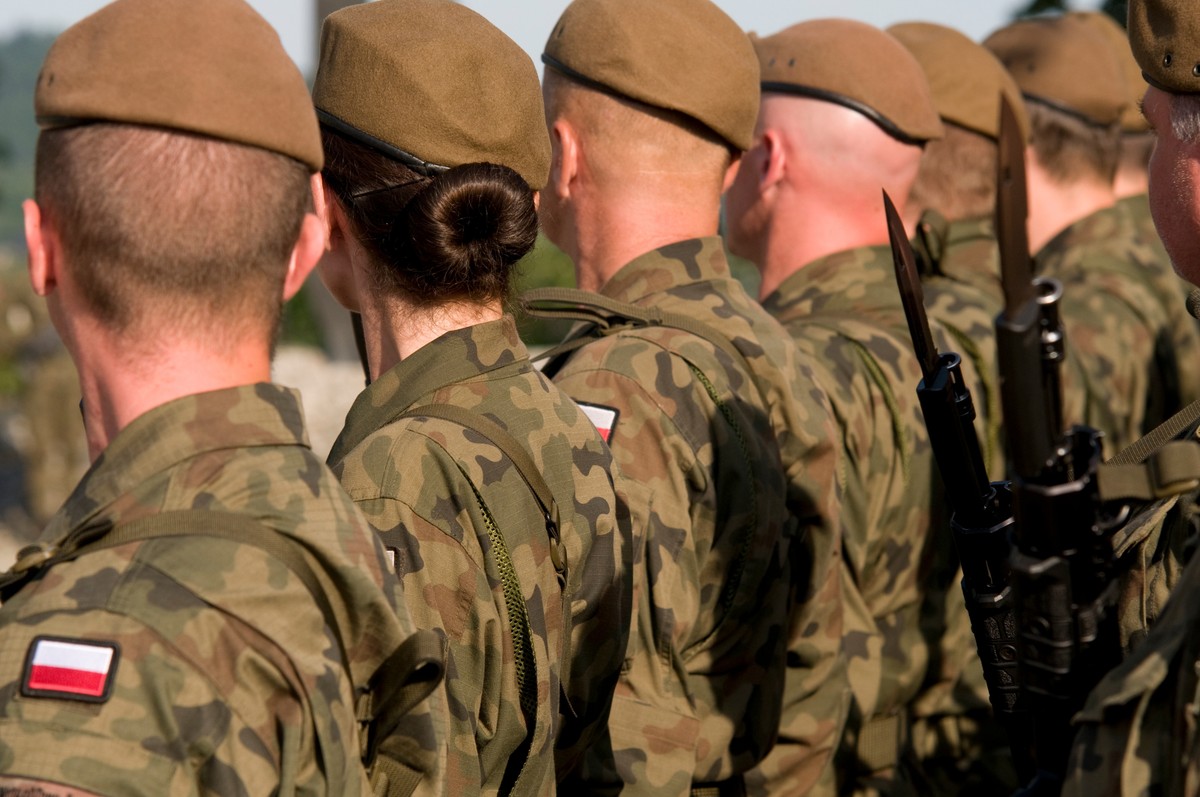
They all look the same in uniform. They don't have to wonder what to wear. They do not waste energy on makeup (only colorless lipstick and delicate “touch-ups” are allowed). Nails may have a maximum of 2 mm beyond the fingertips. Lacquer? Only transparent or nude. Hair tied back and no jewelry except a wedding ring.
— Of course, there's also some discomfort involved. The equipment is designed with men in mind (although this is starting to change). I am six feet three and weigh fifty-five kilograms. The helmet, rifle, ballistic vest and full backpack probably weigh about twenty kilograms together. I get tired sometimes, but I manage.
She admits that for women, service often brings additional challenges – physical and emotional. — We spend many hours in the field in full uniform, and it is a challenge for women to even meet their needs, not to mention menstruation. During voluntary military service, some of the girls missed their children very much. We only had phone calls in the evenings, so the conversations ended in tears – on both sides. One twenty-minute visit for a month. It's a lot of emotions, emotion and just plain tiredness.
Kamila says that the army is very supportive of women. — I haven't heard a single sexist comment here, nor have I experienced any reluctance. Rather, encouragement and recognition that we have the strength, that we want to. After announcing her decision, she heard that the army was pathological – everyone drank, shouted insults, the men were uncouth. Kamila found out that this is absolutely not the case. — In my unit, soldiers show respect for each other.
Read also: Is professional success a guarantee of happiness? Business through the eyes of female leaders
What attracts women to the military? Agency that is hard to find elsewhere. Physical fitness, shooting, survival skills, orientation in the field – this fascinates more women than you might think. — I like the camaraderie between men and women, the directness and sense of humor. I really feel like we are team – describes. In conversations with other candidates, she also heard other motivations. — “Who will defend us if not ourselves?” — it was raining in the corridor.
Officers with many years of experience admit that their attitude has changed. — One told me honestly that he had previously been skeptical of women in uniform. But after years of service, he sees that we are great in the army: we are compulsory, we learn quickly, we flexibly adapt to conditions. On the other hand, we soften customs and bring empathy, says Kamila. — I feel this is my place. This change was the best decision of my life.