November 18, 1935
The newspaper “Birobidzhan Star” (12+) November 18, 1935 tells its readers about the arrival in Birobidzhan of the writer David Khait, one of the few Russian writers who reflected in his work the life and life of Jews in the old ghetto:
“Comrade Chait is going to stay in our region for three months. During this time he will get acquainted and study the new conditions in which Jewish workers have gained the opportunity to create their own national socialist culture.”
The newspaper also published a resolution of the Presidium of the Regional Executive Committee of the Jewish Autonomous Okrug on the construction of a house for the drummer of the “Wheel of Revolution” artel, Comrade Rosenberg.
A.V. Eisenberg, director of the State Theater of the Jewish Autonomous Region, talks about his first new independent work – the play “Goldgraeber” (18+):
“In a few days, before the shock workers and shock women of Birobidzhan, a picture of the pre-revolutionary past of the Jewish shtetl poor will appear on the stage.
The tsarist government, which made Russia, according to Lenin’s sharpest formula, a prison of nationalities, was especially inventive in oppressing the Jewish poor, placed under the combined blow of continuous political, economic and social repression. Expelled from the sphere of agricultural and industrial labor, the mass of the Jewish poor served as the bargaining chip with which the tsarist government paid in solving internal contradictions that arose in its class body.

Day in the history of the Jewish Autonomous Region. Photo: Photo: Regional Library
The builders of socialism, the shock workers of the construction site, the collective farm Red Army soldiers, and students will see from the stage, through the power of art, a preserved piece of the past, which they will hate even more, loving more strongly and brightly our flourishing present, which we are ready to firmly and powerfully defend.
Our viewer will have to feel like Gulliver visiting the Lilliputians in relation to the “Kasriliput” reality that he will observe from the stage.”
The newspaper informs its readers that preparatory work for the delivery of state acts for the eternal use of land has been completed, that 22 collective farms in the region are already ready to issue documents, and 23 documents still need to be prepared. The issuance of certificates will begin in December this year.
November 18, 1889

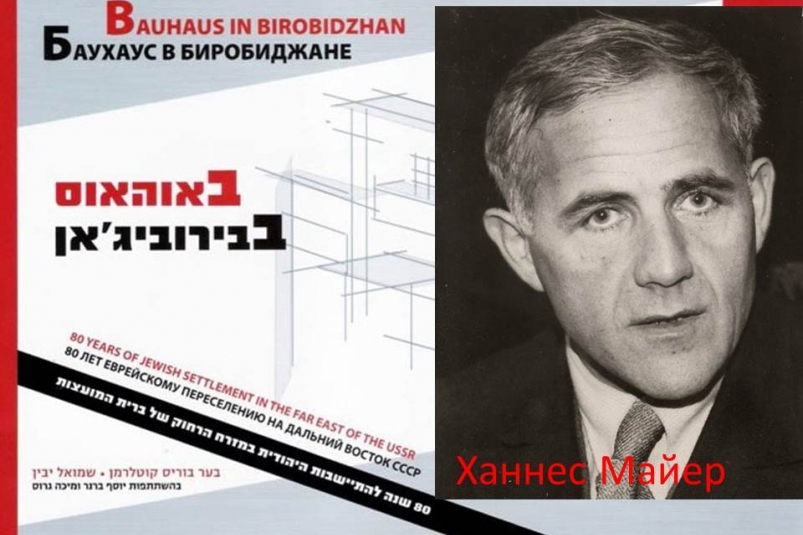
Hannes Mayer. Photo: Photo: Regional Library
Hannes Mayer (Meyer Hans Emil) was born on November 18, 1889, a Swiss architect. The future architect was born in Basel, into the family of builder and businessman J. E. Meyer. From 1905-1909 studied at a vocational school in Basel, then from 1909-1912. studied at the arts and crafts school in Berlin, where he simultaneously attended urban planning courses at the Agricultural Academy. In 1912 he visited Great Britain and studied the cooperative movement and garden-city type settlements there.
In 1919 he opened an architectural studio in Basel. In 1927 he headed the newly opened architectural department of the Bauhaus. In 1928 he became one of the founders of the International Congress of Modern Architecture.
From 1928-1930 – Director of the Bauhaus. For his communist views he was removed from leadership and moved to the USSR.
From 1930-1936, H. Mayer worked in the USSR, taught at the Higher Institute of Architecture and Civil Engineering in Moscow, worked as the chief architect of the Giprovtuz design bureau, participated in architectural competitions, and was involved in urban planning projects.
In the early 1930s, an active process was underway in the Birobidzhan region to form and formalize the administrative structure and the formation of settlements. During the same period, district authorities are thinking about the appearance of the future center of autonomy.
In 1932, the architect Rabinovich was involved in the planning of Tikhonkaya. He noted that the territory of the workers' settlement was being built up chaotically and uncontrollably. Based on this, in Moscow it was decided to involve a team of architects under the leadership of Hannes Mayer in the work.
On May 31, 1933, Hannes Mayer arrived in Birobidzhan. Together with his specialists, he carefully examined the territory allocated for the development of the future city.
After getting acquainted with the surrounding area, it becomes clear to H. Mayer that on the basis of this village it is not possible to build a city for a significant number of inhabitants, and he turns his gaze to the opposite bank of the Bira. There, on the right side of the river, Mayer with specialists and representatives of local authorities are exploring the surroundings of Bolshaya Sopka. As a result, the architect comes to the conclusion that it is here that a new city needs to be built, which will become the capital of the autonomy, while the old part, swampy and prone to frequent floods, should be given over to the industrial sector, to the district administration.
At the end of July 1933, Mayer's brigade, having completed its work, left Birobidzhan.
During the same year, the architects of H. Mayer developed a detailed construction plan, coordinating it with the State Committee for the Resettlement of Jews (KomZET) and the Commissariat of Public Utilities of the RSFSR.
On August 23, 1934, H. Mayer again came to Birobidzhan to present a project to the heads of the newly proclaimed Jewish Autonomous Region. At the end of August, he went to Khabarovsk to approve the project at the regional level.
H. Mayer soon lost control of this project, perhaps due to the outbreak of persecution of foreign specialists.
The planning of Birobidzhan was transferred to another architect and this plan for the development of the future city was never implemented.
In 1936, H. Mayer left the USSR and returned to Switzerland.