
Another housing loan subsidy program – such a decision was recently made by Orbán's government. Meanwhile, surprisingly little construction is taking place in Hungary, showing that financial aid alone does not solve the housing shortage.
The unorthodox, sometimes quite controversial economic moves of the Hungarian Prime Minister and the Fidesz party are sometimes called “orbanomics”. This is an obvious reference to Reaganomics, i.e. the economic policy of Ronald Reagan's times. Can we also talk about “orbanomics” in the case of Hungarian housing policy? It seems so, although housing “orbanomics” is more of a demand-driven rather than a supply-driven nature. A characteristic element of “orbanomics” are, for example, subsequent subsidy programs that are intended to compensate for the high interest rates on Hungarian loans. However, RynekPierwotny.pl experts point out to a structural problem on the supply side. Surprisingly few new premises and houses have been built in Hungary for years. Supply constraints are certainly related to increases in square footage prices, of which Hungary is the leader.
There was CSOK, then CSOK Plusz, and now there is something new?
We will learn more about the previous history of subsidizing housing loans and Fidesz's housing policy from last year's article prepared by experts from the RynekPierwotny.pl portal. It is worth briefly recalling that the Hungarian housing loan subsidy program called CSOK was launched in the middle of the last decade. From 2015 to 2023, more than 240,000 Hungarian households took out preferential housing loans.
Despite subsequent changes to the rules of the CSOK program, it has always had a built-in pronatalist component. For example, a Hungarian family with three children purchasing a new house in 2017 could receive as much as 10 million forints (then approximately PLN 135,000) of non-repayable aid and was entitled to take out a housing loan with a fixed interest rate of 3.00% (up to the amount of 10 million forints). There was also an option to take out a preferential loan for people who declared having three children in the future.
In 2024, the CSOK program received a facelift, or rather was redirected to helping rural borrowers (as Falusi CSOK). The CSOK Plusz program was launched, providing beneficiaries with a low, fixed interest rate on a housing loan (3.00%) and debt cancellation of 10 million forints (approx. PLN 110,000) after the birth of the second or subsequent child. Planning to have children entitles you to favorable loan terms.
Otthon Start, i.e. subsidies for a much wider group
Interestingly, the new Otthon Start subsidy program, which was launched in September this year, can be combined with the previously mentioned CSOK Plusz program and a variant of subsidies for rural residents (Falusi CSOK). Unlike the pro-family CSOK Plusz program, the new Otthon Start program is addressed to a wider group of beneficiaries who have not had their own home for the last 10 years. Borrowers can count on a fixed interest rate of 3.00%, which is more than twice lower than the market average.
Preferential repayment of debt with a maximum value of 50 million forints (approx. PLN 550,000) can be spread over a maximum of 25 years. However, the price of a flat financed under the Otthon Start program should not exceed 100 million forints (approx. PLN 1.1 million) in the case of apartments and 150 million forints (approx. PLN 1.65 million) when choosing a house. The price limit for 1 square meter is 1.5 million forints (approx. PLN 16,500). A greater barrier may be the need to make an own contribution of 10%.
Supply is a bigger problem than too expensive “mortgages”?
Reports from Hungary indicate great interest in the new subsidy program. This situation may raise concerns about the development of square footage prices. It is worth remembering that the situation in Hungary is special. We are talking about an EU country where, from 2015 to 2024, the real prices of houses and premises increased by 82%, which was the highest result in the community. The corresponding price change calculated by Eurostat for Poland is 40% after taking into account inflation, and the average for EU countries is 21%.
Experts from the RynekPierwotny.pl website draw attention to a fact that probably has great price-related significance. We are talking about a low level of construction activity. In 2024, 13,295 apartments and houses were completed throughout Hungary. This is less than in Warsaw (14,873)! Of course, no one expects that Hungarian apartment blocks will grow as much as during the construction boom of János Kádár, when large slabs reigned supreme and over 70,000 apartments and houses were completed every year. Let us remember, however, that in Hungary more than 30,000 apartments and houses were last completed 20 years ago.
Hungarian “housing”: the role of the capital is great
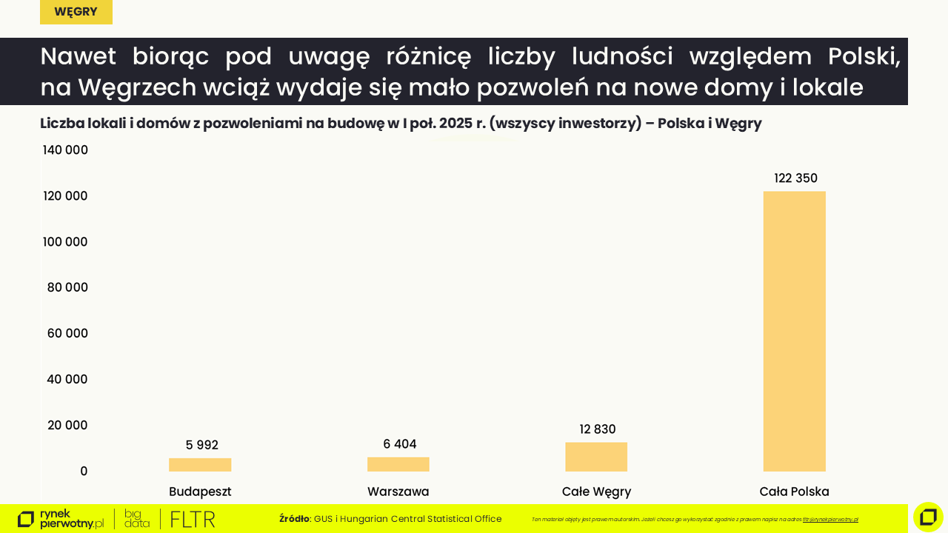
The current situation also seems suggestive. Well, throughout the first half of 2025, in Hungary, which has a population approximately four times smaller, permits were obtained to build almost ten times fewer houses and premises than in Poland. Importantly, last year it was even worse. From January to June 2024, permits were issued for 8,972 Hungarian apartments and houses, and in Budapest alone – for only 1,571.
In the light of this year's data, the Hungarian capital no longer lags behind Warsaw very much, but what draws attention is its currently very high share in nationwide construction activity. In the case of Budapest, we see an increase in the year from 18% to 47% in the number of permits for houses and premises in Hungary. However, even the result for the first half of 2024 at 18% was high – much higher than the percentage calculated for Warsaw (8%).