2025-11-13 22:04
publication
2025-11-13 22:04
Thursday's session on the New York stock exchanges ended with strong declines. Shares of companies related to the AI investment mania were again drastically overvalued. Ironically, Wall Street's declines materialized when agreements were made on Capitol Hill to further fund the federal government.
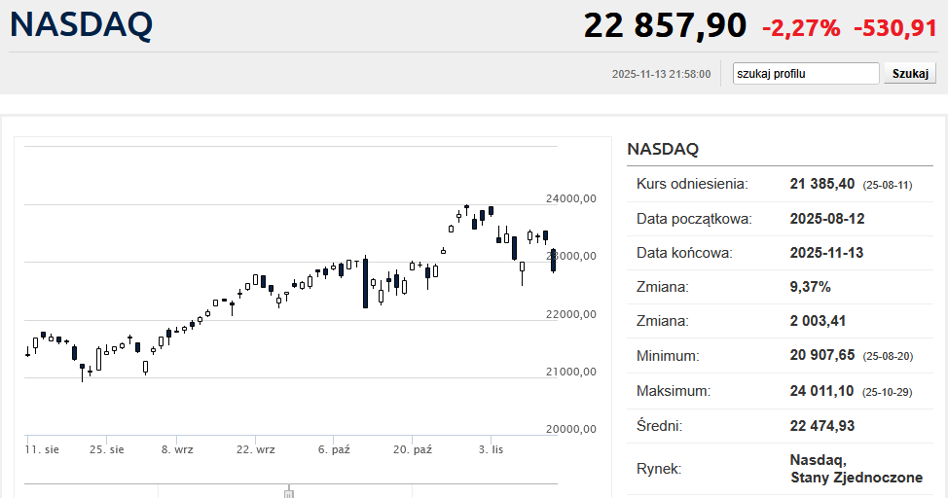
It was a clearly bearish session. The tech-heavy Nasdaq Composite fell 2.29% to finish at 22,870.49 points. And this is hardly surprising, since the shares of Nvidia, Broadcom, Oracle and AMD were each reduced by approximately 4%. Let's add Tesla falling by 6.6%, Palantir's prices falling by 6.5%, and Alphabet and Amazon losing over 2%.
In short, it was another vote of distrust by investors towards companies profiting from the boom in generative artificial intelligence. The stratospheric valuations of some AI companies tempt short-term investors – that is, those who make money from falling prices of “shorted” securities. The most famous short on AI recently is the bet of Michael Burry, who bought out-of-the-money (OTM) put options on Nvidia and Palantir shares. This is the same Burry who correctly predicted the collapse of the mortgage market in 2007.
But it wasn't just technology stocks that fell on Thursday. The financial sector was also hit hard, with the prices of large banks falling by 2-3%, although they had reached historic highs the day before. It was a massive retreat from the stock market, which brought the S&P500 index down by 1.66% and to the level of 6,737.49 points. Dow Jones gave up 1.65% and finished with a score of 47,457.22 points.
But the most spectacular was the nearly 20% increase in the VIX volatility index. This is a signal that large capital is increasingly afraid of a correction of the last wave of the bull market and is looking for security on the futures market, increasing the implied volatility of options.
– There is a lot of uncertainty about the state of the economy. We are going through a kind of correction in the AI sector and we are observing sector rotation, commented Peter Cardillo, chief economist at Spartan Capital Securities in New York, quoted by Reuters. The latest weekly labor market data published by ADP indicated a decline in employment in the private sector by 11,000. full-time positions. In turn, Indeed Hiring Lab data showed that the retail sector employed 16% less staff than a year ago.
The irony of fate may be that this correction would begin after the long-awaited adoption of the law financing the operation of the federal government. The 45-day shutdown was the longest in US history and, according to the Secretary of the Treasury, resulted in a reduction in US GDP growth by 1-1.5 percentage points in the fourth quarter. But for investors, this means that the Treasury Department is returning to the market, issuing huge amounts of Treasuries. That is, bonds that someone has to buy, and to do this, some people will probably have to sell something. E.g. shares of listed companies. So, paradoxically, the end of the shutdown means less money on Wall Street.
Additionally, there were “problems” with the Federal Reserve. The point is that until recently, a December interest rate cut that was considered virtually certain has become significantly less likely. The futures market is pricing the chances of a 25-point reduction in the federal funds rate at roughly 50%. A month ago it was 95.5% – according to FedWatch Tool calculations. Expectations of dynamic rate cuts by the Fed in recent months have been one of the main drivers of the boom in the so-called segment. growth companies. That is, largely in the AI sector.
– Data for the shutdown period will probably start being published at the beginning of next week. It will take time to clear the backlog, and there may still be little new data until the next Federal Reserve meeting, said Tom Nelson, director of market strategy at Franklin Templeton Investment Solutions.
K.K