How much you pay per pig and how much is left after slaughter. The truth about live and net weight


As Christmas approaches, demand for pork increases substantially, and this has a major impact on prices. For now, in supermarkets the price of pork varies between 16 lei/kg (on offer) and 40 lei/kg in the case of specialties, while at the entrance to the slaughterhouse the price of live pig is just over 7 lei/kg.
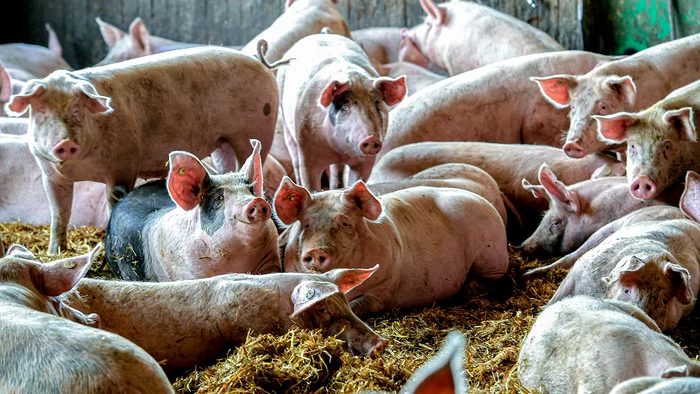
The price of a live pig at the entrance to the slaughterhouse decreased by 1 leu compared to last year
The data of the Ministry of Agriculture, through the Carcass Classification Commission, indicate an average price of a live pig, at the entrance to the slaughterhouse, between 7.1 lei/kg and 7.24 lei/kg depending on the weight.
The price is lower than last year, when it was 8.03 lei per kilogram (compared to 10.05 lei/kg in 2023), but many farmers sell live pigs at prices that reach more than double the value.
Some examples of price per kilogram of live pork, depending on the area, asking prices on social networks:
Ilfov: 10 lei/kg, 11.5, 12 or even 15 lei/kg
Argeș: 16 lei/kg
Timiş: 17 lei
Gorj: 13 lei/kg
Mureș: 14 lei/kg
Other ads, which do not include prices and the locality indicate prices of 14-15 lei/kg for a 120 kg pig or 17 lei/kg for a 100 kg pig.
In general, the price for live pigs is higher if the pig is smaller, meaning less fat, and lower if the pig is larger, over 150-180 kg.
How much does a kilo of pork cost after cutting?
Beyond the fact that, if they do not buy from specialized stores, they have to take pieces of meat to the ANSVSA laboratories for analysis, it must be said that the initial weight of the pig drops considerably after slaughter.
According to specialized websites, immediately after slaughter, before being butchered, the pig loses about 15% of its weight, just by bleeding.
Traditionally, immediately after it has been stabbed and the time required for the blood to drain has passed, the householders move on to searing the pig, an operation absolutely necessary to obtain a tender mouse. And in this procedure the pig loses weight. After cutting the pig, it is mandatory to empty and clean the intestines and belly, reaching a total loss of the weight of the “live” pig of about 25 – 28%.
How to calculate the weight of the animal, without putting it on the scale? It would be difficult to get the pig to step on the scale and sit still until you can read the weight. But pig breeding specialists frequently use a formula based on measurements, according to Agrointel.ro.
The first step – measure the length of the pig (L), starting from behind the ears to where the tail begins
Step two – measure the pig's girth (C), which is measured from behind the animal's front legs.
The approximate weight of the pig will be noted in the calculation formula with G.
Calculation formula:
G = C x CXL x 69.3
where:
G – Approximate weight of the pig
L – length of the pig
C – the circumference of the pig
69.3 – calculation constant
To find the weight of the pig carcass, multiply the approximate weight by 0.72
Case = G x 0.72
Calculation model:
L= 1.02 m
C = 1.27 m
G = CXCXL x 69.3 = 1.27 X 1.27 X 1.02 X 69.3 = 114 kg
The weight of the case is GX 0.72, which is 82 kg.
This means that the 114 kg pig “loses” after slaughter and butchering 32 kilograms, i.e. 28% of its original weight.
From 15 lei/kg, the price reaches 21 lei/kg
Applying this percentage of 28% to a pig weight of 200 kilograms, it follows that the person who bought it will be left with only 144 kilograms, for which he paid the total amount of 3,000 lei, that is almost 21 lei/kg.
Thus, the price of 21 lei/kg can be advantageous compared to the prices in the supermarket, if we take into account the fact that a whole pig can also be obtained delicacies such as mouse, which is sold for at least 90 lei/kg.
The meat must be analyzed by the veterinarian
After slaughtering the pig, keepers should take a piece of meat and take it to the vet for Trichinella testing.
After slaughter, the meat should not be eaten until the vet has tested negative for Trichinella.
The recommendation is also valid for meat obtained from wild boars.
For the test, people can cut a small piece of meat (about the size of a walnut) from the tongue, intercostal muscles, diaphragmatic pillars, masseter muscles, abdominal muscles, the muscular part of the diaphragm located near the ribs or sternum and take it to the veterinarian.