How a woman should take care of herself at 40+. Essential advice from a gynecologist, cardiologist, dermatologist and psychologist


After 40, a woman's body begins to send subtle messages, often ignored until they become obvious or even upsetting. There is fragmented sleep that generates constant fatigue, the skin dries faster, weight is harder to control, and emotional states are fluctuating.
It is not a crisis, but a profound change in biological rhythm. At this stage, the way you live becomes the main factor that decides whether aging will be a balanced or an accelerated process.
The subtle signals that the body transmits
Dr. Anca Sultan, obstetrics-gynecology specialist, describes this age as a “buffer zone” between biological youth and physiological maturity. Hormonal fluctuations become noticeable, estrogen begins to decrease, and progesterone loses its usual rhythm. “We are not talking about a disease, but about a natural transition. Lifestyle can hasten or, on the contrary, can delay menopause,” explains the doctor.
On November 22, at Unirii Commons (Str. Halelor 5 – Hanul lui Manuc area), these topics will be openly discussed during the Conference “I'm getting old and I don't regret it”, organized by SmartLiving.
The event brings together specialists from complementary fields to offer women 40+ a scientific, realistic and empathetic perspective on their own health. Among the guests are Dr. Florin Ioan Bălănică (psychonutrition specialist), Dr. Anca Sultan (obstetrics-gynecology specialist), Dr. Tatiana Niță (dermatologist), Dr. Alina Lemeni (cardiologist), Iulia Barca (psychologist and psychotherapist), Ioana Ginghină (actress) and Dr. Andrei Gabriel Zanfir (psychiatrist and psychologist). Professionals who not only talk about “anti-aging”, but also about the art of living well in your own time.
Conference tickets are available HERE.
Seemingly trivial factors such as diet, stress, lack of sleep, smoking, alcohol can accelerate ovarian exhaustion and increase inflammation. At the same time, maintaining a stable weight, regular exercise, and quality sleep can balance estrogen secretion and strengthen the immune system's response.
Sleep, moreover, becomes an essential link. “After 40 years, sleep is no longer a luxury, but a condition of health,” warns Dr. Alina Lemeni, cardiologist. Melatonin levels decline with age, and perimenopausal women are at greater risk of sleep disturbances. Its lack affects metabolism, blood pressure and even emotional health. That's why sleep hygiene, which involves giving up screens, the right temperature in the bedroom, fixed bedtimes, becomes a medical tool, not just a gesture of comfort.
The heart, metabolism and body reprogramming
In the first few years after menopause, women lose the biological advantage that estrogen provided to the heart. “The woman becomes equal to the man in the face of cardiovascular diseases,” warns Dr. Lemeni. “Good” cholesterol (HDL) levels drop, fat redistributes to the abdominal area, and blood pressure can rise even in the absence of symptoms.
Therefore, prevention becomes mandatory. Annual examinations, heart ultrasound when needed, blood pressure monitoring and giving up sedentary lifestyle are the simplest things an adult woman can do for her health. It's not just about avoiding disease, it's about cultivating vitality.
In this sense, Dr. Florin Ioan Bălănică talks about “metabolism reprogramming”. After 40 years, the same eating habits no longer work. “If you eat the same, but you're different than you were, the result can't be the same,” he explains. His recommendations include regular meals rich in protein, good fats and vegetables, reducing sugar and ultra-processed foods, adequate hydration (30ml water/kg body weight) and a light dinner before 7pm. In addition, exercise should be seen as medicine. 150 minutes of moderate physical activity per week can reduce cardiovascular risk by 30%, says Dr. Florin Bălănică.
The skin that “talks”
Dr. Tatiana Niță, dermatologist, says that the skin “speaks”. “Everything we do, what we eat, how much we sleep, how much we stress can be seen on the face, on the body.” After 40 years, collagen decreases by about 1% per year, and the skin loses its elasticity and brightness. But it is not a sentence, but a signal.
“Skin aging is not just genetic. It reflects the way we live,” explains Dr. Niță. Smoking, excessive sun exposure, oxidative stress and unbalanced diets accelerate the degradation of collagen and elastin fibers. On the other hand, a consistent routine involving daily sun protection, retinol or peptide products, deep hydration, quality sleep can visibly slow down the process.
“We can't stop time, but we can stop biological stress. And this occurs when the body is on constant alert. When we eat chaotically, we sleep little, we don't hydrate, we accelerate aging,” says the dermatologist.
In the same vein, Dr. Niță insists on the link between skin and nutrition. The intake of antioxidants (vitamins A, C, E, zinc, selenium, Omega-3) helps restore the skin barrier and delay inflammatory processes. Healthy skin doesn't come from a jar, it comes from a consistent lifestyle.
Mind and emotions. Vulnerability as strength
“Menopause is not a shame, it's reinvention,” says psychologist Iulia Barca. In working with patients between the ages of 40 and 55, she notices a recurring phenomenon: women lose their emotional bearings just when they're being asked to be stronger than ever. Children grow, parents age, careers become demanding and in between all this, the woman looks at herself.
“The problem is not age, but guilt: that you are no longer what you were, that you do not live up to the standards of the past. But right now is the time to redefine yourself. Say: I don't want to be young anymore, I want to be well,” says the psychologist.
The same perspective is supported by Dr. Andrei Gabriel Zanfir, psychiatrist and psychologist, who warns that anxiety and depression disorders are common around the age of 40-50, but often do not receive the necessary attention. “Many women come to the doctor after months of exhaustion, irritability and insomnia, not knowing that there is a combined hormonal and psychological imbalance behind it.”
Zanfir advocates emotional prevention: “Don't wait until you break down. Speak up. Ask for help. A timely discussion with a specialist can completely change the direction.” He reminds that the woman in transition 40+ needs not only balanced hormones, but also meaning, a new narrative about herself.
The transforming femininity
Ioana Ginghină, actress and woman who spoke openly about how she redefined her life after 40 years, offers an unusually serene perspective. “I'm approaching 50, but I feel more and more beautiful, sexier and more alive.” For her, femininity no longer means seduction, but freedom. The freedom to enjoy your body without shame, to cultivate your femininity beyond compare, and to embrace your age as a form of strength, not frailty.
This attitude resonates with everything the specialists advocate. Care is not a list of products, but a form of conscious presence. Caring for 40+ means reclaiming your place in your own life.
Practical guide to a balanced life
- Get your tests done annually, even if you feel well: gynecological check-up, hormonal analyses, blood pressure, cholesterol, blood sugar, vitamin D.
- Choose a balanced dietwith an emphasis on protein and raw vegetables.
- Exercise constantlybut without the pressure of performance — 30 minutes of brisk walking daily can be enough.
- Protect your skin: Daily SPF, hydration, rest, antioxidant-rich diet.
- Sleepeven if you feel that you are efficient without sleep. His absence is not recovered.
- Talk about how you feel with a psychologist, a friend, a community. Silence heightens the tension.
- Keep the joy. Read, travel, dance. Vitality also feeds on the little things.
A new stage, not an end
What sometimes seems like decline is actually a rewrite. The 40+ woman no longer seeks to please, but to live in harmony with herself. Medicine, psychology and life experience converge towards the same conclusion. Care at this age is no longer about anti-aging, but about quality of life.
“When you learn to listen to your body, you stop fighting it,” says Dr. Anca Sultan.
“When you allow yourself to slow down, you rediscover your power,” adds psychologist Iulia Barca.
“When you see yourself beautiful because you're alive, not because you're young,” adds Ioana Ginghină, “then you know you've arrived where you were supposed to.”
Aging, in the deepest sense, is not a loss, but a liberation: from pressures, from fears, from false standards. It is the moment when the woman finally becomes a woman for herself.
Conference “I'm getting old and I'm not sorry”
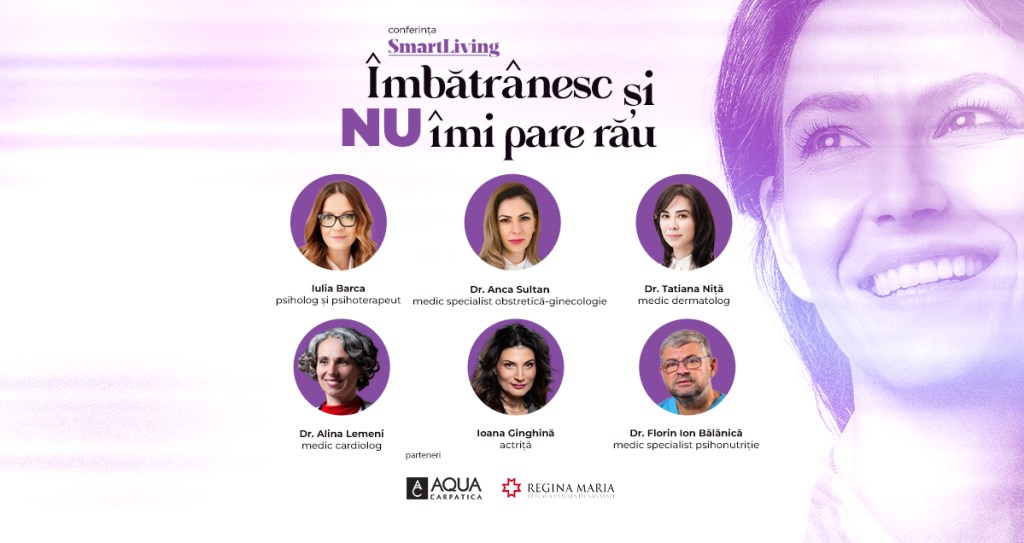
The conference “Growing old and not sorry”, organized by the publication SmartLiving, is a space for answers and inspiration. Here you will find clear and useful medical information, as well as stories from women like you. It's the place where specialists will talk openly about health, balance and prevention and answer specific questions from the audience in an enlightening Q&A. Find tickets HERE. Come with a friend and benefit from the special offer!
Agenda
10.30-11.10 – The woman you become: about meaning, balance and acceptance during (peri)menopause, Iulia Barca, psychologist and psychotherapist
11.10-11.50 – Pre-menopause without taboos: what happens to your body and how you can stay in harmony with it, Dr. Anca Sultan, gynecologist
11.50-12.00 – Coffee break
12.00 -12.40 – Emotions, stress and the heart: invisible connections that can save your life, Dr. Alina Lemeni, cardiologist
12.40-13.20 – Anti-aging with meaning: how to love your skin at any age, Dr. Tatiana Niță, dermatologist
13.20 – 13.40 – Lunch break
13.40-14.20 – Sleep and emotional balance in middle age: how we maintain our mental health in an aging body, Dr. Andrei Gabriel Zanfir, psychiatrist/psychologist
14.20 -15.10 – From metabolism to mentality: how to recalibrate your life after 40 years, Dr. Florin Ioan Bălănică, psychonutrition doctor
15.10-15.50 – The beauty of vulnerability: about how to remain you, regardless of age, Ioana Ginghină, actress