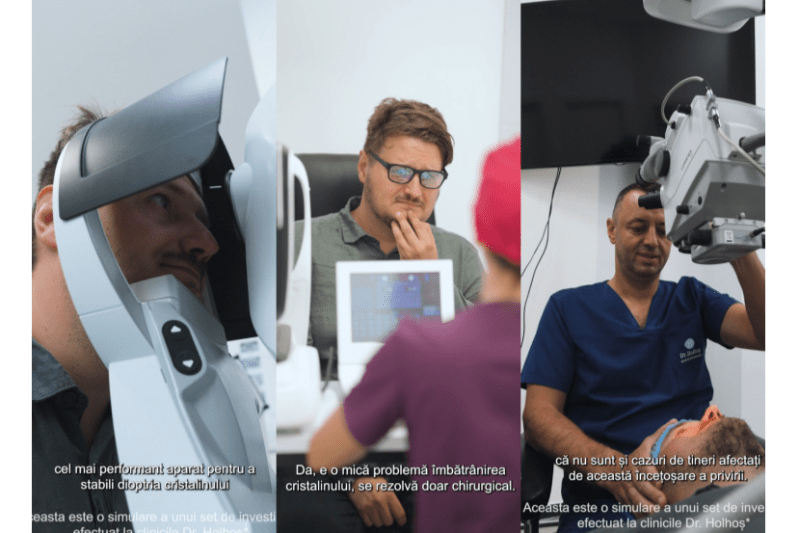
Photo: Dr. Holhoș Clinics
Cataracts are one of the most common eye conditions in the world, and with age, almost all people end up facing them. “Cataract is the aging of the crystalline lens. The lens inside the eye loses its elasticity after 40 years, the vision becomes blurred, the colors more faded, and the image seems covered by a yellowish film,” explains Dr. Teodor Holhoș, ophthalmic surgeon and founder of the Dr. Holhoș Clinics.
In place of the natural lens, which has lost its transparency, an artificial one is implanted. “This lens inside the eye needs to be replaced with an artificial lens. Fortunately, this very easy operation has arrived. I do it in about three minutes. No blood flows, no stitches are made, no injections are given, the anesthesia is with drops, and the next day the patient can resume his activity.”
We went through all the stages of pre-operative investigations for a cataract operation at Dr. Holhoș's clinic and simulated how real intervention stages would proceed. The operation is performed under the operating microscope Lumera, one of the most advanced equipment in the field of ophthalmology, which provides a precise view of the anterior pole of the eye and the lens. “This machine on my left is the operating microscope. It has functions with which I can see the lens, magnifications and essential details during the operation,” explains the doctor.
For optimal results, the clinic uses trifocal lenses produced by Zeiss, the world leader in medical optics. “There are the best lenses in the world, trifocals. We work with Zeiss, which is a reputable company, and then the patient's vision is very good, both at distance, intermediate and near. These lenses are for life and the patient no longer needs glasses.”
Lasting only a few minutes, cataract surgery is today one of the safest and most effective medical interventions, which restores vision completely and radically improves the quality of life.
Article supported by Dr. Holhoș Clinics