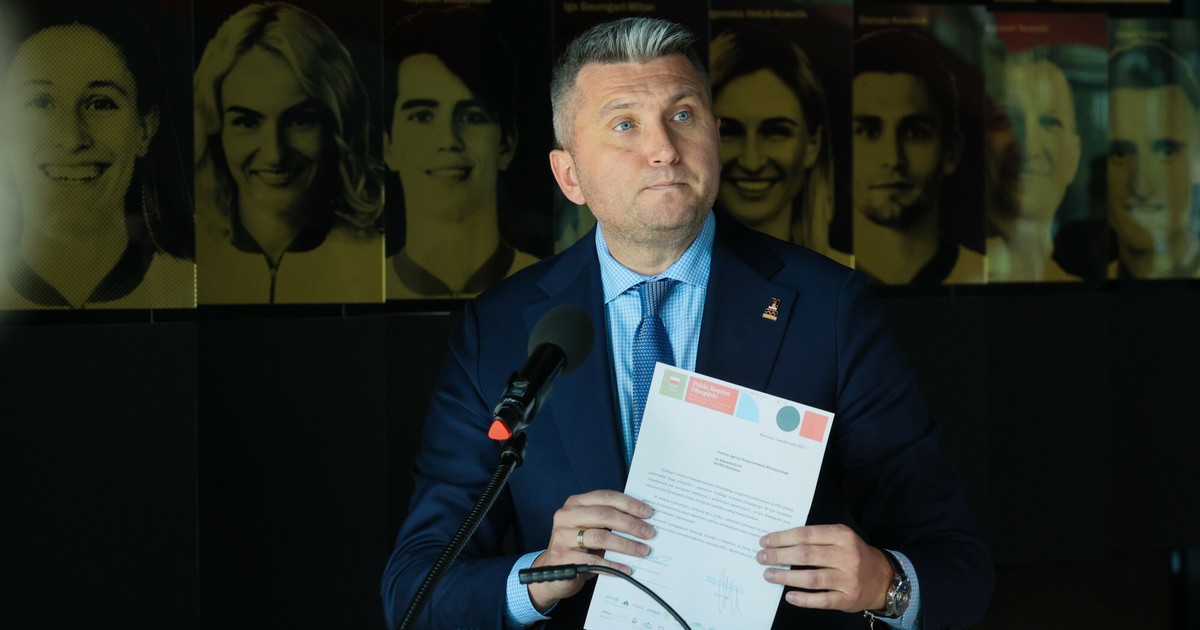
The changes in the structure of the Supreme Audit Office are aimed at eliminating unclear personnel procedures that were used by the previous president of the Chamber. Marian Banaś, as “Rzeczpospolita” reports, just before he left office, organized competitions in which mainly current directors and their deputies took part, and only his trusted associates sat on the competition committees.. In this way, Banaś tried to ensure irremovability for his people for five years.
The rest of the article below the video:
The new president of the Supreme Audit Office, Mariusz Haładyj, after taking up his position on September 24, began the process of dismissal of people associated with the previous management. First, Jarosław Melnarowicz lost his position, and recently Michał Jędrzejczyk and press spokesman Marcin Marjański were dismissed, replaced by Barbara Mroczek.
Fewer departments, more specialization
As “Rzeczpospolita” reminds, During the six-year presidency of Marian Banaś, fourteen departments operated at the Supreme Audit Office.
The new statute provides for their liquidation and the creation of eight interdisciplinary units, six of which will deal exclusively with control. The departments of National Security, Finance and Public Affairs, Jurisprudence and Legal Support, Development and Economy, Social Affairs, Cohesion and Infrastructure, Control Process Management and Natural Resources will be established.
According to NIK, this change is a response to current trends in control and audit activities and to international standards. Audits are to be entrusted to larger units, as confirmed by the examples of the European Court of Auditors and the Austrian Chamber of Audit, where the organizational structure is simplified and based on several large audit teams..
President Haładyj, presenting the new statute to the members of the parliamentary committee, emphasized that the aim of the changes is to create specialization within delegations, which will allow for more effective control of key areas of the state's functioning.
Read also: A scandal in financial supervision? Marian Banaś bluntly about the GetBack scandal
The chairman of the Parliamentary Committee for State Control, Marek Sawicki, expressed the opinion that limiting the number of departments and specializing regional branches is a step in the right direction. He drew attention to the need to group field units into three voivodeships, and in one case into four voivodeships, which will enable teams to specialize in specific tasks. Sawicki also emphasized that it is not true, as some claim, that the new statute is only for staff exchange. He noted that there are still vacancies at NIK and the salaries do not differ significantly from market rates.
New rules for control and evaluation of officials
MP Sawicki pointed out that President Haładyj also convinced him with another proposal that required statutory changes. Ccalls for extending the scope of NIK's audit to include the assessment of officials' omissions, and not only purposefulness, reliability and economy.
According to Sawicki, there is often “decision-making failure” in central and local administration, and the lack of decisions is currently not punished. The MP emphasized that a bad decision can be changed, but a decision that has not been made cannot be corrected. He emphasized that legislative changes are necessary in this respect and expressed hope that President Haładyj will propose them.
Return to transparency: competitions for positions and a new structure of delegations
The reorganization of the NIK structure will enable President Haładyj to dismiss all directors elected by Marian Banaś in unclear competitions and to conduct new, transparent recruitments.
MP Krzysztof Sobolewski from PiS, member of the State Audit Committee, assessed the changes positively, expressing hope that they herald the NIK's return to activities consistent with its constitutional role.
Many NIK employees believe that the new statute will allow for conducting reliable competitions not only for the positions of directors, but also for deputy directors, as well as for reviewing the competences of all employees and employing them in accordance with their qualifications in appropriate units. Changes in the Supreme Audit Office's work plan for 2026 and the new concept of operation of the delegations are aimed at removing pathologies and introducing extended activities that will meet new challenges.
Read also: NIK criticizes the Ministry of National Defense again. Problems with spending billions on the army
NIK confirms that all directors of the new organizational units will be selected in competitions in accordance with the regulations. Until the competition proceedings are completed, the functions of acting directors of departments and delegations will be performed by selected persons to ensure the continuity of the Chamber's operations.
Reorganization of delegations and digitization of control
The changes will also apply to the Supreme Audit Office's branch offices, which, as “Rzeczpospolita” reminds, currently operate as separate units in each of the sixteen voivodeships. After the reform, they will operate in five macroregions, which is expected to increase the effectiveness and specialization of the teams. The new structure is to come into force at the beginning of next year, but decisions regarding the specialization of individual delegations have not been made yet. Internal consultations are currently underway regarding the detailed division of tasks and defining specializations for the delegations.
Audits conducted by the Supreme Audit Office are to be more effective thanks to the implementation of modern methods, including advanced digital tools. As explained by the Chamber's spokesman, this will allow for faster detection of irregularities and more efficient response to threats at all levels – from local to central.
Read also: NIK enters the Museum of Modern Art in Warsaw
The new statute also introduces a significant change in the functioning of the NIK College. The President will convene meetings on his own initiative or at the request of at least one third of the members of the College, and will also propose the agenda.