The US is assembling a powerful flotilla. Trump is close to starting a new war and chaos on an unprecedented scale. “Maduro must go”


An aircraft carrier strike group is en route to join forces in the Caribbean. The Americans reopened a closed base in Puerto Rico. Bombers are circling over Venezuela and Marines are practicing sea landings. The CIA was authorized to conduct covert operations.
At least 60 people have already been killed in American attacks. Meanwhile, the gathering American armada threatens to repeat the mistakes of the “war on terror.”
We deploy American resources and interests around the world, but when we do it in our own hemisphere… everyone panics.” This is how Marco Rubio, the US Secretary of State, dismissed concerns about the prepared military campaign against “narco-terrorists.”
American military-based diplomacy revives a dark history of military interventions and coups in Latin America, often motivated by fear of hostile powers that waned after the end of the Cold War.
Its return is partly due to concerns that Iran, Russia and especially China are gaining in importance. But it's mostly about Trump's obsession with securing his homeland, coupled with his desire to be seen as a powerful statesman. A few months earlier, he had worried about China taking over the Panama Canal and the need for the US to capture Greenland. Now it turns to Venezuela, following another doctrine based on questionable foundations.
The Trump administration has defined drug gangs as terrorists, not criminals, to justify the use of military force against them. She linked Maduro directly to gangs to justify the pressure on his regime.
Rubio calls drug gangs the “Al-Qaeda of the Western Hemisphere.” Like the “global war on terror,” the new war on narcoterrorism carries the risk of a costly military commitment — all from a president who has promised to end America's “forever wars.” An opinion poll conducted last month by pollster YouGov showed that a majority of Americans oppose military action in Venezuela. Another poll, conducted by AtlasIntel, found that a majority of Latin Americans supported the idea.
America's actions are strangely contradictory. If Venezuela is a terrorist state, why did the United States end the “temporary protective status” of approximately 600,000 people? Venezuelan asylum seekers and sent some of them back to narco-terrorists? Planes filled with deportees land in Venezuela twice a week, even as B-1 and B-52 bombers threaten to bomb the place. Tankers chartered by Chevron [amerykański koncern naftowy] they still flow out of Lake Maracaibo, loaded with oil destined for American refineries.
“Failed intervention could lead to chaos in Venezuela”
Earlier this year, relations with Venezuela appeared to be improving. The country has released several Americans from prison. In July, Chevron received permission to resume oil supplies. However, almost immediately there was a radical turnaround.
The U.S. Treasury Department has designated a mysterious organization called the Cartel de Los Soles (Cartel of the Suns), a drug smuggling group with ties to high-ranking military officers, as a “specially designated global terrorist organization.” Maduro was recognized as its leader. The cartel has been accused of helping another Venezuelan gang, Tren de Aragua, which was designated a “foreign terrorist organization” in February.
In August, the State Department doubled the reward for information leading to the arrest or conviction of Maduro to $50 million. (over PLN 183 million). On September 2, shells began to fall on boats suspected of drug smuggling. More than 60 people have died so far. Charred body parts were found on the beaches of Trinidad and Tobago.
US officials say all this reflects Trump's evolution.
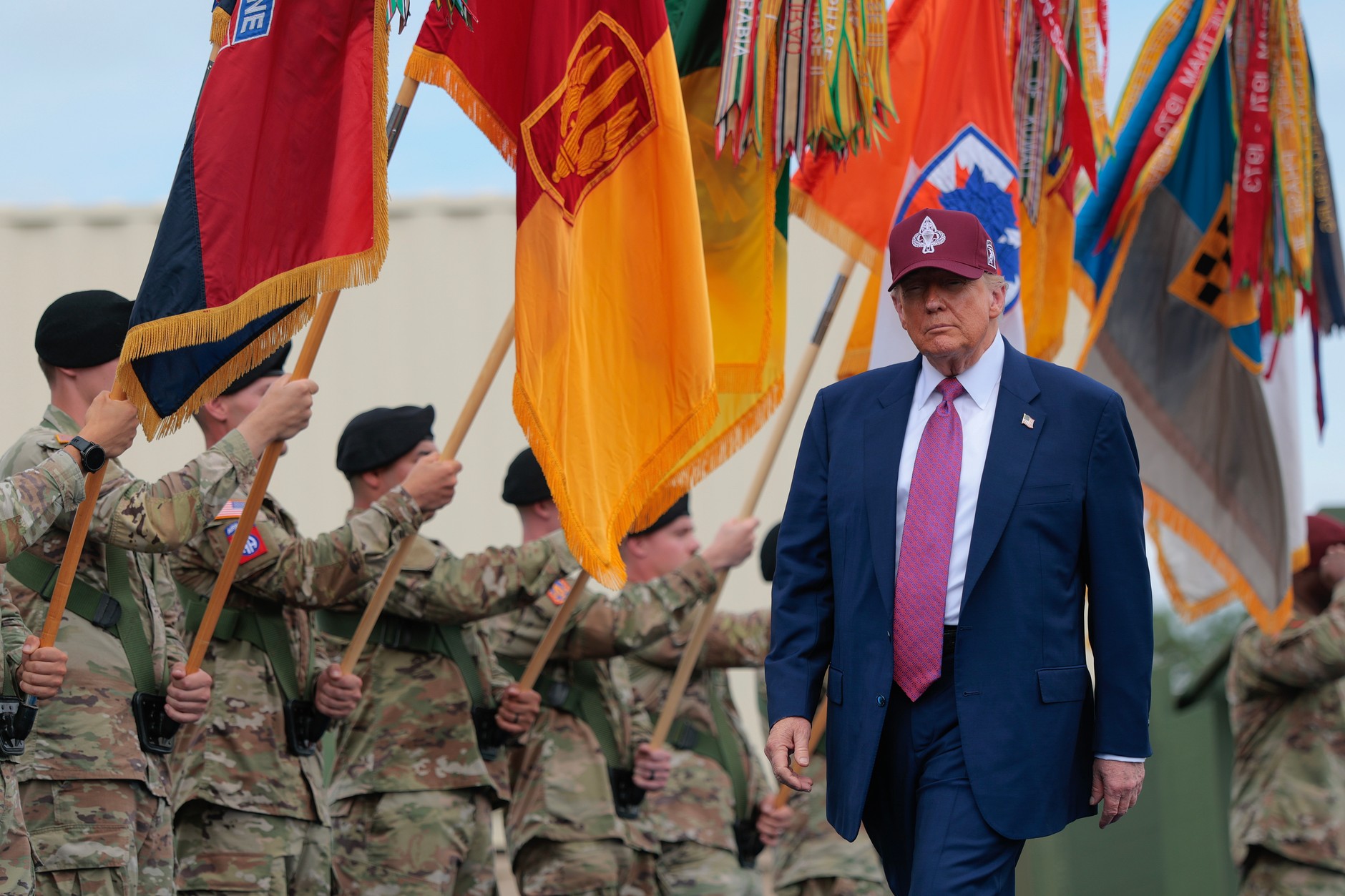
Donald TrumpAnna Moneymaker / Staff / Getty Images
The US president gave diplomacy a chance, was disappointed with the results, and then increased the pressure. This change also reflects the changing balance of power among his advisors. Ric Grenell, Trump's “special envoy for special missions,” has held talks with Maduro and is said to favor diplomacy. Rubio, who also serves as national security adviser, favors a tough approach. As a former senator of Cuban origin, he puts emphasis on restoring US influence in “their” hemisphere.
Rubio's show
US Secretary of State Marcio Rubio has combined his neoconservative instincts with Trump's nationalist “America First” policies. He argues that many of the U.S.'s problems, from migration to drug smuggling, come from South America. As domestic policy expands into foreign policy, “America First” becomes “Americas First.”
Perhaps Rubio sees an opportunity to transform the Caribbean as Washington wishes. If Maduro falls, countries like Cuba and Nicaragua will likely lose access to subsidized Venezuelan oil and be destabilized.
However, the dominoes may fall the other way. A failed intervention could lead to chaos in Venezuela and beyond, fueling anti-Americanism and worsening drug and migration problems.
Optimists believe that an intervention would be similar to the brief, successful invasions of Grenada in 1983 and Panama in 1989. Critics, however, say that Venezuela is a larger and more complex country and that an intervention could resemble the disasters in Afghanistan, Iraq and Libya. Anyway, there is little indication that the Trump administration has a coherent plan to overthrow Maduro, let alone what happens next.
America's greatest asset is the unpopularity and lack of legitimacy of Maduro and his regime. This government led to political repression and economic collapse, which resulted in one of the largest waves of refugees in the world. Maduro rigged the 2024 presidential elections by banning opposition leader Maria Corina Machado from running. Her deputy, Edmundo Gonzalez, won with a landslide, but the regime announced fraudulent election results.
The best hope for overthrowing Maduro is that loud military threats bring down his regime. Bringing the USS Gerald Ford, America's largest and newest aircraft carrier, closer to Venezuela's borders could play a role in that.
— I assume the CIA's role is to relay messages to those in the regime and military. The message is probably: “Listen, Maduro has to go. There is no reason for you to go down with him,” said Elliott Abrams, special envoy to Venezuela in Trump's first term.
The Venezuelans offered concessions. According to the Miami Herald newspaper, one of the proposals was to create a transitional government composed of high-ranking officials — without Maduro. Another one, described by the New York Times, was to provide the US with privileged access to oil and mineral resources and limit the role of China, Russia and Iran. “He offered everything [Maduro’]” — Trump declared on October 17. “You know why? Because I don't want to mess with the United States.”
However, Maduro still controls the army. With the help of Cuban intelligence, he intensifies purges of suspected dissenters. Dozens of military officers deemed disloyal were imprisoned, many of them tortured, and their families were also threatened and imprisoned. Few will risk moving against Maduro until they are sure his days are numbered.
Trump may therefore have to use force, not just threaten to use it. He favors quick surprise attacks that pose little risk to U.S. forces, such as the bombing of Iranian nuclear facilities in June. In the case of Venezuela, however, Trump appears to be signaling his actions to apply pressure. Information leaks suggest it may first attack distant facilities, perhaps airports linked to drug networks. If this develops into a sustained air campaign against the regime, it will be necessary to destroy air defense systems.
However, air power alone has rarely, if ever, brought down a government without ground forces, which Venezuela appears to lack. Perhaps the Trump administration believes it can kill Maduro out of thin air (assuming it is willing to roll back the executive orders that have banned the killing of foreign leaders since 1976). That would be difficult too. Saddam Hussein, the Iraqi dictator, was captured only after US forces occupied Iraq in 2003. Sending ground forces to Venezuela would also be met with deep reluctance from the American public.
The success of any intervention will depend on whether its effects are sustainable. Two key questions arise. First, is the opposition able to govern in the chaos that exists in Venezuela? Many of its leaders are in exile. Marica Corina Machado, this year's Nobel Peace Prize winner, is hiding in Venezuela but can communicate. He supports Trump.
“I believe that escalating the conflict is the only way to force Maduro to understand that it is time to go,” she said in an interview with Bloomberg.
Not all opposition representatives share this opinion. Still, Machado says he has plans for the first 100 hours since taking power and the next 100 days.
It is also unclear whether the regime's remnants – army troops, colectivos (armed militias linked to community organizations) and security officials – not to mention criminal groups and Colombian rebels operating in Venezuela, will choose to fight. If so, a short war could turn into a long fight against the resistance.
Ryan Berg of the Center for Strategic and International Studies, a think tank in Washington, predicts three scenarios: the Venezuelan army will overthrow Maduro and take power; The United States will negotiate the terms of transformation with him or part of his clique; or the regime will fall as a result of the US military campaign. The first two scenarios, he argues, provide stability but are unlikely to bring democracy. The third one may lead to the legal opposition taking power, but it is more unstable. It's also quite possible that Trump will lose interest and move on to something else. Perhaps it will announce success after making the first strike on Venezuelan territory.
In January, Trump posted a meme of himself looking like a gangster next to a sign that read “FAFO” — short for “Fuck Around and Find Out.” This was a warning to Colombia, which (briefly) refused to accept deportees. This meme can also be applied to Venzuela, but is Trump ready to see the consequences of intervening in this South American country?
© The Economist Newspaper Limited, November 6, 2025