publication
2025-11-07 22:05
Despite serious declines in the first part of the session, the New York stock exchanges managed to make up most of the losses by the end of the day. However, the highly valued technology sector was still under pressure. The mood of American consumers also clearly deteriorated.

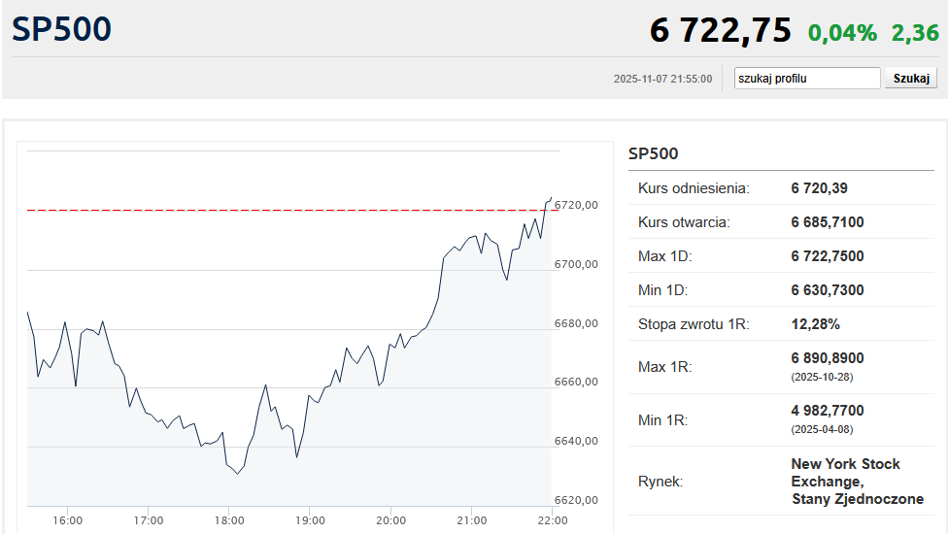
At the worst moment of Friday's session, the S&P500 lost as much as 1.3%. And then the Americans did what they like best – they tricked the Europeans. Already after the end of trading on the Old Continent, the New York indices began to make up for losses. And it worked out quite well for them.
The S&P500 went over the line in the last seconds of trading, finishing with a score of 6,728.80 points. The Dow Jones also managed to break even, gaining 0.16% and ending the day at 46,987.10 points. The Nasdaq lost only 0.21%, falling to 23,000.54 points. The VIX volatility index rose for another day in a row, signaling growing fears of a more serious correction.
Very generously valued companies related to the boom in AI algorithms came under pressure from sellers again this week. Shares of Broadcom were depreciated by 1.7%, Oracle by 1.9%, Tesla by 3.7%, and Aphabet by almost 2%. Except for Tesla, in all of the above. cases, it was possible to significantly reduce losses in the last minutes of trading. In this context, it is worth noting that throughout the week the Nasdaq lost 3%, which is the worst weekly result since the April panic.
Wall Street is increasingly saying that the valuations of AI companies have become detached from any foundations and are discounting the almost impossible growth of these businesses. It is difficult to argue with this opinion when, for example, Broadcom is valued at the equivalent of 88 times the profits reported for the previous four quarters. Even if the company increased profits fourfold, it still wouldn't be cheap.
Additionally, there have been not very optimistic signals coming from the real economy recently. On Friday, investors learned that the November reading of the University of Michigan Index measuring household sentiment was 50.3 points. vs. 53.6 points in October and expectations of 53.2 kpt. This is the lowest result in three years. Whereas the assessment of the current economic situation reached the lowest result in the history of this survey.
So there is a lot of disappointment, and the deterioration of American sentiment is accompanied by very high inflation expectations. The expected inflation in the short term is as much as 4.7% (compared to 4.6% in October), and in the long term it decreased from 3.9% to 3.6%. But that's still well above the Federal Reserve's 2 percent target.