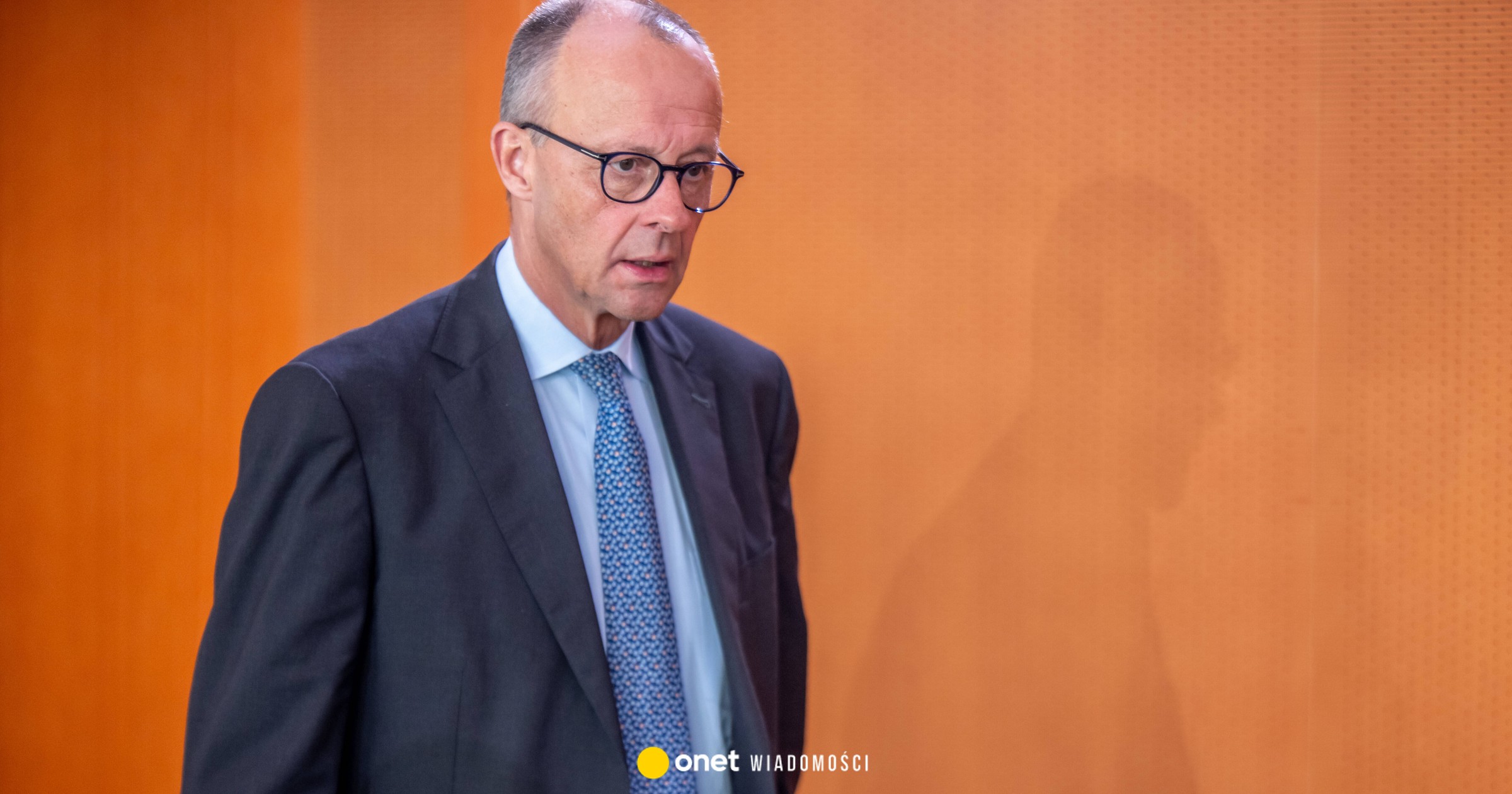
“There have been too many public discussions that have been interpreted as disagreements,” Merz said last week of his fractious coalition of conservative Christian Democrats and center-left Social Democrats. — The government has to solve problems. And it must not give the impression that it is divided, Merz continued. — Then society's trust in political parties, as well as in the people involved in them, will gradually increase again.
Disputes between leading politicians of the center-left and center-right regarding key issues of government policy influence Germany's position at the heart of the EUas other countries find it difficult to determine Berlin's position on many key issues. There are also growing doubts about the coalition's long-term survival prospects.
According to a survey conducted by the polling institute Insa for the Bild daily, less than one third of Germans believe that the coalition will be able to govern until the end of the term in 2029. The survey also showed that support for the government has fallen to a record low of 25%.
At the same time, according to a POLITICO poll, the far-right Alternative for Germany (AfD) recently overtook Merz's conservatives as the most popular party in Germany, and its growing power increases tensions in the coalition.
Since taking office in May, Merza's Christian Democrats have tried to clip the AfD's wings by promising to fight migration. However, members of SPD, Merz's smaller coalition partner, are increasingly trying to distance themselves from the discourse, which they believe is taken straight from the far-right program.
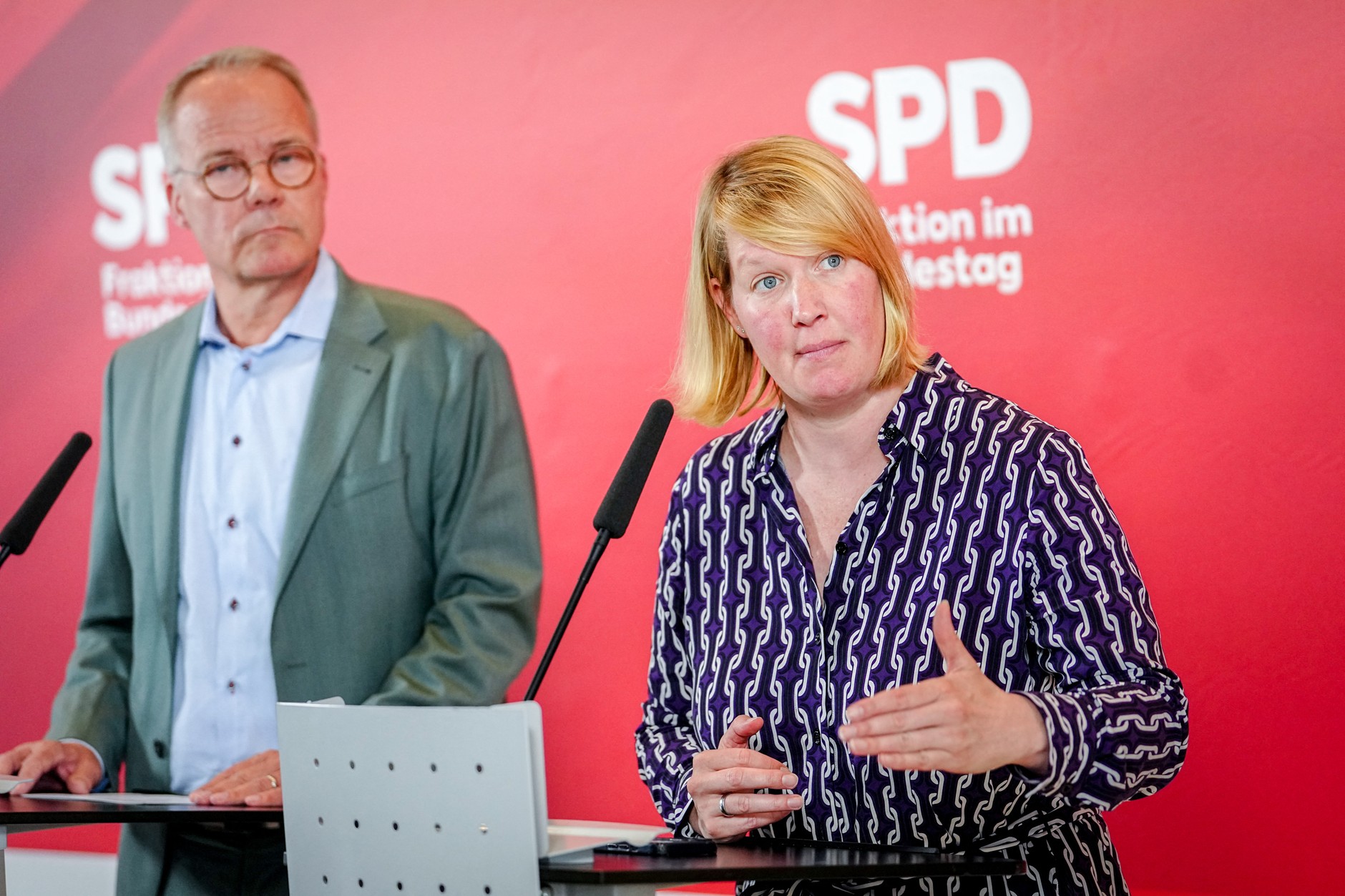
The SPD's vice-president in parliament, Wiebke Esdar, even went so far as to join protests against Merz over the weekend.
Wiebke Esdar and Matthias Miersch of the SPD during a press conference in Berlin, June 3, 2025.KAY NIETFELD / DPA / dpa Picture-Alliance via AFP / AFP
— The two main parties of the former center are currently facing a dilemma because, on the one hand, they have to distance themselves to some extent, but at the same time remember that if they do not cooperate properly, the extreme parties will benefit, said Florian Grotz, a political scientist at the Helmut Schmidt University in Hamburg.
The divisions are getting deeper
PerfectAn example of chaotic internal fighting in the coalition is the dispute over military conscriptionconcerning both the future of the army and its role in German national identity.
The Bundeswehr must reach 260,000. soldiers by 2035. Currently, there are approximately 180,000 of them. Conservatives want to reintroduce a random draft if voluntary recruitment fails, citing civic duty as the foundation of national resilience.
The SPD, backed by Defense Minister Boris Pistorius, argues that coercion will only contribute to inefficiency at a crucial moment of Germany's rearmament. Pistorius has already torpedoed the compromise between the two parliamentary groups by rejecting the introduction of certain mandatory elements.
Both sides agree that the army needs people, but they disagree on how to rebuild the armed forces destroyed by decades of neglect. Critics warn that six-month tours of duty for 18-year-old conscripts would be just a drop in the ocean of the Bundeswehr's high-tech needs.
The article continues below the video
These issues have turned into a referendum on Germany's post-war image and whether the country's ability to implement sweeping reforms is equitable for all – young and old.
While the SPD seeks to protect young people from compulsory military service, an entirely different generational issue has sparked a revolt within Merz's own bloc: pension reform.
At the center of this dispute is the SPD's Labor Minister, Barbel Bas, who wants to maintain the current pension level of 48%. average wage after 2031. She argues that this protection is necessary to prevent benefit cuts as baby boomers retire at the end of this decade.
For Germany, this is not a trivial matter. Pensions are the largest item in the country's public expenditure — bigger than defense, education or health — and the system is based on a delicate understanding between workers and retirees. In the coming years, millions of people will leave the labor market and far fewer young people will enter it, threatening to lead to a pay-as-you-go model. [opartego na zasadzie solidarność, gdzie pracujące pokolenie utrzymuje pokolenie starsze] to the brink of bankruptcy.
However, for a group of younger Christian Democrats it looks like intergenerational theft. The Bas reform means approximately “115 billion euros (PLN 489 billion) in additional costs” by 2040, according to a document presenting the position of 18 parliamentarians who want to block it, obtained by POLITICO.
The rebellion became a test of Merz's authority. His government has a 12-seat parliamentary majority, one of the smallest in post-war German history, which means that relatively a small group of MPs can easily block any bill.
Lack of coherent position in the EU
The coalition's impasse is also felt in Brussels.
The EU's phasing out of internal combustion engines by 2035 – a key issue for Germany's automotive industry, which accounts for almost a fifth of the country's exports – is another sensitive issue that exposes Germany's weakening position in Europe's industrial transformation.
Merza's Christian Democratic Union and the SPD have tentatively backed a compromise that essentially maintains the EU's ban, which is due to apply from 2035. But they introduced exceptions for plug-in hybrid vehicles, range-extender vehicles, which use small combustion engines to extend the range of batteries, and some synthetic fuels.
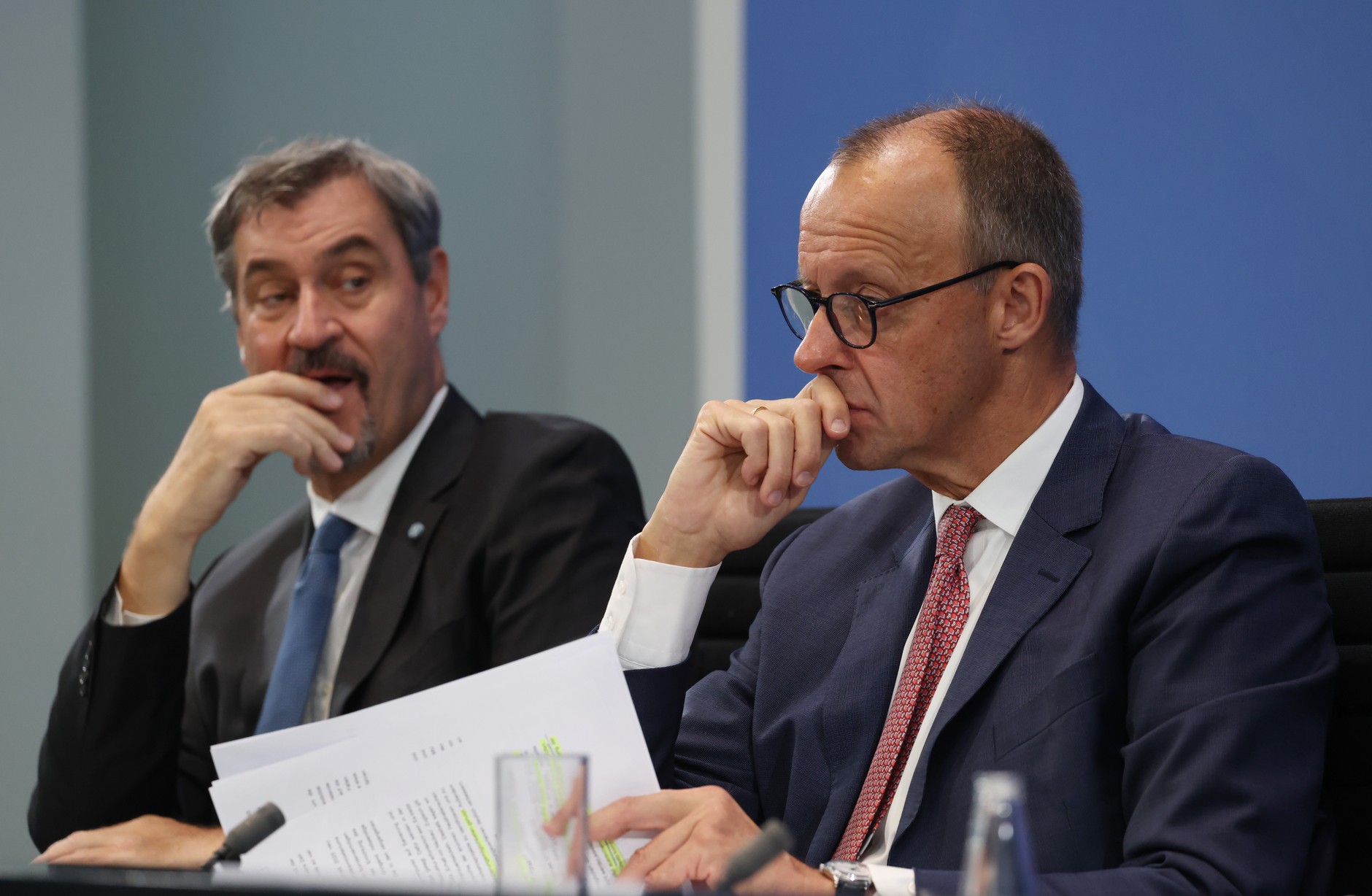
However, the Bavarian-based Christian Social Union, Merz's CDU sister party, firmly refused. Bavaria's Prime Minister Markus Soder recognized this ban attack on the industrial soul of Germany, warning Brussels to withdraw its 'ideological regulations'
Chancellor and leader of the Christian Democratic Union (CDU) Friedrich Merz and Prime Minister of Bavaria and leader of the Christian Social Union (CSU) Markus Soeder in Berlin, October 9, 2025.Sean Gallup/Getty Images
Soder's strong opposition stems from the influence of auto giants such as BMW and Audi in Bavaria, but also from political concerns, two people familiar with CSU's strategy told POLITICO, who spoke on condition of anonymity to discuss internal affairs.
Soder fears losing working-class voters to the far-right AfD, which has made defending combustion engines an election slogan before next year's local elections.
The European Commission will start reviewing car emissions rules by the end of the year and expects member states to present their positions before the review begins. While other major countries such as France and Spain are trying to maintain the ban, Germany remains essentially voiceless until the government takes a common stance.
Fear of the far right
Identifying new approaches to pressing issues – including the future of Germany's automotive industry – has become even more important as the old global system in which Germany was Europe's dominant economy appears increasingly shaky.
During former Chancellor Angela Merkel's long rule from 2005 to 2021, Germany's prosperity rested on three pillars: exports to China, cheap gas from Russia and protection of the United States through NATO. They all broke downdevastated by China's market barriers, Moscow's full-scale invasion of Ukraine, and President Donald Trump's questioning of US security guarantees for Europe.
— During the Merkel era, Germany created and enjoyed relatively favorable conditions — economically, geopolitically, etc. — and made no preparations for the future, Grotz noted. — That is why today the difficulties concern not only one field, but many.
— As a result, the country is forced to rediscover itself, but fear of extreme parties paralyzes mainstream politicians said Sabine Kropp, professor of political science at the Free University of Berlin.
“The really bad approach at the moment is the constant fear of the AfD,” she said. — Everything is perceived through the prism of whether it benefits or harms the AfD, and this limits its ability to solve problems.
I’m Ashley Davis as an editor, I’m committed to upholding the highest standards of integrity and accuracy in every piece we publish. My work is driven by curiosity, a passion for truth, and a belief that journalism plays a crucial role in shaping public discourse. I strive to tell stories that not only inform but also inspire action and conversation.