For the first time in almost four decades, UNESCO has decided to hold its General Conference – its supreme decision-making forum – outside its traditional headquarters in Paris. Between 30 October and 13 November 2025, all 194 member states gather in Samarkand, Uzbekistan, for the 43rd session of the UNESCO General Conference. The choice is not accidental: Samarkand is a symbolic city of the Silk Road, a true crossroads of civilizations, where the East and the West have always looked at each other in the mirror of the same world.
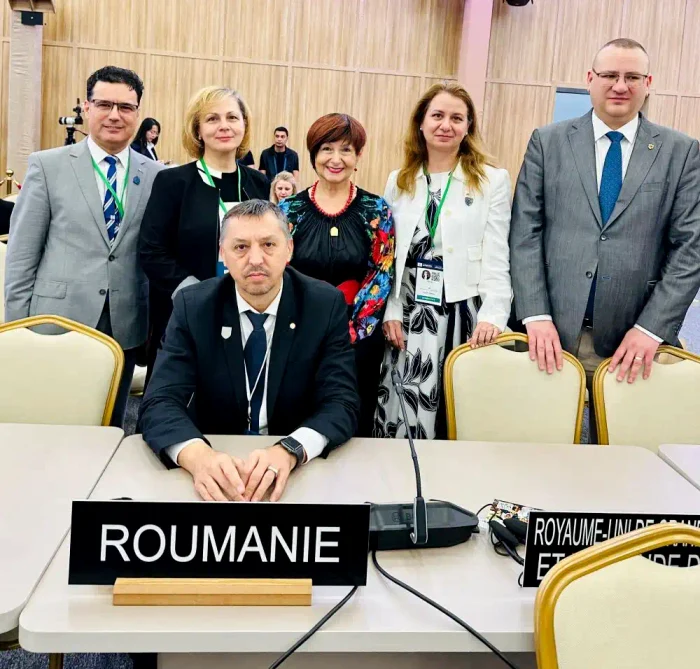
PHOTO Personal archive
Samarkand is one of the oldest inhabited cities on the planet, with a history of over 2,700 years. Known in Antiquity as Maracanda, it was conquered by Alexander the Great in 329 BC. and reached its peak in the 14th–15th centuries, under the reign of Timur (Tamerlan). The Observatory of Ulugh Beg, one of the most advanced astronomical centers of the medieval world, also dates from that period, where the length of the sidereal year was calculated with an error of only 25 seconds.
Long before Europe erected its first universities, Samarkand was already a center of higher learning, where science and faith coexisted in harmony. In the 15th century, the Ulugh Beg Madrasa, founded in 1420, was one of the most prestigious schools in the Islamic world, with a comprehensive curriculum that included mathematics, astronomy, philosophy, theology and literature. Famous scholars such as Qadi Zada al-Rumi, Ali Qushji and al-Kashi, the mathematician who anticipated modern decimal notation, taught here.
On the frontispiece of this temple of education (madrasa) is written, even today, an exhortation that should appear on the pediment of any contemporary university:
“The desire to know is the duty of every believer.”
Through these institutions of study and through its observatory, Samarkand became, in the 15th century, a veritable laboratory of early modernity, where reason and spirit met under the same sky. This heritage perhaps explains UNESCO's choice: Samarkand embodies the idea of a “crossroads of cultures”, for which it was included in the World Heritage List in 2001. It is where science, art and faith have intertwined in a rare balance of civilization.
The organization of the UNESCO General Conference in Samarkand is, in itself, a demonstration of strategic vision on the part of the Republic of Uzbekistan. In recent decades, this country at the crossroads of the great Asian civilizations has made a remarkable effort to reopen to the world, reaffirm its cultural identity and invest in education and heritage diplomacy. After periods of isolation and difficult transitions, Uzbekistan understood that the rebirth of a nation is not through walls, but through bridges – through education, culture and dialogue. The choice of Samarkand as the meeting place of the 194 UNESCO member states shows not only organizational strength, but also symbolic intelligence: a country with ancient roots, which gave the world poets, scholars and visionary architects, today claims its place in the global concert of ideas. While others wall off in rhetoric of fear and nationalism, Uzbekistan chooses to reopen the old routes – those that for centuries have linked cultures, faiths and people.
Politically, Uzbekistan is going through a gradual process of opening up and modernizing, while maintaining its Asian specificity – that of a stability built through balance and continuity. In recent years, the state has initiated economic, institutional and constitutional reforms aimed at gradually bringing the country closer to higher democratic and international standards, without losing its identity and internal cohesion.
With a population of more than 36 million, almost half of whom are under the age of 30, Uzbekistan is a young and rapidly changing society, where demographic pressure is intertwined with the aspiration to modernize. Annual growth of more than 1% and accelerated urbanization make this country an emerging force of Central Asia, but also a laboratory for intelligent adaptation to change: how tradition can be combined with innovation, stability with democratic openness.
Today, Uzbekistan manages to balance its relations with major power centers, positioning itself as a pragmatic and constructive actor in the global dialogue. Active participation in international bodies, especially the UN and UNESCO, is not just an image strategy, but the expression of a coherent vision of reconnection: a state with deep roots, which chooses to reopen to the world through culture, science and education, not through force or isolation.
The opening of the UNESCO General Conference takes place under the presidency of Ambassador Simona-Mirela Miculescu, a Romanian diplomat elected by unanimous vote in 2023 for a two-year term. It is the first time that Romania leads this global forum, which brings together the member states to decide the major directions of the organization in the fields of education, science, culture and communication. His presence in Samarkand is not only a diplomatic honor, but also a symbol: Romania, through its representatives, becomes a visible part of the international geography of dialogue and cultural cooperation.
In a city that gave the world one of the most accurate astronomical observatories of the Middle Ages and some of the oldest forms of university, UNESCO reaffirms its founding mission: to build peace in the minds of people, through education and knowledge. From the blue domes of Registan to the tranquility of Ulugh Beg's Observatory, everything in Samarkand seems like an invitation to reflection: about how fragile borders are, how perennial culture is, and how necessary dialogue remains.
In a world marked by fragmentation and distrust, the choice of Samarkand is a metaphor and a lesson. Just as ancient caravans once brought silk, ideas and poetry, the UNESCO General Conference today brings leaders, scholars and diplomats from all corners of the world — to rebuild, through reason and cooperation, the invisible bridges between people.
Beneath the same sky that Ulugh Beg measured six centuries ago, mankind is again seeking the exact measure of its own wisdom. And Samarkand, this city of stars, offers him perhaps the most suitable mirror.
Article also published in Revista Cultura.