Under what circumstances may federal agents use irritants on children preparing for a Halloween parade? On October 28, Northern District of Illinois Federal Judge Sara Ellis subpoenaed Greg Bovino, a senior Customs and Border Protection (CBP) official, to clarify when his officers could use tear gas in compliance with the court order she issued on October 9. The answer, she clearly stated, is basically never.
Judge Ellis subpoenaed Bovino after an incident in which federal agents, faced with threats from middle-aged fathers shouting at them, threw tear gas grenades as a crowd of children in costumes gathered in the street. “These children were tear gassed as they went to celebrate Halloween in the parking lot of a local school,” Judge Ellis said. “I can only imagine how terrified they were.
During the hearing, neither Greg Bovino nor lawyers representing the government disputed the facts, although the Department of Homeland Security (DHS) concluded that the use of force was justified because the agents were “surrounded.”
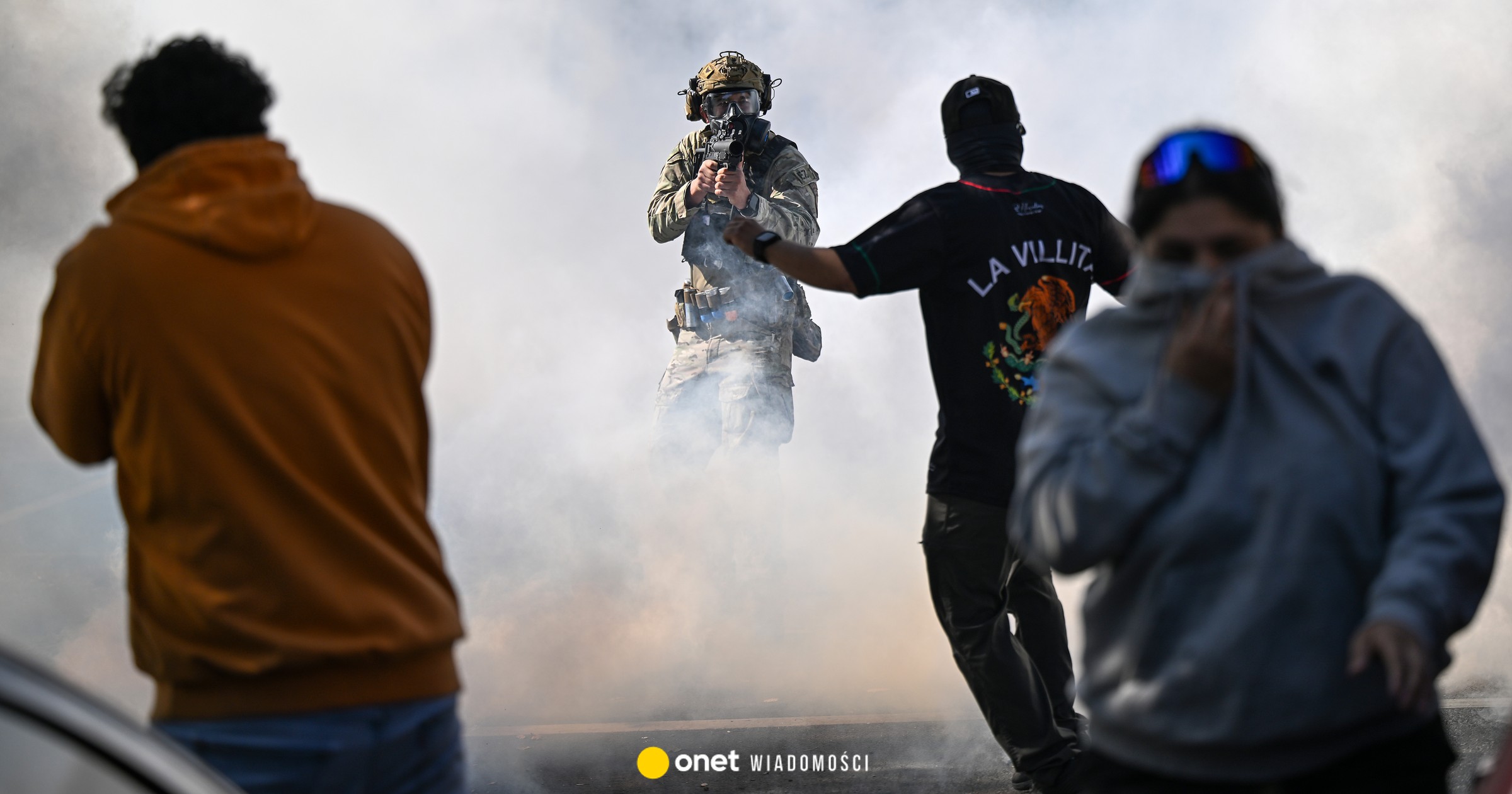
The event, which took place in Old Irving Park, a quiet neighborhood on Chicago's Northwest Side, was just one of at least five this week in which CBP officers [U.S. Customs and Border Protection, czyli Urząd Celny i Ochrony Granic USA] they threw tear gas into the apparently peaceful crowd.
That's how “Operation Midway Blitz,” the federal immigration enforcement operation in Chicago, goeswhich started in early September. As it expands, the US administration claims that arrested almost 3,000 migrants. However, the use of tear gas appears to reflect how local resistance in the form of whistleblowing protesters is hindering their work.
In just a few days, border patrol officers were filmed throwing tear gas grenades from a car, pushing a woman to the ground who was screaming at them, and pulling a 67-year-old man from his car and pinning him to the ground – allegedly breaking his ribs in the process.
In the last two cases, both victims were citizens and not people who were to be arrested. These films, cited in court, were viewed by The Economist. According to court documents submitted to Judge Ellis by the plaintiffs, one of the officers also pointed a rifle at the protester and told him “Bang, bang” and “You're dead, liberal.”
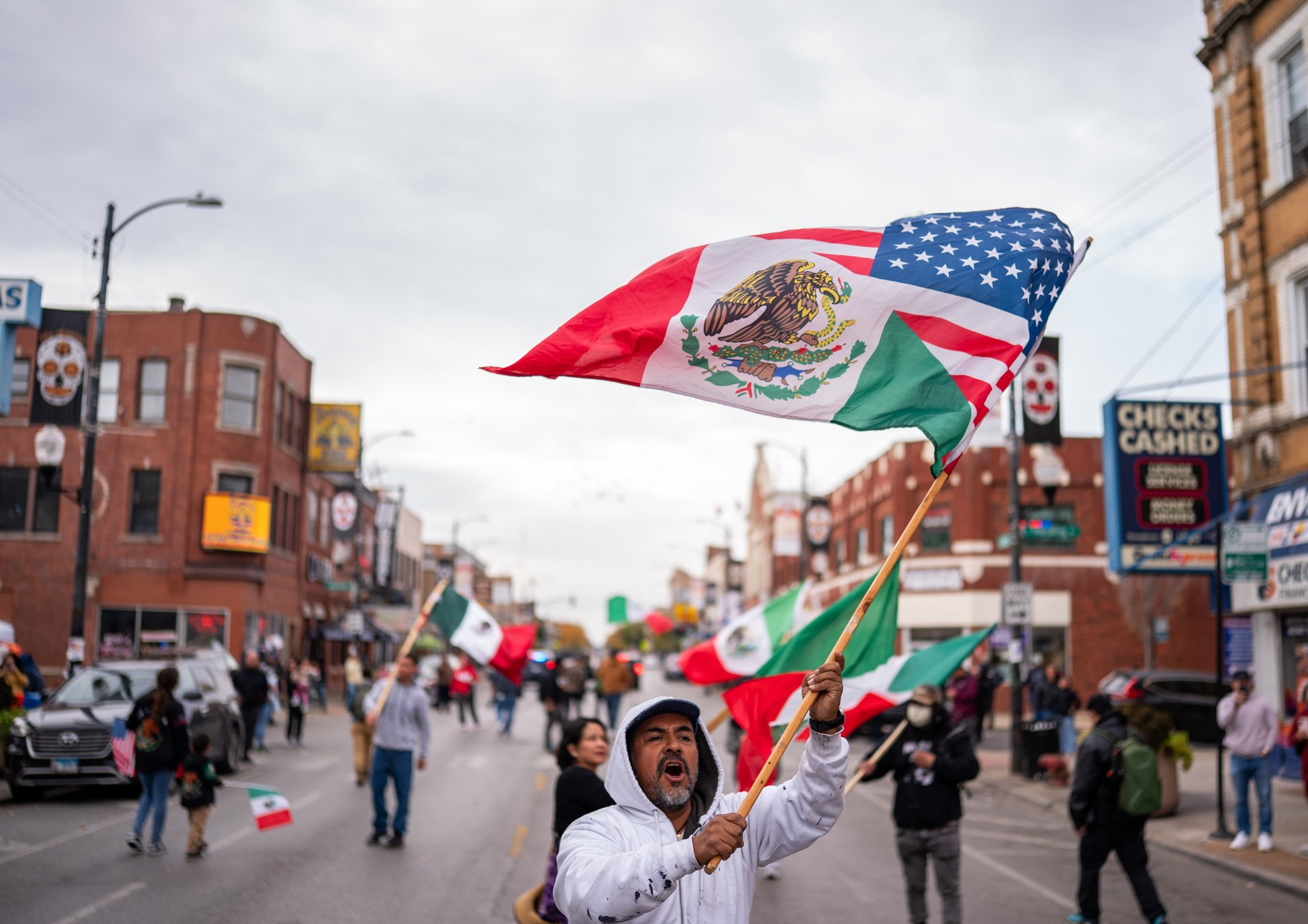
A protester waves a flag with a portion of the Mexican national flag and the United States flag in the Little Village neighborhood during a protest against Immigration and Customs Enforcement (ICE) following two days of raids earlier this week in Chicago, Illinois, U.S., October 25, 2025. Little Village is a neighborhood on Chicago's South Side with a large Mexican-American communitySeth Herald/Anadolu via Getty Images/Getty Images
I never expected to be tear-gassed on a street lined with million-dollar homes.
– says a woman who witnessed the incident in Lakeview, one of the city's wealthier neighborhoods.
Interestingly, even Bovino himself was caught on camera in the lead on October 23 groups of heavily armed officers throwing tear gas grenades in Little Village, the heart of Chicago's Mexican neighborhood. It appears that he did not issue a warning in accordance with the court order, Judge Ellis emphasizes. He also threw a grenade over the heads of the crowd of protesters, which was also prohibited by the order.
DHS spokeswoman [Department of Homeland Security, czyli Departament Bezpieczeństwa Krajowego Stanów Zjednoczonych] she said he only did so after someone threw a rock that hit him in the head, but the department provided no evidence of this. Even with professional photographers and people filming on their phones, as well as body cameras from federal agents, no one seems to have caught it. Bovino did not have a head injury during the court hearing.
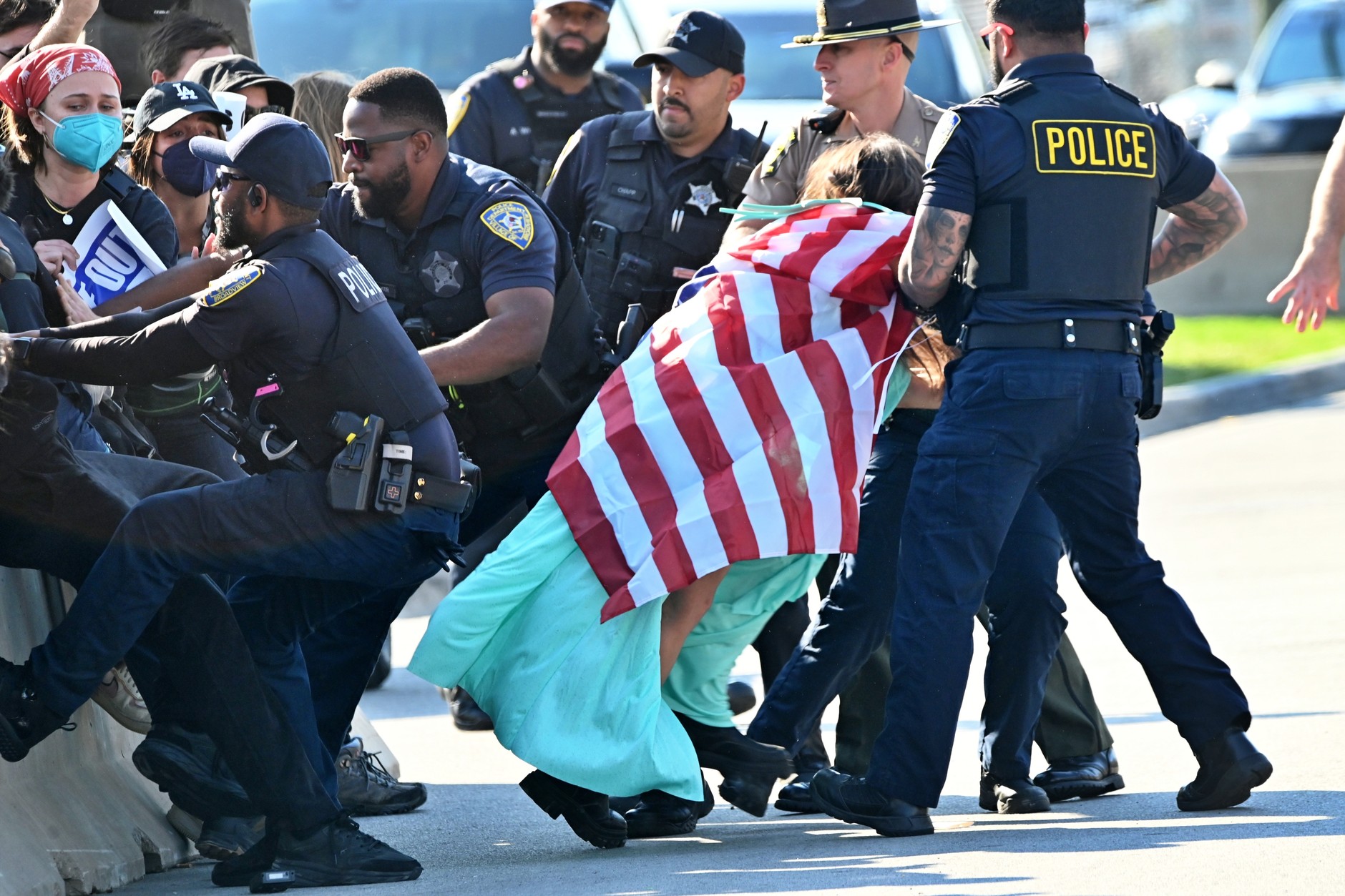
Police detain a protester during a rally outside an ICE building after recently dismantling the facility's security fence in Broadview, Illinois, Chicago, October 17, 2025.Jacek Boczarski/Anadolu via Getty Images / Getty Images
If there is any reason beyond intimidation for this show of force, it appears that federal agents are having an increasingly difficult job. The resistance works like this: In group chats and in Facebook Live videos, activists share information about when federal agents have been spotted. When this is confirmed, dozens of people rush to the scene, whistling, shouting and creating traffic jams to slow down cars. Potential targets are brought inside buildings where they cannot be arrested without a court order. With only 200 CBP officers in Chicago and a similar number from ICE [Immigration and Customs Enforcement, czyli Urząd Celno-Imigracyjny]overtaking them is not that difficult. “There are more of us than them,” says Tatiana Solis, a resident of Pilsen, a neighborhood inhabited mainly by Latinos.
Pomegranate on the dashboard
Baltazar Enriquez, the Mexican-American president of the Little Village Community Council, a nonprofit organization, is among those rushing to the scene of arrests, usually live-streaming the footage on his Facebook page. He says his organization transports 68 children to school every morning who are either illegal immigrants or have illegal immigrants as parents.
“Great people are willing to take to the streets and help these kids get to school safely,” he says. His the group is providing food and other support to street vendors who are sheltering at home. Enriquez says FBI agents visited his home earlier this month because of these problems.
Washington considers all of these actions to be unlawful and aggressive disruptions. Kristi Noem, the DHS secretary, wrote in the Wall Street Journal that the organizers are “terrorists, gang members and rioters.”
During the October 28 hearing, Judge Ellis ordered Bovino to report to her in person in court each evening and explain each day's proceedings. All body camera footage must be turned over to the court and all officers must wear it while working in the field. From now on, “I don't think we'll see a lot of tear gas being used,” she said. Bovino listened carefully and promised to comply. However, as he left the courthouse, he got into his car and, in front of a crowd of protesters with camera phones, placed a tear gas grenade on the dashboard.
I’m Ashley Davis as an editor, I’m committed to upholding the highest standards of integrity and accuracy in every piece we publish. My work is driven by curiosity, a passion for truth, and a belief that journalism plays a crucial role in shaping public discourse. I strive to tell stories that not only inform but also inspire action and conversation.