Testimonies of Chinese volunteers fighting for Ukraine: I wanted a life that meant something


The Guardian journalists published the testimonies of Chinese volunteers who defied the government and public opinion, fighting on the side of Ukraine and against Beijing's most important geopolitical partner, Russia.
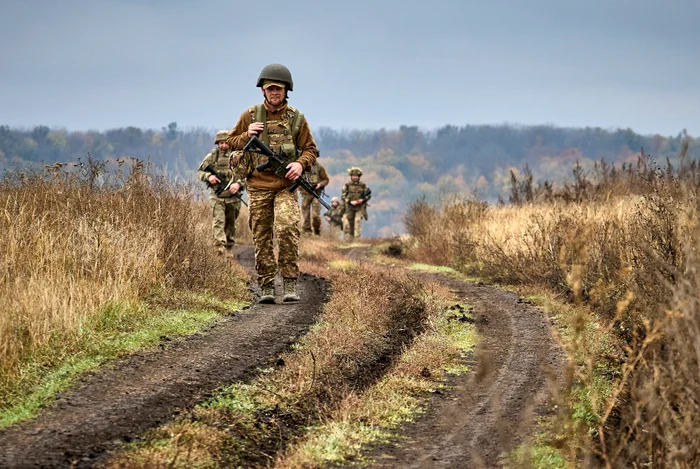
Members of the Hartia brigade train before arriving at the front PHOTO EPA-EFE
Tim, 43, was bringing aid on the outskirts of Kiev when he heard a rocket whizzing overhead. Soon, he read the news on the phone: the largest children's hospital had been hit. It happened on July 8, 2024, the day Russia launched one of its bloodiest attacks on Ukraine, killing more than 40 people. But the attack on the Ohmatdit pediatric hospital in Kiev was shocking for the Chinese volunteer.
“Seeing the severed limbs, some of them belonging to children, I cried,” said the father of two. “I went thinking about how the Chinese get angry. Once it's triggered, it's intense. I decided to join the army.”
A year later, Tim was in his barracks in southern Ukraine, designing drones for the army's ground forces.
He arrived in Ukraine in July 2023 on a business visa with the intention of supporting humanitarian efforts.
“At the time, I was unemployed. I wanted to go to Ukraine as a volunteer – to see a struggling country and deliver the donations that many of my close friends had made to help those in need,” he said.
Tim's story
Like many of the other Chinese volunteers, Tim is animated by sympathy for the Ukrainian cause, along with a sense of despair at the direction his own country is taking. He had been thinking about emigrating for over a decade before going to Ukraine and deciding after several trips that the country had a “bright future”, the Ukrainians were friendly, and that he would like to live there. He was making plans to bring his family too. Then came the attack on the hospital, which led him to make a decision: he will enlist in the Ukrainian army.
“Fifteen years ago, you could see the problems, you could talk about them freely, and there were people willing to talk about them,” he said.
He obtained the information about the war in Ukraine through a virtual private network (VPN), as YouTube is blocked in China.
“I don't read news on Chinese websites… because all the news there is fake,” Tim points out.
Foreign nationals have the opportunity to serve in the regular units of the Ukrainian army or in one of the two dedicated international legions. Kostiantin Milevski, a Ukrainian military official, said in August that about 8,000 foreign nationals are enlisted in the ground forces alone. Including those from other armed branches, the number is probably double.
The Ukrainian military does not release information on the nationalities of international recruits, but many of them are known to be from South America, lured by salaries exceeding $3,000 a month for the most dangerous missions. Otherwise, the base salary is no more than $500 per month.
Who are the Chinese citizens enlisted in the Ukrainian army
Chinese volunteers fighting for Ukraine estimate their number to be a few dozen people at most.
The Chinese public's views on Russia are not uniform. On the one hand, there are the nationalists, who have never forgiven Tsarist Russia for annexing large swaths of territory during the Qing dynasty at the end of the 19th century. Currently, regarding the war in Ukraine, aggressive propaganda has arisen in China in the state media, which blames the US for this crisis.
Officially, Beijing claims to have a neutral position in the conflict and advocates for peace.
On the other hand, Chinese President Xi Jinping more or less explicitly supported his Russian counterpart, Vladimir Putin, throughout the war. According to Western analysts, it would be very difficult for Moscow to continue the war without China's economic support. For example, bilateral trade between the two countries has reached record levels since the 2022 invasion. China does not provide direct military aid, but there is strong evidence that it allows exports of vital weapons components, such as fiber-optic drone cables, which have seen explosive sales.
A study by Tao Wang of Manchester Metropolitan University found that 80% of Chinese surveyed had pro-Russian views in the first year of the war, and that “the government-controlled media succeeded in swaying public opinion in favor of Russia” as it progressed.
However, there is also an appreciable segment of the Chinese population that sympathizes with Ukraine, which has been largely overlooked,” explained the author of the study. Citizens are afraid to express such views explicitly, as they are “considered unconventional.”
Fan's story
It's not just ideology that drives citizens like Tim, an unemployed auto mechanic, to leave the country to fight in a war. China is going through a crisis caused by the high unemployment rate, which has raised dissatisfaction with the government.
Another Chinese volunteer, Fan, has a similar story.
Before leaving China earlier this year, the 39-year-old in China was basically living a “laying flat” life, he explained, referring to a Chinese expression for passive unemployment. The pandemic ruined his business and left him 3 million yuan (£314,000) in debt. Fan is married and has a daughter.
One day, surfing on Western social networks, he read about compatriots fighting in Ukraine. That's how he learned about the case of Peng Chenliang, a Chinese volunteer from Yunnan Province who served in the Foreign Legion and was killed in November 2024 during an operation on the Eastern Front.
“I was basically doing nothing at home… I felt like I couldn't go on living a meaningless life,” Fan said. I wanted to “do something that made more sense”.
He is among the few Chinese volunteers who have chosen Ukraine, although Chinese social media is flooded with videos promoting the benefits of becoming a mercenary for Russia.
After the Ukrainian army took two Chinese prisoners of war in Donetsk in April, Volodymyr Zelensky gave an estimate of the number of Chinese citizens fighting on Russia's side: more than 150 people.
There is no indication that China, which denies providing military aid to Russia, is encouraging these mercenaries, but the spread of the videos on the tightly controlled Internet still appears to be free of restrictions.
Finding information on how to enlist in Ukraine is much more difficult, according to Fan's testimony, who says he used ChatGPT for this purpose. Although he had no military experience, only a passion for drones, he was accepted by a recruiting office in Lviv. Originally deployed as a drone operator on the eastern front, he was withdrawn due to the significant language barrier. He is currently guarding a warehouse.
Fan has no political views. But he says the government's crackdown has become increasingly coercive, especially with the pandemic. Many of his favorite bloggers have been persecuted or detained on charges such as “quarrels and inciting unrest” – a generic term used to target those who are not to the liking of the authorities. “Many ordinary people, just by expressing their opinions on live broadcasts or on their platforms, opinions that do not align with the general opinion in China, end up being wronged,” he said.
“I'm almost 40 years old and I've never voted… the government never listens to the voice of ordinary people. I don't want my son to grow up in that kind of environment.”
Chinese law does not explicitly prohibit citizens from joining foreign militaries unless they pose a threat to national security, but many fear reprisals. Another Chinese soldier in Ukraine, whose call sign is Brunko, said China's national security police questioned his family.
Asked why he would risk his life for another country, Tim says his main goal is to build a new life for himself and his family in Europe. “Secondly, I want to show the world that there are many Chinese people like me. I want the world not to give up on China,” he said. “Don't associate China with negative things. In fact, there are many good people in China and many constructive ideas.”