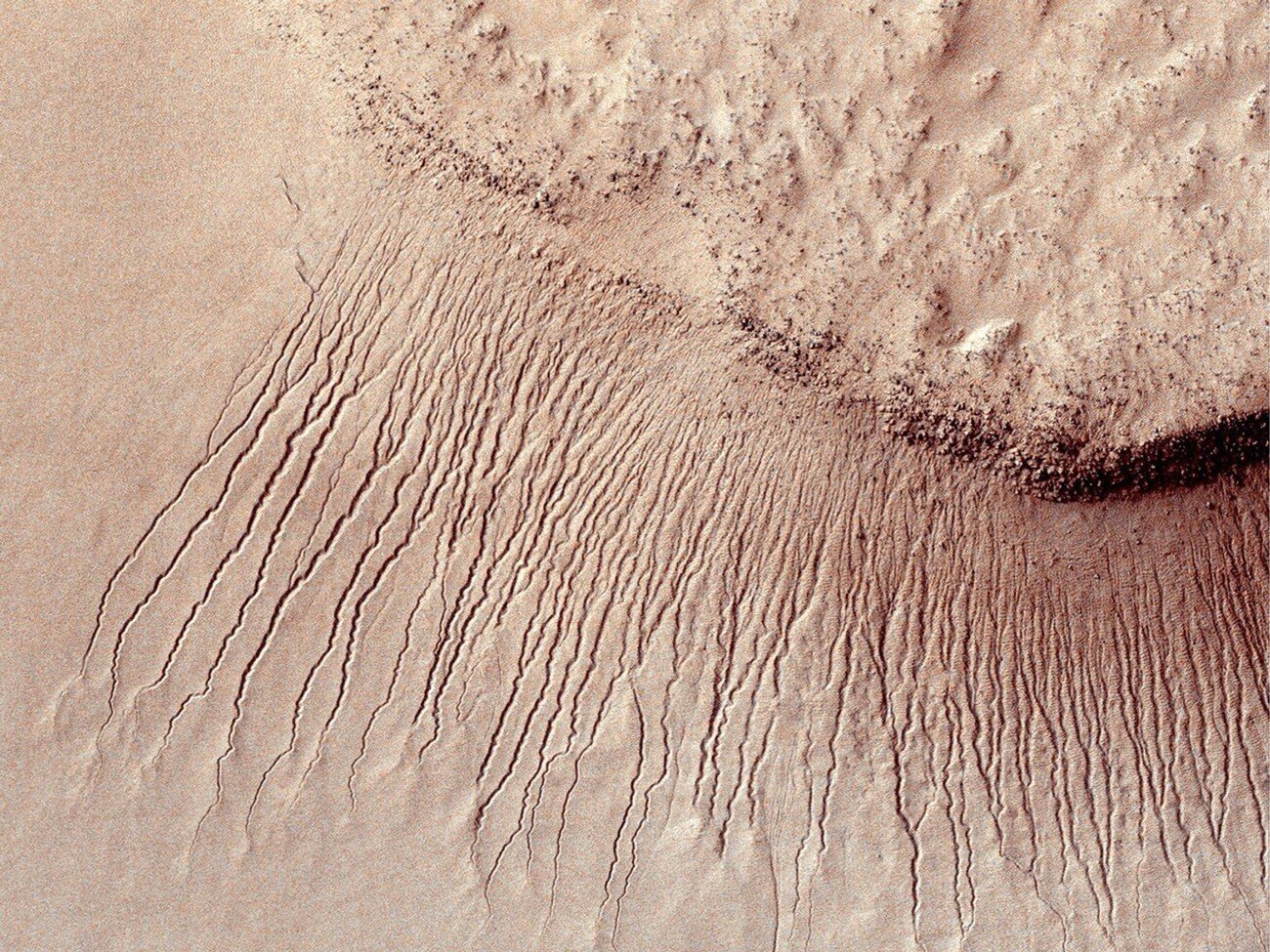
The winding channels seen in images of Martian dunes resembled erosion caused by fluid flows. For decades, this seemed like a strong indication that Mars once had water. However, a new study has shown that these grooves are not carved by water at all, but by dry ice – solid carbon dioxide, which behaves completely differently in Martian conditions than on Earth.
Such structures were first noticed in 1999 in orbital images. Scientists have long assumed that they are created by meltwater that occurs in the spring. But the data showed that the surface of Mars is too cold and dry for liquid water to exist there.
A team of scientists led by Lonneke Relofs from Utrecht University decided to reproduce Martian conditions in the laboratory. In a chamber simulating the low pressure and temperature of the Martian atmosphere, they launched blocks of solid CO₂ along inclined sandy surfaces. Cameras recorded the behavior of ice at different angles of inclination and types of soil.
As it turned out, on gentle slopes, pieces of ice did not just slide – they partially sank into the sand, throwing material out and laying winding passages almost identical to those observed on Mars.
Activation occurs every Martian spring. In winter, the atmosphere of Mars, rich in carbon dioxide, freezes and settles on the surface in the form of a layer of dry ice up to 70 cm thick. With the arrival of spring, this layer begins to evaporate. The remaining fragments on the tops of the dunes crack, slide down and continue to sublimate, squeezing out the gas underneath and carving characteristic depressions in the sand. This is only possible on fine-grained dunes, which explains why such grooves are not found everywhere.
The process is explained by the fact that the transparent dry ice allows sunlight to pass through, which warms the dark sand underneath. The resulting gas does not find a way out, the pressure increases, and at some point the gas rushes out with force, pushing out sand and forming furrows. This movement is chaotic, with many bends, which explains the serpentine shape of the Martian canals.
Scientists estimate that in low Martian gravity, blocks of dry ice up to a meter thick can throw sand up to 13 meters away.
Studying the formation of relief on other planets helps to look at the geological processes of the Earth in a new way, explained the head of the study.