Romania is changing the way it will tax the TIRs that use the country's roads. Even so, it will have tariffs twice as low as in Bulgaria and six times lower than in Hungary / The experiment with a TIR that crosses the three countries shows how much money we lose


Starting next year, Romania will switch to a system of charging heavy road transport based on the distance travelled, compared to the current tolls that are for limited periods of time. Thus, our country will align itself with the other surrounding European states that have already had such charging systems for a long time. The rates set, however, will be among the lowest, compared even with direct neighbors. “A disgrace”, say independent experts who accuse heavy traffic of under-taxing infrastructure use and damaging it.
- Article made within the European PULSE project by Victor Cozmei (HotNews.ro). Krasen Nikolov (Mediapool – Bulgaria), Boroka Paraszka (HVG – Hungary), Petr Jedlička (Denik Referendum – Czech Republic) and Michal Kokot (Gazeta Wyborcza – Poland) also contributed to the article.
- Tomorrow HotNews will publish the second part of the article, with explanations of the authorities, the reactions of the transporters and possible effects of the implementation of the TollRo project in the current conditions.
Of the 2024 tolls collected by Romania, half of the money came from goods vehicles
Currently in Romania, to use the network of national roads and highways, a cargo vehicle over 3.5 tons and under 7.5 tons pays a toll starting from 7.5 euros per day and reaching up to 380 euros per year.
At the other end of the heavy tolling spectrum, a TIR weighing 12 tonnes or more with 3 axles pays from €17 per day to €855 per year. A TIR with 4 axles pays from 28.5 euros per day to 1,425 euros per year.
All these rates are also not calculated based on the pollution factor. Thus, any goods vehicle pays the same, regardless of whether it is in newer pollution classes (Euro 6) or in an older pollution class.
In 2024, according to the data consulted by HotNews, the Romanian state collected about 300 million euros from wreckage, of which more than half – about 157 million euros – was collected from wreckage paid by freight transport.
Of the 157 million euros paid by freight transport, about 66 million euros came from the one-day tolls paid by heavy TIRs, usually heavy vehicles from other countries that only transit Romania. Another 41 million euros came from the 30-day vignettes.
- In 2024, according to data consulted by HotNews, 6.7 million scrapers for TIRs over 12 tons were sold. Also in 2024, according to the data sent to HotNews by the Border Police, our country was transited by 3.7 million heavy goods vehicles, TIRs and trucks.
From the vignette, to the tax per distance traveled
The proposal for the TollRo system, starting in the summer of 2026, is for all freight vehicles to be charged in relation to the distance travelled, the type of infrastructure used (Motorways and Expressway vs National Roads) and the vehicle's pollution class.
Thus, the tariffs were divided into three classes, for vehicles with the Euro 6 pollution norm, those with the Euro 5 pollution norm and those that are in the older Euro 3 – Euro 0 classes.
According to the new tariffs, a cargo vehicle between 3.5 and 7.5 tons, Euro 6, will pay 0.17 lei (per kilometer of highway used and 0.08 lei per kilometer of national road.
A TIR with a weight greater than or equal to 12 tons will pay 0.48 lei per kilometer of highway used and 0.24 lei per kilometer of national road.
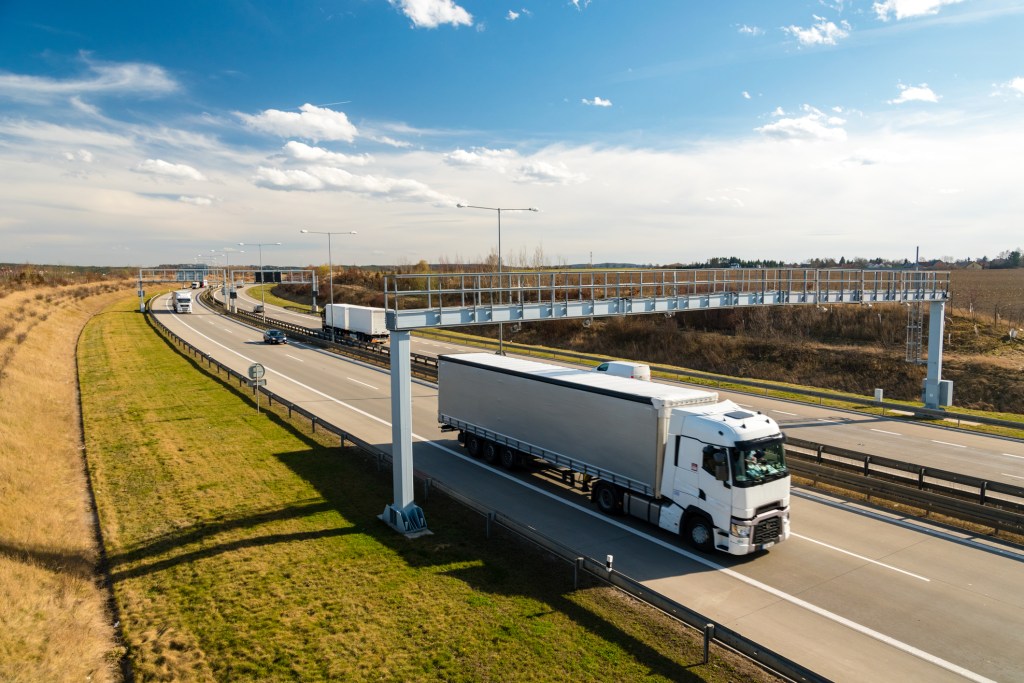
Romania will charge the same TIR twice as much as Bulgaria and six times less than Hungary
To standardize the calculations, we will convert the rates into euros and calculate them per 1000 km of highway or national road.
Thus, a small cargo vehicle will pay 33.4 euros for 1,000 km of highway, and a 12+ ton TIR will pay 94.4 euros/1,000 km.
In comparison, countries around Romania tax heavy transport much more drastically. The only country that has approximately the same tariff ceiling as the one proposed in Romania is Poland, instead countries such as Bulgaria, Hungary, the Czech Republic or Slovakia charge much more.
How much does a TIR 12+ tons, with 5 axles, Euro VI and classified in the best CO2 emission class – price in Euros/1000 km of highway:
- Bulgaria: 220
- Romania: 94
- Hungary: 570
- Slovakia: 300-330
- Czech Republic: 225
- Poland: 90
- Austria: 485
- Germany: 238 (under 18 tons), 348 (over 18 tons)
- France: 300+
How much could Romania collect if it applied road taxes similar to the surrounding states
If through the classic tolls Romania collected around 157 million euros in 2024 from goods vehicles, according to the data consulted by HotNews, through the new TollRo system and the tariffs calculated at a distance, the state will end up collecting more.
Political sources, however, told HotNews that the level of estimates varies. A calculation from Transporturi estimates that the new system could lead to revenues of almost 1 billion euros, based on elements such as Romania's entry into Schengen and the construction of key highways such as the Capital Ring A0 or A1 Sibiu – Pitesti, which would make Romania more attractive for TIRs.
Other sources, however, say that this scenario is far too optimistic, given that only Hungary collects such an amount at a level of taxation more than five times higher, even with a smaller area and road network.
However, a more realistic estimate indicates at least a doubling of the current level, i.e. about 300 million euros through the current tariffs approved for TollRo, political sources tell HotNews.
If Romania, on the other hand, were to tax at the level of Bulgaria or the Czech Republic, these revenues would practically double.
In 2024, the Czech Republic collected 686 million euros from the taxation of heavy goods vehicles or passenger transport. Comparatively, as we showed above, Romania collected only 157 million euros.
Half of the amount collected by the Czech Republic was paid by heavy vehicles registered in another country and which only transited the country, the journalists from Denik Referendum report.
In Bulgaria, charging heavy goods traffic meant revenues of almost 295 million euros in 2024, Mediapol.bg journalists report
Experiment: How much does a TIR pay in road taxes that, on its way, crosses Bulgaria, Romania and Hungary
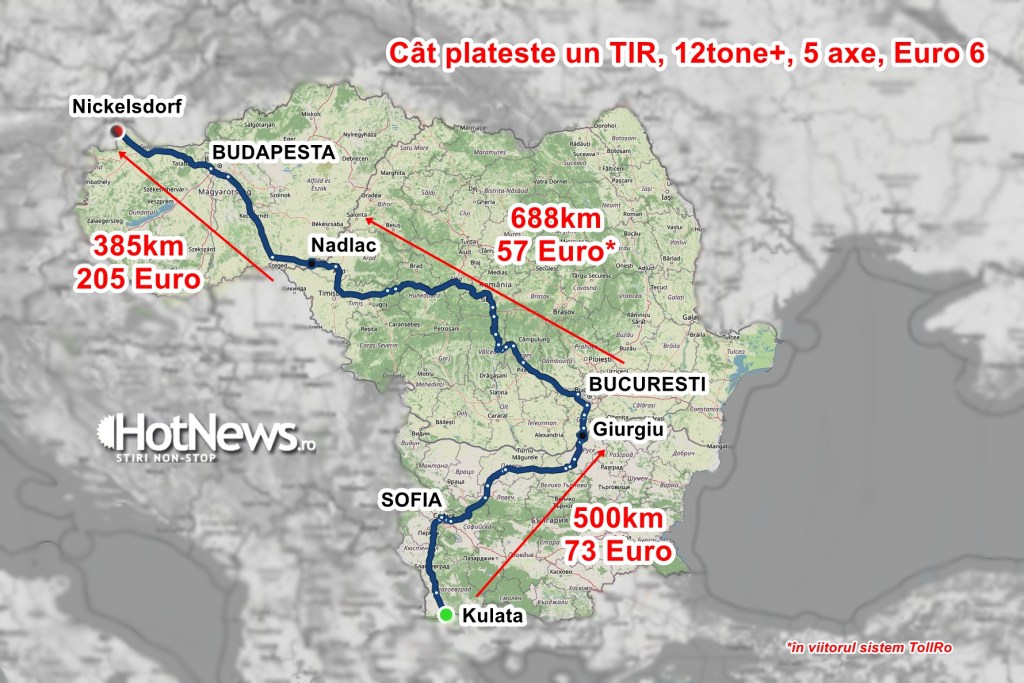
Journalists from Mediapol.bg made a hypothetical calculation for HotNews: a 12+ ton TIR that crosses the country from the south, from Greece, from the Kulata customs and reaches Ruse, at the bridge over the Danube towards Giurgiu. Such a route has a length of 500.89 km, of which about 450 km are tolled. For this route, the TIR will pay a total of 73.02 euros, according to estimates made by Bulgarian journalists.
Further, we took the same TIR of 12+ tons, Euro 6 and tried to simulate what taxes it will have to pay if it enters Romania via Giurgiu and exits the country via Nădlac. It has, therefore, about 688 km to travel, of which 529 km on the highway and 159 km on the national road.
Applying the tariffs proposed for the TollRo system, the TIR will pay 57.2 Euros – a lower amount than in Bulgaria. In other words, although the same TIR travels 37% more in Romania, it pays 28% less.
Further, from Nădlac through Hungary to the border with Austria, at Nickelsdorf, the same TIR will travel about 385 km and will pay about 205 Euros to the authorities in Budapest, almost four times more than in Romania, although in our country it traveled almost 80% more.
“It's a shame. There's no logical argument why it should be priced so low compared to others”
“It's a joke,” claims Ionuț Ciurea from Asociația Pro Infrastructura, one of the most active non-governmental organizations that monitors the evolution of transport infrastructure in Romania.
“The rate that the transporters will pay is effectively a shame. A shame! The position is very unpopular, but we have been saying it for years: The lobby of the transporters in the Road Company and in the Ministry of Transport is maximum”, says Ciurea.
“It's a shame the rate that the carriers pay in Romania. I mean, the Bulgarians do it twice as well? It would have meant more money for the roads and it would have mattered a lot. There is no logical argument why the price should be so low compared to others. Especially in Romania's situation, let's look at the economic figures – we are above the Bulgarians. We are not Switzerland compared to Bulgaria, but no matter what figures we look at, you cannot to say that Bulgaria is richer than Romania. Or compared to Hungary, we are still there in terms of GDP per capita. Hungary is smart, it has transit traffic, they charge it for ruining the roads”, says Ciurea.
He believes that higher taxation of heavy goods vehicles, which cause the most damage to infrastructure, should be a key element for the state to be able to afford proper maintenance for its growing network of highways and national roads.
“We are talking about billions of euros to maintain the entire network, for many years, of course, but a lot of money is needed,” says Ciurea.
On the other hand, however, the transporters accuse even the current proposed rates of being too high and that, in fact, the new tolls will inevitably lead to higher prices. They are even demanding a three-fold reduction of the current established tax level. You will read tomorrow on HotNews.ro about the position of the Transporters, the official explanations from the Transports, but also the effects of the new taxing system for goods transport