Lithuanian commander accuses Merkel. This concerns actions during the annexation of Crimea. “It was her request”


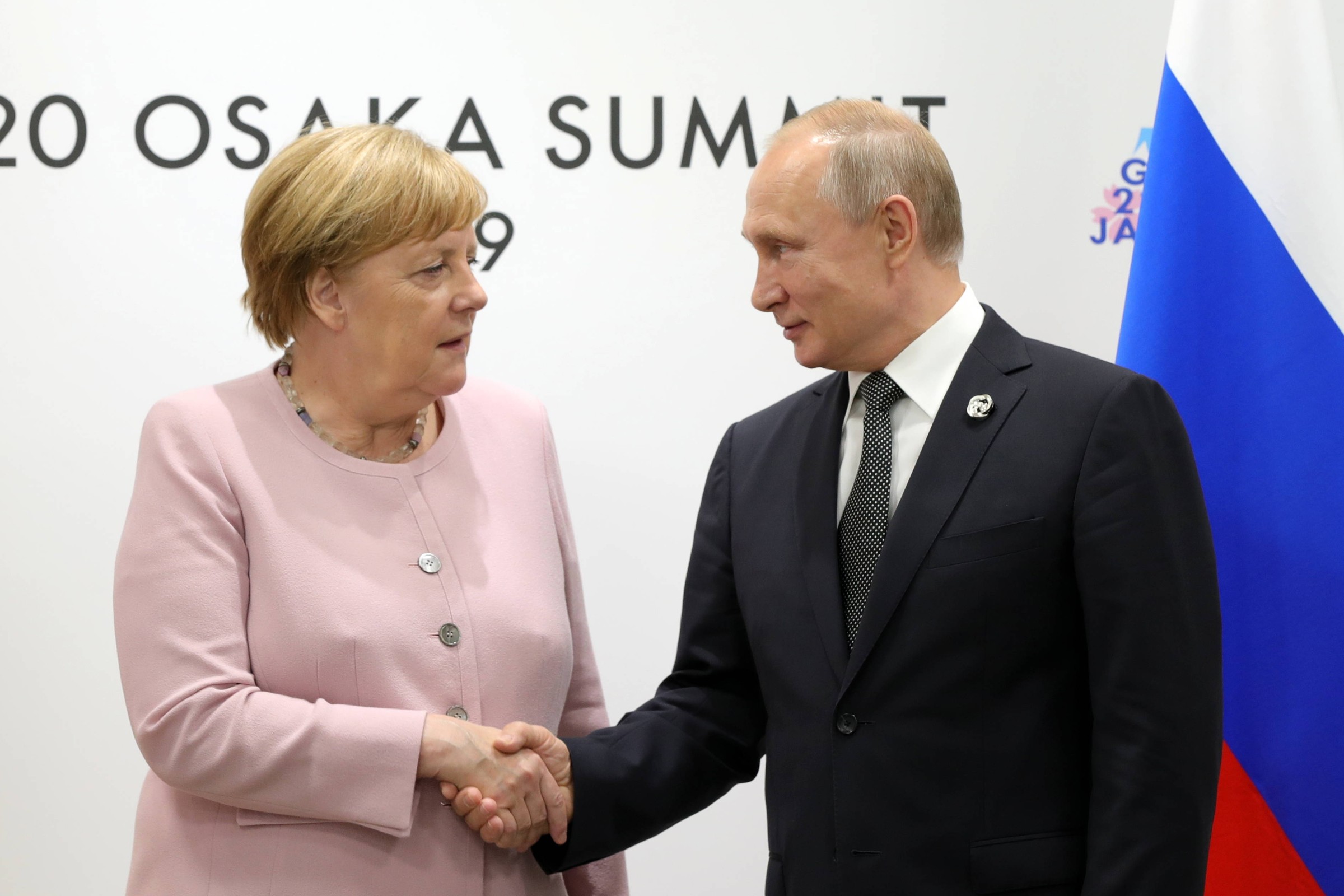
Paweł Jabłoński, a Polish MP and former secretary of state at the Ministry of Foreign Affairs, described the former German chancellor as “the most pro-Russian politician in the history of the EU.” According to former Prime Minister Mateusz Morawiecki, she is one of the German politicians “who have caused the greatest damage to Europe over the last hundred years.”
In this interview, she stated that Poland and the Baltic countries did not support the European format of talks with Vladimir Putin in 2021, which she proposed, which meant that she indirectly held the countries of Central and Eastern Europe co-responsible for the outbreak of the Russian war against Ukraine.
Merkel has never been uncontroversial in Poland and the Baltic countries. The fact that she pushed through the construction of the Nord Stream 2 gas pipeline after Russia's illegal annexation of Crimea in 2014 — which Warsaw saw as almost a gift to Moscow — already pitted Poland against the then-chancellor.
The Russian attack in Ukraine in February 2022 completely ruined Merkel's reputation in eastern EU countries – thus apparently replacing Gerhard Schroeder as the least popular German politician in recent history. The Minsk agreement she negotiated is considered a cardinal mistake.
The article continues below the video
It was already clear in 2019 that Russia did not take the Minsk agreements seriously — and it went unpunished. Then the Kremlin illegally began a campaign of mass granting citizenship to residents of the occupied territories. In 2020, approximately 200 thousand Ukrainians living there obtained Russian citizenship, and in 2021 there were already over 500,000 of them. Merkel turned a blind eye to this and continued the construction of Nord Stream 2.
Paweł Kowal has a clear opinion on how Europe should deal with Merkel – and Schroeder too. — Chancellor Merkel should explain in detail to the whole of Europe why she supported the construction of Nord Stream. Then Chancellor Schroeder should face consequences for his contribution to the development of this most important war tool, Nord Stream, he said in an interview for Die Welt.
An incredible accusation
However, not only accusations are coming from Central and Eastern Europe, but also – probably – revelations about Merkel's policy in the period preceding the Russian invasion of Ukraine. Now Jonas Vytautas Zukas, commander in chief of the Lithuanian Armed Forces and representative of his country in NATO, has commented on this matter.
In his latest book he describes that Merkel allegedly influenced the Ukrainian authorities during the annexation of Crimea by persuading Ukrainian soldiers not to resist Russian units.. If this were really the case, it would be a scandal. However, outrage over this situation has not yet spread beyond Lithuania's borders.
In response to questions from “Die Welt”, Zukas stated that he was in Kiev at the time as the commander-in-chief of his country's army. There he met with Oleksandr Turchynov, former head of the Ukrainian secret services, speaker of parliament and interim president until Petro Poroshenko took office in June 2014.
When asked by Zukas why Ukraine did not resist the occupation of the parliament building in Crimea, Turchynov allegedly replied: “He told me it was Merkel's demand expressed during the phone call.”
In response to a request for comment on Kowal and Zukas' statements, a spokeswoman for Angela Merkel's office stated: “We do not comment on these opinions“. He then refers to the full text of the interview with Merkel in Hungary and “other public statements and descriptions of the former chancellor, also contained in the political memoir “Freedom” published in 2024, to which we have nothing to add in the light of the questions you asked.”
Behind Merkel's harsh assessments in Central and Eastern Europe is the basic assumption that kAnclerz has caused significant and, above all, lasting damage to Germany and Europe in three main policy areasthus enabling Putin's war or at least encouraging it.
Three main mistakes of Angela Merkel's policy
Firstly, it is Germany's failed energy policy and, above all, the abandonment of nuclear energy. According to Germany's eastern partners, this makes Europe less competitive today compared to its competitors and leads to a loss of prosperity on the continent; It is repeatedly said that this paved the way for dependence on Russian raw materials.
Secondly, it was accompanied by a naive, wrong approach to Russia in general. In the eyes of the inhabitants of Central and Eastern Europe, Moscow's policy has always been imperial and aimed at domination in Eastern Europe. Appropriate warnings were ignored for a long time in Berlin.
Thirdly, German migration policy from 2015 to this day has had a negative impact in Poland and Lithuania. In Poland, politicians of all parties agree that ten years ago Merkel sent a disastrous signal to the world by accepting refugees from Syria without consulting other European countries. and thus encouraged illegal migration to Europe. The result was cultural and social upheaval and the strengthening of the position of radical and often pro-Russian parties.
The latter is crucial from the point of view of Poland and the Baltic countries, especially since the countries located on NATO's eastern flank are struggling with a specific phenomenon: the regime of Belarusian dictator Alexander Lukashenko, an ally of Moscow, has been forcefully pushing people, mainly from the Middle East and Africa, across the borders to Lithuania or Poland since 2021 in order to destabilize the EU.
Few wonder whether the use of “migration as a weapon”, as experts say, against Poland, Lithuania and Latvia would have been possible at all if Merkel's refugee policy had not revealed the problems related to illegal migration and the lack of consent among Europeans on this issue.
Polish Minister of Foreign Affairs and Deputy Prime Minister Radosław Sikorski also criticized Merkel's presentation of the genesis of the Nord Stream project. Regarding this project, “the German Chancellor lied in her memoirs, claiming that Central Europe did not protest,” Sikorski said in an interview for Onet.
He himself protested loudly against it. In his opinion, Merkel's “balance” looks worse and worse every year. This is a view that may slowly gain popularity in Germany as well.